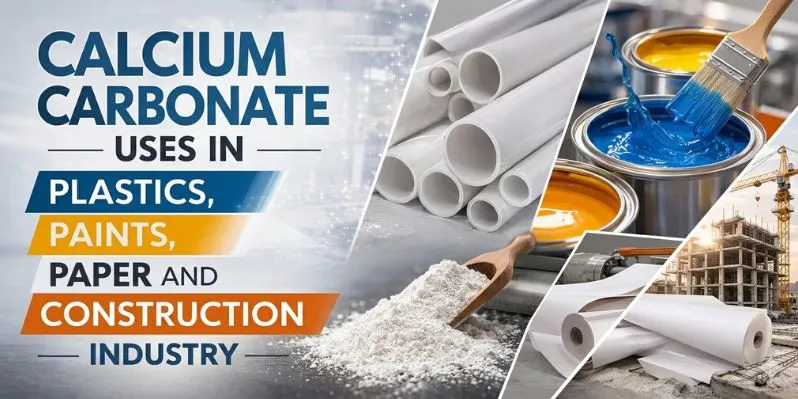

The modern plastics industry depends heavily on materials that can enhance performance while keeping production costs under control. Among these materials, calcium carbonate has established itself as a highly valuable and versatile component. Used widely as a functional filler, it contributes not only to cost reduction but also to improved mechanical and processing properties. This guest post provides a fresh perspective on calcium carbonate uses in plastics, aligning with the expertise and solutions offered by HTMC Group.
Calcium carbonate, commonly known as CaCO₃, is a naturally occurring mineral sourced from limestone, marble, and chalk. Its fine particle size, chemical stability, and availability make it a preferred choice in plastic manufacturing. Today, it is used across multiple polymer applications, helping manufacturers achieve better efficiency and product performance.
Understanding the Industrial Value of Calcium Carbonate
In plastic production, calcium carbonate is far more than a simple filler. It plays an active role in modifying the properties of polymers. When incorporated into materials like polyethylene (PE) and polypropylene (PP), it enhances strength, stiffness, and dimensional stability.
Manufacturers use calcium carbonate to optimize formulations without compromising on quality. Its inclusion allows for reduced dependence on expensive polymer resins, making production more economical. At the same time, it improves the overall consistency of the final product, which is essential for maintaining quality standards in large-scale manufacturing.
HTMC Group specializes in delivering high-grade calcium carbonate that meets the specific requirements of plastic manufacturers. Their products are designed to ensure uniform dispersion and reliable performance across applications.
Improving Mechanical Properties in Plastics
One of the most significant advantages of calcium carbonate in plastics is its ability to improve mechanical strength. When added in the right proportion, it increases rigidity and enhances resistance to deformation. This makes plastic products more durable and suitable for demanding applications.
For example, in the production of pipes and construction materials, calcium carbonate helps maintain structural integrity under pressure. In packaging applications, it provides the necessary stiffness to ensure that products retain their shape during transportation and storage.
The use of calcium carbonate also contributes to better impact resistance in certain formulations. This is particularly important in applications where plastics are exposed to external forces or varying environmental conditions.
Enhancing Processing Efficiency
Efficiency in manufacturing is a critical factor for any industry, and calcium carbonate plays a key role in improving processing performance. Its presence in plastic compounds increases thermal conductivity, allowing materials to heat and cool more efficiently during production.
This results in shorter cycle times, which directly translates to higher productivity. Manufacturers can produce more units in less time, reducing energy consumption and operational costs. This efficiency is especially beneficial in high-volume production processes such as extrusion and injection molding.
HTMC Group’s calcium carbonate products are engineered to support smooth processing, minimizing issues such as uneven dispersion or machine wear. This ensures a seamless manufacturing experience for clients.
Cost Optimization Without Compromising Quality
Cost reduction is one of the primary reasons why calcium carbonate is widely used in plastics. By partially replacing polymer resin, it significantly lowers raw material costs. However, what makes it truly valuable is that this cost saving does not come at the expense of product quality.
Instead, calcium carbonate enhances certain properties, making the final product more robust and visually appealing. This balance between cost and performance is essential for manufacturers looking to remain competitive in the market.
HTMC Group provides calcium carbonate solutions that are tailored to different industrial needs, allowing manufacturers to achieve optimal cost-performance ratios.
Surface Finish and Aesthetic Benefits
In addition to mechanical and economic advantages, calcium carbonate also improves the visual and surface properties of plastic products. It enhances opacity, giving products a cleaner and more uniform appearance. This is particularly useful in packaging and consumer goods, where aesthetics play an important role.
The use of calcium carbonate also contributes to a smoother surface finish, reducing the need for additional processing or coatings. This not only improves product quality but also streamlines the manufacturing process.
With HTMC Group’s advanced formulations, manufacturers can achieve superior surface characteristics that meet both functional and aesthetic requirements.
Applications Across Industries
The versatility of calcium carbonate allows it to be used in a wide range of plastic applications. In the packaging industry, it is commonly used in films, carry bags, and containers to improve strength and reduce costs. In the construction sector, it is used in pipes, fittings, and profiles where durability is essential.
In agriculture, calcium carbonate is used in plastic films and sheets that require both strength and flexibility. In the automotive industry, it contributes to lightweight components that maintain structural integrity. Household products, electrical components, and industrial goods also benefit from its inclusion.
HTMC Group supports these diverse applications by providing consistent and high-quality calcium carbonate that meets industry-specific requirements.
Environmental and Sustainability Benefits
As industries move toward sustainable practices, calcium carbonate offers several environmental advantages. Being a natural mineral, it reduces the reliance on petroleum-based polymers. This contributes to a lower carbon footprint in plastic production.
Additionally, the improved processing efficiency associated with calcium carbonate leads to reduced energy consumption. This aligns with global efforts to make manufacturing processes more eco-friendly.
Calcium carbonate is also non-toxic and safe, making it suitable for applications that require compliance with safety and environmental standards. HTMC Group ensures that its products meet these requirements, supporting responsible manufacturing practices.
Why HTMC Group Stands Out
HTMC Group has built a strong reputation in the industry by consistently delivering high-quality calcium carbonate products. Their focus on innovation, quality control, and customer satisfaction sets them apart from competitors.
The company understands the challenges faced by plastic manufacturers and provides solutions that address these challenges effectively. From ensuring consistent particle size to offering customized formulations, HTMC Group is committed to helping clients achieve the best results.
Their expertise and dedication make them a reliable partner for businesses looking to enhance their plastic production processes.
Future Trends in Calcium Carbonate Usage
The role of calcium carbonate in plastics is expected to grow as industries continue to seek cost-effective and sustainable solutions. Advances in material science are likely to expand its applications, making it even more integral to modern manufacturing.
With increasing demand for lightweight, durable, and eco-friendly materials, calcium carbonate will remain a key component in the development of innovative plastic products. Companies like HTMC Group are at the forefront of this evolution, driving progress through quality and innovation.
Conclusion
Calcium carbonate has become an indispensable material in the plastics industry, offering a unique combination of cost savings, performance enhancement, and environmental benefits. Its ability to improve mechanical properties, streamline processing, and enhance product appearance makes it a valuable asset for manufacturers.
For businesses seeking reliable and high-performance solutions, HTMC Group provides the expertise and quality needed to succeed. By leveraging the advantages of calcium carbonate, manufacturers can create products that meet modern demands while maintaining efficiency and sustainability.





























Sign in to leave a comment.