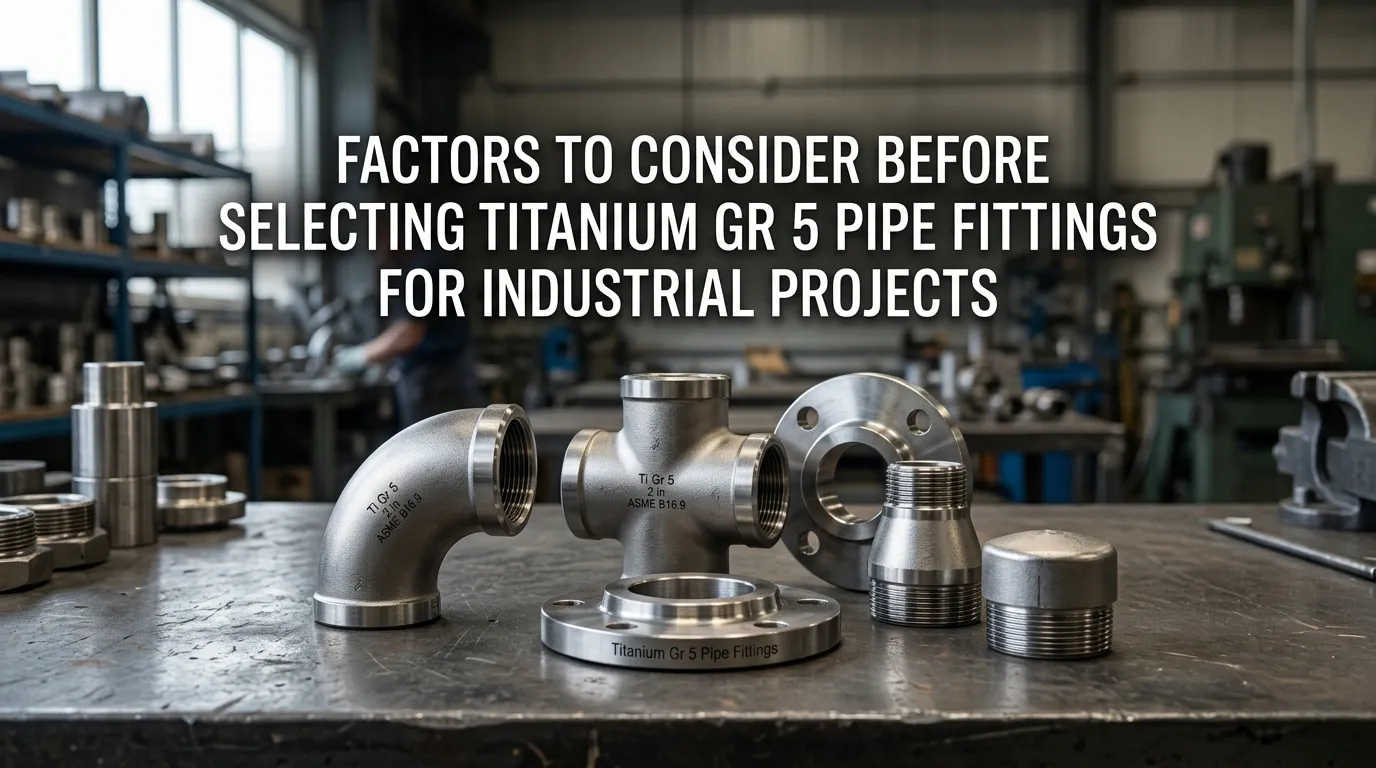

A single wrong fitting choice can shut down a process line for days. Fitting selection determines how a piping system handles pressure, resists corrosion, and survives thermal cycling without leaking. The margin for error shrinks fast in corrosive, high-pressure, or chemically aggressive environments, where a fitting that performs fine in a mild water line can fail within months. This is where titanium Gr 5 pipe fittings really stand out. The fittings are made of Ti-6Al-4V, a high-strength titanium alloy for low weight and mechanical performance where standard stainless steel cannot do the job.
Understanding Titanium Gr 5 Pipe Fittings and Their Material Characteristics
Titanium Gr 5 Fittings are titanium alloy fittings made with Ti-6Al-4V. It contains about 6% aluminum and 4% vanadium with titanium as the base metal. That composition creates a two-phase microstructure, which is why engineers reach for it when strength under load matters more than maximum ductility. The same properties that suit aerospace structures now suit industrial piping carrying corrosive fluids at elevated pressure.
Important Material Properties
Ti-6Al-4V delivers a strength-to-weight ratio that exceeds most stainless steels, weighing about 40% less than steel at comparable tensile strength. Its corrosion resistance comes from a stable oxide layer that reforms instantly if scratched. Tensile strength reaches around 895 MPa in the annealed condition, and fatigue resistance stays high across repeated pressure cycles, pushing service life into decades rather than years.
Evaluate the Operating Environment Before Material Selection
Service conditions dictate fitting performance more than any single mechanical specification. A fitting rated for one chemical environment can degrade rapidly in another, even at identical pressure and temperature.
Environmental Factors to Assess
Corrosive media, like chlorides, acids and oxidizing agents, narrow the list of suitable materials quickly. You have to consider that the marine environment means constant contact with saltwater; titanium's resistance to pitting and crevice corrosion is better than standard stainless steel. Chemical processing conditions often involve the use of several aggressive media in one system, and moisture in coastal installations accelerates corrosion in less resistant alloys.
Consider Pressure and Temperature Requirements
Operational requirements set the boundaries for what any fitting can safely handle. Pressure and temperature don't act independently; their combined effect on material performance often differs from how each behaves alone.
Key Performance Considerations
The system pressure requirements must be equal to the rated working pressure of the fitting over the entire temperature range of the fitting, not just at ambient temperature. Materials must be fatigue resistant to withstand repeated stress reversals imposed by cyclic loading, as is common in lines subject to frequent valve actuation. The operating temperature range is also important, as titanium alloys behave differently above 315°C, and safety factors should consider transient spikes, as well as reliability expectations for design lives of 20+ years.
Check Corrosion Resistance Requirements for the Application
Corrosion resistance directly shapes lifecycle cost, often more than the upfront purchase price. A corrosion-resistant fitting lasting 25 years costs less over its service life than one that must be replaced every five years. Titanium's resistance to oxidation is excellent with acids like nitric acid, and the risks of degradation, such as pitting and stress corrosion cracking, depend on the actual fluid composition, so checking compatibility against actual service data avoids selecting corrosion-resistant titanium fittings that fail despite looking suitable on paper.
Assess Strength-to-Weight Requirements
Weight reduction changes more than shipping costs. Every kilogram removed from piping infrastructure reduces structural load on supporting frameworks. Titanium Gr 5 fittings cut installed weight by roughly 40% compared to steel equivalents at matching strength, easing structural design and lowering support costs. This matters most in aerospace fuel lines, weight-constrained offshore platforms, and portable skids moved between sites, where lower weight becomes a design driver rather than a secondary benefit.
Review Fitting Type and System Compatibility
Selecting the correct fitting configuration matters as much as selecting the correct material. A titanium fitting with the wrong connection type creates installation problems regardless of how well the alloy resists corrosion.
Selection Factors
Compression fittings, widely used for instrumentation and small-bore tubing, require precise tube outer diameter matching to seal properly. Tube compatibility extends to wall thickness and surface finish, both of which affect how well titanium compression tube fittings grip and seal under pressure. Connection requirements, whether threaded, welded, or flanged, need to match existing system hardware before fittings arrive on site.
Understand Applicable Standards and Certifications
Specifications confirm that a fitting performs as claimed. ASTM requirements, particularly ASTM B363 titanium fittings standards specify chemical composition, mechanical properties, and dimensional tolerances for titanium pipe fittings in industrial service. Mill test certificates prove the actual batch is what it’s supposed to be. Traceability is most important in regulated industries where each fitting has to have a paper trail from raw material to finished part.
Consider Fabrication and Installation Requirements
Installation complexity affects project timelines and labor costs more than buyers often anticipate. Welding titanium requires controlled atmospheres, typically argon shielding, to prevent oxygen and nitrogen contamination that embrittles the weld zone. Design for maintenance accessibility is an important consideration early in the fitting placement, and minimum bend radii specific to titanium are different from those of steel and need to be considered at the fabrication stage.
Common Industrial Applications for Titanium Gr 5 Pipe Fittings
Aerospace systems rely on titanium Gr 5 fittings for fuel and hydraulic lines, where weight savings directly improve fuel efficiency.
Chemical processing plants use these fittings in lines carrying chlorides, acids, and oxidizing agents, where titanium outlasts stainless steel in aggressive service.
Marine systems, including shipboard piping and offshore infrastructure, benefit from titanium's resistance to seawater corrosion over time.
Instrumentation systems use titanium compression tube fittings in sampling lines, where corrosion resistance and dimensional precision affect reading accuracy.
Oil and gas applications in sour service depend on Titanium Grade 5 fittings to resist hydrogen sulfide exposure without the stress cracking that affects some steel alloys.
Questions Buyers Should Ask Before Purchasing Titanium Gr 5 Fittings
Procurement decisions improve when buyers ask specific questions rather than accepting general assurances. Are certifications available, including mill test certificates against ASTM B363? Is the fitting compatible with the system design, covering the connection type and pipe schedule? Are pressure ratings suitable across the full operating temperature range? What inspection standards are followed, and can testing records be provided? Is traceability available from raw material heat to the finished fitting?
Conclusion
Choosing titanium Gr 5 pipe fittings is a matter of aligning the material’s properties with the real project needs. A sound decision must consider the operating environment, the pressure and temperature range, exposure to corrosion, weight constraints, and compatibility with the system, and the omission of any one of these increases the risk of premature failure or unplanned downtime. The right approach begins with the application, not the material name. Titanium Grade 5 fittings provide unmatched performance when project requirements demand high strength, low weight, and resistance to aggressive chemical or marine environments.


























Sign in to leave a comment.