

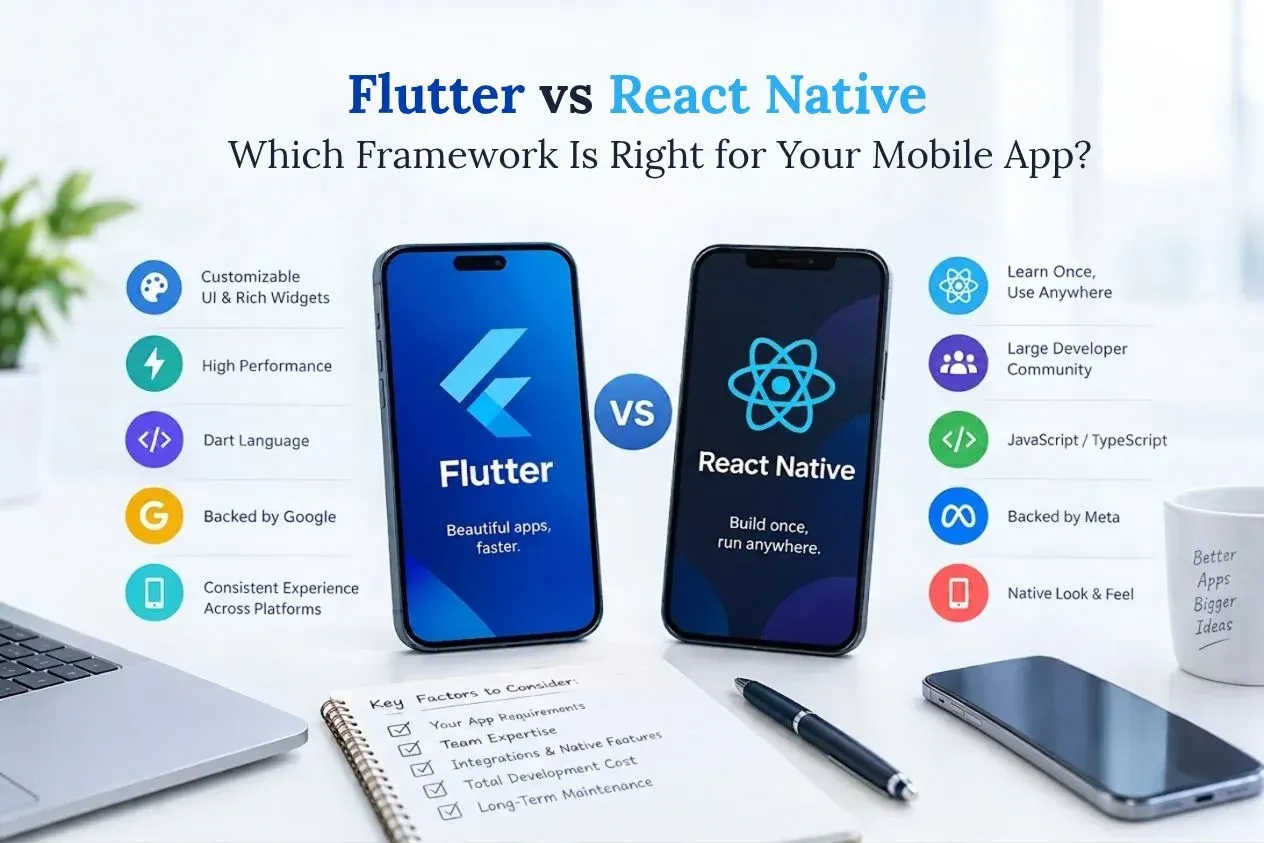
Flutter vs React Native is a common comparison for businesses planning applications that run on both Android and iOS. Flutter uses Dart and a customizable rendering system, while React Native combines JavaScript or TypeScript with React-based development and native components. Both frameworks can support production-ready applications, but their suitability depends on interface requirements, integrations, team experience, and maintenance plans. For custom mobile app development, a clear technical assessment is more useful than choosing a framework based on popularity.
What Are the Main Differences Between Flutter and React Native?
Flutter is an open-source framework maintained by Google. It provides widgets and rendering capabilities that help developers build consistent interfaces across supported platforms. This approach is useful for products with distinctive branding, complex animations, and customized layouts.
React Native is an open-source framework supported by Meta. It allows developers to build mobile interfaces using React principles and JavaScript or TypeScript. Its component-based structure can be appealing to organizations that already employ React developers or maintain JavaScript-based applications.
The frameworks also differ in their development ecosystems. Flutter uses Dart, so developers may need to learn another language if their existing experience is primarily JavaScript. React Native can reduce that learning requirement for teams familiar with React, although mobile development still introduces platform-specific concepts.
Neither option removes the need for native integration. Features such as specialized hardware access, background execution, and third-party payment SDKs may require additional platform code.
The most important distinction is not simply language choice. It is how well the framework, development team, and application architecture work together.
Is Flutter Still Relevant in 2026?
Yes, Flutter remains relevant in 2026 for businesses seeking cross-platform applications with consistent visual design. It can support booking platforms, customer portals, business dashboards, and applications with highly customized interfaces.
However, relevance does not guarantee that every package or integration will suit a particular project. Teams should verify dependency maintenance, operating-system compatibility, accessibility support, and upgrade requirements before committing to the framework.
A practical evaluation should include a small prototype that tests the application's most demanding screen and its most important integration. For example, a logistics application might need location tracking, background updates, and reliable synchronization when connectivity drops.
Testing these requirements early helps uncover limitations before the application becomes difficult to change.
Which Is Better in 2026, Flutter or React Native?
Neither framework is the best choice for every business. Flutter is worth considering when interface consistency and customized rendering are priorities. React Native can be a strong option when a team has established React expertise and needs a familiar development model.
Compare both frameworks against five requirements.
Development skills: Existing experience affects onboarding, recruitment, and delivery schedules.
User interface: Prototype important screens to compare visual consistency, navigation, responsiveness, and accessibility.
Native integrations: Check whether essential services provide reliable libraries and documented implementation paths.
Application performance: Measure startup time, memory usage, scrolling, and network behavior on representative devices.
Maintenance: Evaluate automated testing, dependency updates, crash reporting, and the team's ability to maintain native modules.
Avoid selecting a framework because a demonstration performs well on a high-end phone. Real users may have older devices, unreliable connections, or accessibility needs. Testing realistic conditions gives a more reliable basis for the decision.
What Is Custom Mobile App Development, and What Affects Its Cost?
Custom mobile app development means creating an application around specific business processes, user needs, and technical requirements. Examples include healthcare appointment systems, delivery applications, employee management tools, and inventory platforms connected to existing company software.
Mobile app development cost depends on functionality, design complexity, backend services, integrations, security requirements, and ongoing maintenance. An application with a few informational screens requires a different level of effort from a platform supporting payments, multiple account types, real-time updates, and offline operation.
A useful estimate separates discovery, UX design, implementation, integration, testing, deployment, and post-launch support. Businesses should document the required features and identify which can wait until a later release.
Consider a delivery application that needs live tracking and proof of delivery. Its budget must account for mapping services, location permissions, backend processing, network interruptions, and testing across devices. These operational details can affect cost more than the choice of framework alone.
Include hosting, third-party service fees, security updates, and maintenance in the total budget. When comparing development partners such as MicroLent, review technical expertise, communication, testing procedures, and post-launch responsibilities alongside price.
Conclusion
Flutter and React Native remain practical frameworks for cross-platform applications in 2026. Flutter can suit products requiring extensive interface customization, while React Native can benefit teams with existing React and TypeScript experience. Define essential workflows, validate integrations through a prototype, and estimate maintenance before committing. This approach supports a better technology decision and a more realistic mobile app development cost estimate.




















Sign in to leave a comment.