
The FMGE Exam Pattern is one of the most important things every foreign medical graduate should understand before starting preparation. The Foreign Medical Graduate Examination (FMGE) is a mandatory screening test conducted for Indian students who complete their medical education abroad and want to practice medicine in India. The exam is conducted by the National Board of Examinations in Medical Sciences (NBEMS).
Understanding the latest FMGE Exam Pattern helps students prepare in a more organized and effective way. It gives clarity about the number of questions, marking system, exam duration, subjects covered, and qualifying criteria. Candidates who know the pattern well can manage their preparation better and improve their chances of passing the examination.
What is FMGE?
FMGE stands for Foreign Medical Graduate Examination. It is a licensing examination for Indian citizens and Overseas Citizens of India (OCI) who obtain their medical degree from foreign medical colleges. Clearing this examination is compulsory for getting provisional or permanent registration from the National Medical Commission (NMC) or State Medical Councils in India.
The exam is conducted twice every year, usually in June and December. Thousands of students appear for the exam each year to continue their medical careers in India.
FMGE Exam Pattern 2026 Overview
Before starting preparation, candidates should understand the complete structure of the examination.
Basic Exam Details
- Exam Name: Foreign Medical Graduate Examination (FMGE)
- Conducting Body: National Board of Examinations in Medical Sciences (NBEMS)
- Exam Mode: Computer-Based Test (CBT)
- Frequency: Twice a year
- Language: English
- Type of Questions: Multiple Choice Questions (MCQs)
- Total Questions: 300
- Total Marks: 300
- Duration: 5 hours
- Negative Marking: No
The FMGE Exam Pattern is designed to test both theoretical understanding and clinical knowledge of candidates.
FMGE Exam Structure
The FMGE examination is divided into two parts.
Part A
Part A contains 150 questions and covers pre-clinical and para-clinical subjects.
Part B
Part B also contains 150 questions and mainly focuses on clinical subjects and practical medical knowledge.
Each part is conducted separately with a scheduled break between them.
Duration of Each Part
- Part A: 2 hours 30 minutes
- Break: Scheduled interval
- Part B: 2 hours 30 minutes
Candidates should manage their time carefully because all questions must be answered within the allotted time.
FMGE Subject Distribution
The FMGE Exam Pattern includes subjects from the MBBS curriculum followed in India. Questions are generally distributed according to the weightage of each subject.
Pre-Clinical Subjects
- Anatomy
- Physiology
- Biochemistry
Para-Clinical Subjects
- Pathology
- Pharmacology
- Microbiology
- Forensic Medicine
Clinical Subjects
- Medicine
- Surgery
- Obstetrics and Gynecology
- Pediatrics
- Orthopedics
- Ophthalmology
- ENT
- Dermatology
- Psychiatry
- Radiology
- Anesthesia
- Community Medicine
Clinical subjects usually carry more weightage compared to pre-clinical subjects.
Marking Scheme in FMGE
The marking system is simple and student-friendly.
- Each correct answer carries one mark.
- No marks are deducted for wrong answers.
- Unanswered questions receive zero marks.
Since there is no negative marking, candidates should attempt all questions whenever possible.
FMGE Passing Criteria
To pass the examination, candidates must score at least 150 out of 300 marks. This means students need a minimum of 50% marks to qualify.
The passing criteria remain the same for all candidates. There are no separate cut-offs based on category.
Importance of Understanding FMGE Exam Pattern
Knowing the FMGE Exam Pattern offers several advantages during preparation.
Better Time Management
Students can allocate time according to subject weightage and exam difficulty.
Improved Preparation Strategy
Understanding the pattern helps candidates focus on important subjects and frequently tested topics.
Reduced Exam Anxiety
Familiarity with the exam structure helps students feel more confident on exam day.
Effective Practice
Candidates can solve mock tests and previous question papers according to the actual exam format.
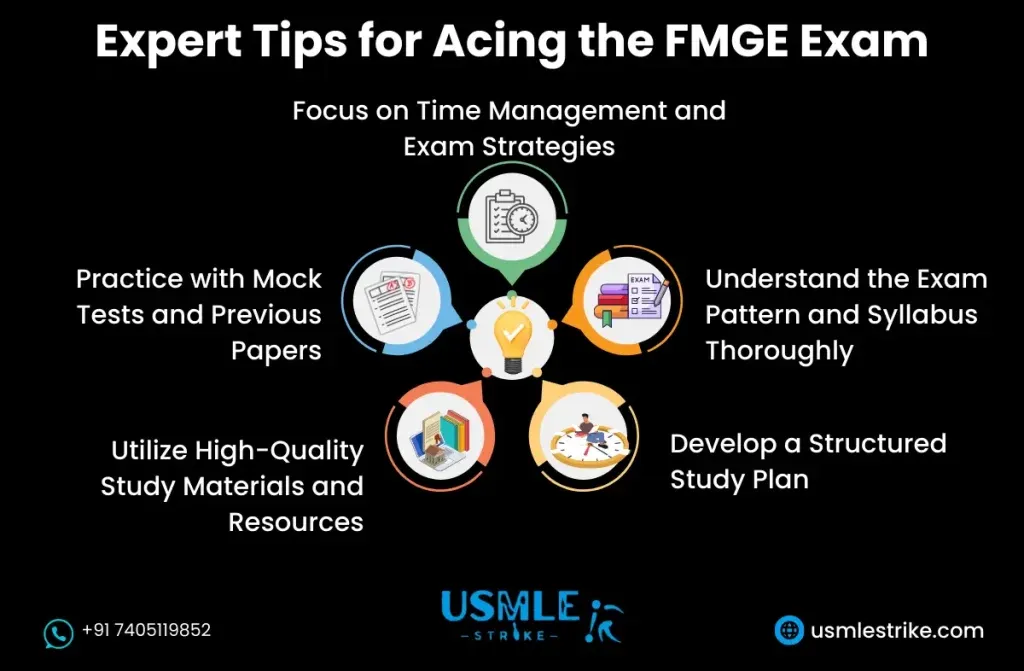
FMGE Preparation Tips
Preparing for FMGE requires consistency, planning, and regular revision. Here are some useful preparation tips.
Create a Study Schedule
Prepare a daily study timetable covering all subjects. Divide your preparation into smaller targets.
Focus on High-Weightage Subjects
Medicine, Surgery, Obstetrics and Gynecology, and Community Medicine usually carry higher marks.
Practice MCQs Daily
FMGE is completely MCQ-based. Regular practice improves speed and accuracy.
Revise Multiple Times
Revision is essential for retaining medical concepts. Short notes and flashcards can help during revision.
Solve Previous Year Papers
Previous papers help students understand important topics and question patterns.
Take Mock Tests
Mock tests improve time management and identify weak areas that need improvement.
Common Challenges Faced by FMGE Aspirants
Many students face difficulties while preparing for FMGE.
Vast Syllabus
The MBBS syllabus is extensive and requires proper planning.
Time Management Issues
Balancing multiple subjects can become challenging without a study schedule.
Lack of Revision
Many students focus only on studying new topics and ignore revision.
Stress and Pressure
Exam stress affects concentration and confidence levels.
Proper preparation and regular practice can help overcome these challenges.
FMGE Exam Day Guidelines
Candidates should follow all instructions carefully on exam day.
Carry Required Documents
- FMGE Admit Card
- Valid Photo ID Proof
Reach Early
Candidates should arrive at the exam center before reporting time to avoid unnecessary stress.
Follow Exam Rules
Electronic devices, study materials, and prohibited items are not allowed inside the examination hall.
Stay Calm
Reading questions carefully and managing time properly are important for better performance.
Difference Between FMGE and NEXT
Many students confuse FMGE with NEXT (National Exit Test).
FMGE is currently conducted for foreign medical graduates only, while NEXT is expected to become a common licensing examination for both Indian and foreign medical graduates in the future.
Until official implementation of NEXT, FMGE continues as the mandatory screening test for foreign medical graduates.
Best Resources for FMGE Preparation
Students can improve preparation using reliable resources.
Standard Medical Textbooks
Textbooks provide strong conceptual understanding.
Online Coaching Platforms
Online classes offer flexibility and expert guidance.
MCQ Practice Books
MCQ books help improve question-solving skills.
Video Lectures
Video lectures simplify difficult concepts and improve understanding.
Final Thoughts
The FMGE Exam Pattern is designed to assess the medical knowledge, clinical understanding, and practical competence of foreign medical graduates. Understanding the exam structure is the first step toward successful preparation.
Candidates should focus on smart study methods, regular revision, mock tests, and proper time management. Since the exam does not have negative marking, students should attempt all questions confidently.
Consistent preparation, strong fundamentals, and disciplined revision can significantly improve the chances of clearing the examination. With the right strategy and dedication, foreign medical graduates can successfully qualify FMGE and move forward in their medical careers in India.























Sign in to leave a comment.