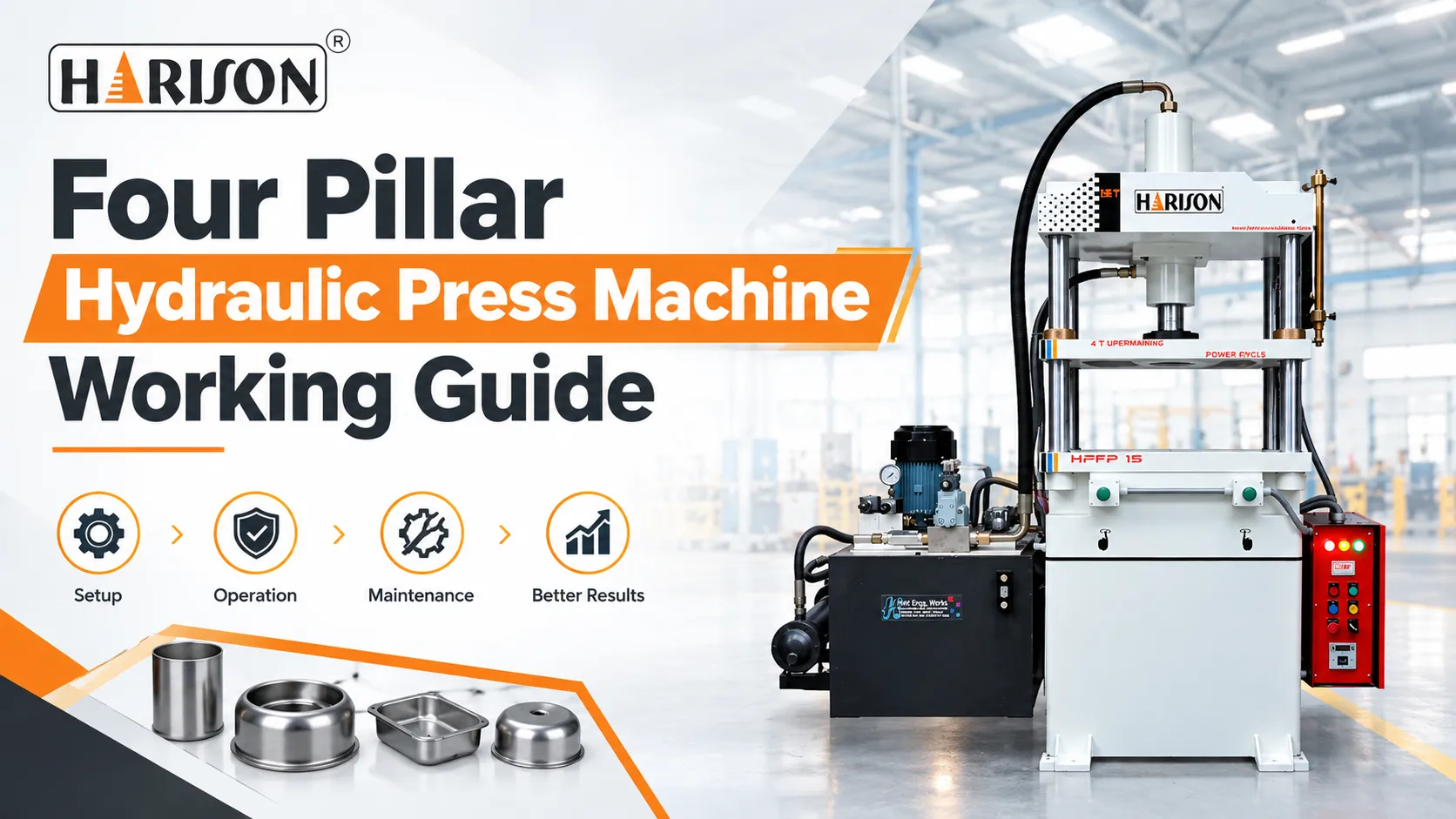

Quick Overview:
A four pillar hydraulic press uses four vertical columns to keep the platen perfectly square to the bed under load, making it a go-to choice for precision work like deep drawing, forging, and molding. This guide walks through how the machine actually works, what its key features do, where it's commonly used, and what to check across tonnage and specifications before choosing one for your production line.
Table of Contents
- What Is a Four Pillar Hydraulic Press
- How a Four Pillar Hydraulic Press Actually Works
- Why Four Pillars Instead of Two
- Key Features That Affect Performance
- Common Industrial Applications
- Understanding Tonnage and Specifications
- What to Check Before Buying One
- Maintenance Basics
- FAQs
What Is a Four Pillar Hydraulic Press
A four pillar hydraulic press is a heavy-duty industrial machine built around four vertical steel columns that support and guide the moving platen as it presses down under hydraulic force. The machine works using hydraulic cylinders, which generate pressing force through fluid pressure, and this force gets transmitted evenly across the die and workpiece thanks to the four-column structure holding everything in alignment.
This design is specifically suited for high-pressure operations that need consistent, repeatable accuracy, molding, forging, punching, and deep drawing all rely on the platen staying perfectly aligned with the bed, stroke after stroke, and that's exactly what the four-pillar structure is built to deliver.
How a Four Pillar Hydraulic Press Actually Works
The basic operating sequence is fairly simple to follow, even if the engineering behind it is fairly involved.
- Hydraulic fluid is pressurised and directed into the main cylinder, which drives the ram and platen downward
- The four pillars guide this movement, keeping the platen travelling in a straight vertical line without tilting or shifting sideways
- Pressing force is applied to the workpiece, held in place on the bed between the die and punch
- Limit switches, proximity switches, or linear encoders are often used to control exactly where in the stroke the speed changes, allowing a controlled approach as the tooling nears the workpiece
- The platen retracts once the press cycle completes, ready for the next piece to be loaded
This entire sequence happens with fairly tight repeatability, which is a big part of why four pillar presses are trusted for production runs where every single part needs to come out the same.
Why Four Pillars Instead of Two
This comparison comes up a lot, and it's worth understanding the actual mechanical reason behind it.
- Two-column presses can flex slightly at the top under heavy tonnage, since the frame is only supported from one side of the working area
- Four pillars resist lateral and torsional movement far better, keeping the platen square to the bed throughout the entire stroke, not just at the starting position
- This matters most in operations like deep drawing, where lateral force builds up mid-stroke, a two-column frame can deflect under this load in a way that shows up as misalignment in the finished part
- For precision work like coin minting or embossing, where surface detail can't tolerate any ram tilt, the four-pillar structure is often the deciding factor over other frame types
If your work involves tight tolerances or deep, lateral-force-heavy operations, this structural difference genuinely affects part quality, not just machine rigidity on paper.
Key Features That Affect Performance
A few specific design features shape how well a four pillar press actually performs in daily production.
- Adjustable pressure settings, letting operators fine-tune force output to match different materials and part requirements
- User-friendly control interface, reducing setup time and operator error during changeovers
- Robust steel frame construction, built to handle continuous, heavy-duty cycling without fatigue over time
- Precise alignment of die and punch, directly supporting consistent part quality across long production runs
- Overload protection system, safeguarding both the machine and the tooling from damage if pressure exceeds safe limits
- Automatic pressure release, adding a layer of operational safety during the press cycle
- Low maintenance requirements, a benefit of the relatively simple hydraulic mechanism compared to more complex mechanical press designs
- Versatile tool and die compatibility, allowing the same machine to handle a range of different jobs without needing separate equipment
These features together are really what separates a dependable production press from one that needs constant adjustment and babysitting on the shop floor.
Common Industrial Applications
Four pillar hydraulic presses show up across a genuinely wide range of manufacturing processes:
- Metal forming and forging, shaping raw material into precise final geometries
- Deep drawing of automotive parts, where lateral force control is essential for consistent panel quality
- Embossing and stamping operations, requiring fine surface detail accuracy
- Coin minting and medal pressing, where zero ram tilt is non-negotiable for surface quality
- Assembly of complex machinery parts, using controlled pressing force for precise fitment
- Powder metallurgy applications, compacting powdered material into solid components
- Rubber vulcanization, often using heated platens for the molding process
- Extrusion of aluminium profiles, where consistent vertical clearance matters for the extrusion process
This range, from heavy automotive body panels down to fine-detail coin pressing, shows just how adaptable the four-pillar design actually is across different tonnage and tooling setups.
Understanding Tonnage and Specifications
Four pillar presses are typically available across a wide tonnage range, and picking the right one comes down to matching capacity to your actual production need rather than simply going with the highest number available.
- Lower tonnage models (around 15 to 40 tons) suit smaller dies and lighter-force work, medal pressing, badge embossing, and similar detail-focused jobs
- Mid-range tonnage (60 to 150 tons) covers a wide band of general forming, deep drawing, and assembly operations, and tends to be the most commonly selected range for medium-volume production
- Higher tonnage models (200 tons and above) suit heavier forming, larger automotive components, and extrusion work needing more force and working clearance
Beyond tonnage alone, table size, ram-to-bed clearance, stroke length, and motor horsepower all shift together as capacity increases, so comparing full specifications, not just the tonnage figure, matters when deciding between two closely rated models.
What to Check Before Buying One
A few practical factors are worth confirming before finalising a four pillar hydraulic press purchase.
- Table size and ram-to-bed clearance, matched against your die dimensions and the physical size of parts you'll be pressing
- Stroke length, ensuring it accommodates the full range of motion your specific process requires
- Motor horsepower, which affects cycle speed and how well the press handles continuous, high-volume use
- Customisation availability, since standard catalogue sizes don't always match every application, and many manufacturers offer tailored platen sizes and pressing speeds
- Safety features, confirming overload protection and emergency stop mechanisms are built in as standard
Sharing your specific application, part dimensions, material type, and expected daily cycle count with the manufacturer upfront makes it much easier to land on the right configuration the first time.
Maintenance Basics
Four pillar hydraulic presses are generally known for being relatively low-maintenance, but a few routine checks keep them performing reliably.
- Check hydraulic fluid levels and condition regularly, contaminated or low fluid affects both pressing force and system longevity
- Inspect the four guide pillars periodically for wear, since consistent alignment depends on these surfaces staying smooth and undamaged
- Test overload protection and emergency stop systems on a routine schedule to confirm they're functioning correctly
- Keep limit switches and sensors clean and calibrated, since these directly control stroke accuracy and speed changes
A bit of consistent upkeep goes a long way toward keeping both part quality and machine uptime steady across years of production use.
Choosing the Right Manufacturer
Specifications on a catalogue page only tell part of the story, actual build quality, frame rigidity, and after-sales support decide how the press performs once it's running daily production. Hari Engineering Works manufactures four pillar hydraulic presses across a wide tonnage range, from 15 tons up to 500 tons, with customisation available on platen size, pressing speed, and capacity based on the buyer's specific application.
FAQs
1. What is the difference between a four pillar press and a C-type hydraulic press?
A four pillar press uses four vertical columns to keep the platen square to the bed throughout the stroke, resisting lateral flex under heavy load. A C-type press has an open frame design, which can deflect slightly under lateral force, making the four-pillar design generally better suited for deep drawing and precision work.
2. What tonnage range do four pillar hydraulic presses come in?
These presses are commonly available from around 15 tons up to 500 tons or more, depending on the manufacturer. The right tonnage depends on your specific application, material thickness, and part size, rather than simply choosing the highest capacity available.
3. What materials can be processed on a four pillar hydraulic press?
Four pillar presses handle a wide range of materials, including various metals for forming and forging, rubber for molding and vulcanization, and powdered metal for compaction applications. Material compatibility mainly depends on the tooling and die setup used.
4. Why is precision alignment important in a four pillar hydraulic press?
Precision alignment ensures the die and punch meet consistently on every stroke, which directly affects part quality and surface finish. This matters especially in applications like coin minting, embossing, and deep drawing, where even slight misalignment shows up as visible defects.
5. How is a four pillar hydraulic press different from a mechanical press?
Hydraulic presses generate force through fluid pressure, offering more control over pressing speed and force throughout the stroke, while mechanical presses rely on a flywheel and mechanical linkage. This gives hydraulic presses more flexibility for varied tonnage and application needs.
6. Can a four pillar hydraulic press be customised for specific applications? Yes, many manufacturers offer customisation on platen size, pressing speed, and tonnage capacity to match specific production requirements, rather than limiting buyers to standard catalogue configurations alone.























Sign in to leave a comment.