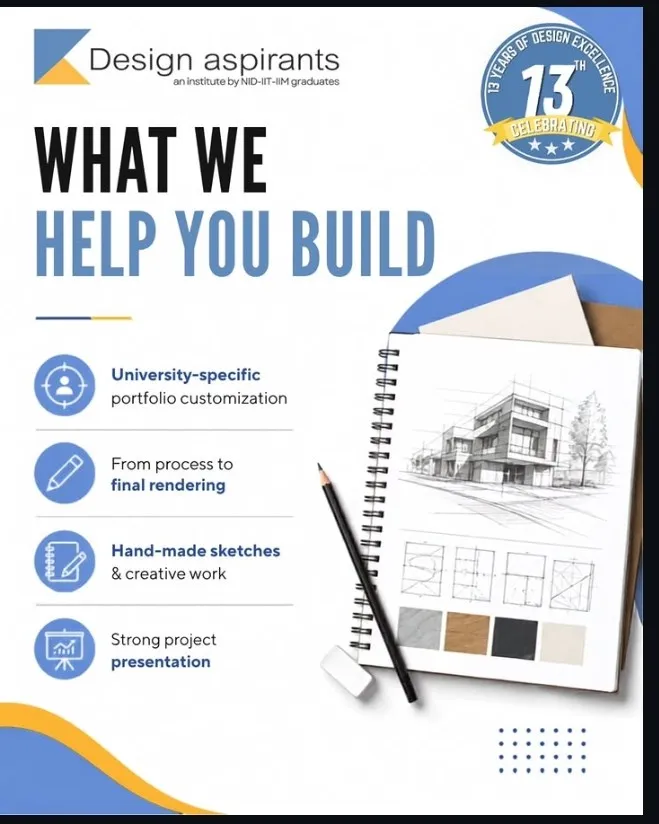

A polished final design may look simple, but behind most successful creative work lies a detailed process of observation, research, experimentation and refinement.
For design entrance aspirants, learning this process is equally important as learning drawing techniques.
Design institutes are interested in how students think. They want to understand whether a student can identify a problem, generate multiple ideas, evaluate alternatives and develop a meaningful final solution.
Students preparing through design entrance exam coaching in Bhopal or design entrance exam coaching in Indore can benefit from practising complete design processes instead of concentrating only on final artwork.
Start With Understanding the Problem
Every design project begins with a question.
What needs to be improved?
Who will use the solution?
Where will it be used?
What challenges does the user currently face?
Students should understand the problem before they start drawing solutions.
For example, if the task is to redesign a school bag for young children, the student should first think about weight, comfort, storage, safety and ease of use.
Jumping directly to a final illustration may produce an attractive image but not necessarily a useful design.
Research the User
Design is created for people.
Students should learn to consider the needs of the intended user.
A product for an elderly person will have different requirements from a product designed for a child.
Observation can provide useful insights.
Students can notice how people hold objects, move through spaces, use public facilities and interact with products.
Even simple observations can generate strong design ideas.
Generate Multiple Ideas
The first idea is rarely the only possible solution.
Students should create several quick concepts before choosing one.
At this stage, sketches can be rough.
The objective is exploration.
Suppose the project involves designing an umbrella for cyclists.
One idea might focus on mounting the umbrella to the bicycle. Another might involve wearable protection. A third might rethink the cyclist's clothing.
Generating alternatives helps students avoid predictable solutions.
Evaluate Your Concepts
After creating different options, students should compare them.
Which idea is practical?
Which one solves the actual problem?
Can it be manufactured?
Is it comfortable for the user?
Does it introduce another problem?
These questions help students make more thoughtful design decisions.
Design is not only about being different. A creative solution should also make sense.
Refine the Selected Idea
Once a concept is selected, the student can develop it in greater detail.
This may involve improving proportions, materials, mechanisms, colour, ergonomics and usability.
Several versions may be required before reaching the final form.
Students should not be afraid to change an idea.
Refinement is a normal part of the design process.
Create the Final Rendering
The final rendering should clearly communicate the completed concept.
Depending on the project, students may use colour pencils, markers, digital tools or mixed media.
The rendering should show important details without becoming unnecessarily decorative.
If the design has a specific feature, it should be easy to understand.
Students can use small annotations where necessary.
Show the Process in Your Portfolio
A portfolio becomes stronger when viewers can see how a project developed.
Instead of showing only the final page, students can include selected stages such as research notes, rough sketches, alternative concepts and refinement.
This helps admissions panels understand how the student approaches creative problems.
It also demonstrates that the final result was developed through thinking rather than copied from a reference.
Learn From Unsuccessful Ideas
Not every concept will work.
Some ideas may be impractical or difficult to communicate.
These attempts still have value.
Students can learn why an idea failed and apply that understanding to future projects.
Creative confidence grows when students become comfortable experimenting without expecting every attempt to be perfect.
Practise With Everyday Problems
Design process practice does not require expensive materials.
Students can choose simple everyday problems.
How can a school desk be improved?
How can grocery packaging become easier for elderly users?
How can a bus stop provide a better experience during rain?
How can stationery be organised more effectively?
Such exercises train students to observe common situations from a designer's perspective.
Final Thoughts
Understanding the journey from rough idea to final rendering is one of the most valuable skills a design aspirant can develop.
A strong design process includes understanding the problem, researching users, generating alternatives, evaluating ideas, refining concepts and presenting the final solution clearly.
Students who regularly practise this approach begin to think more logically and creatively.
The goal is not simply to create an impressive drawing. It is to demonstrate how thoughtful design can solve real problems.



















Sign in to leave a comment.