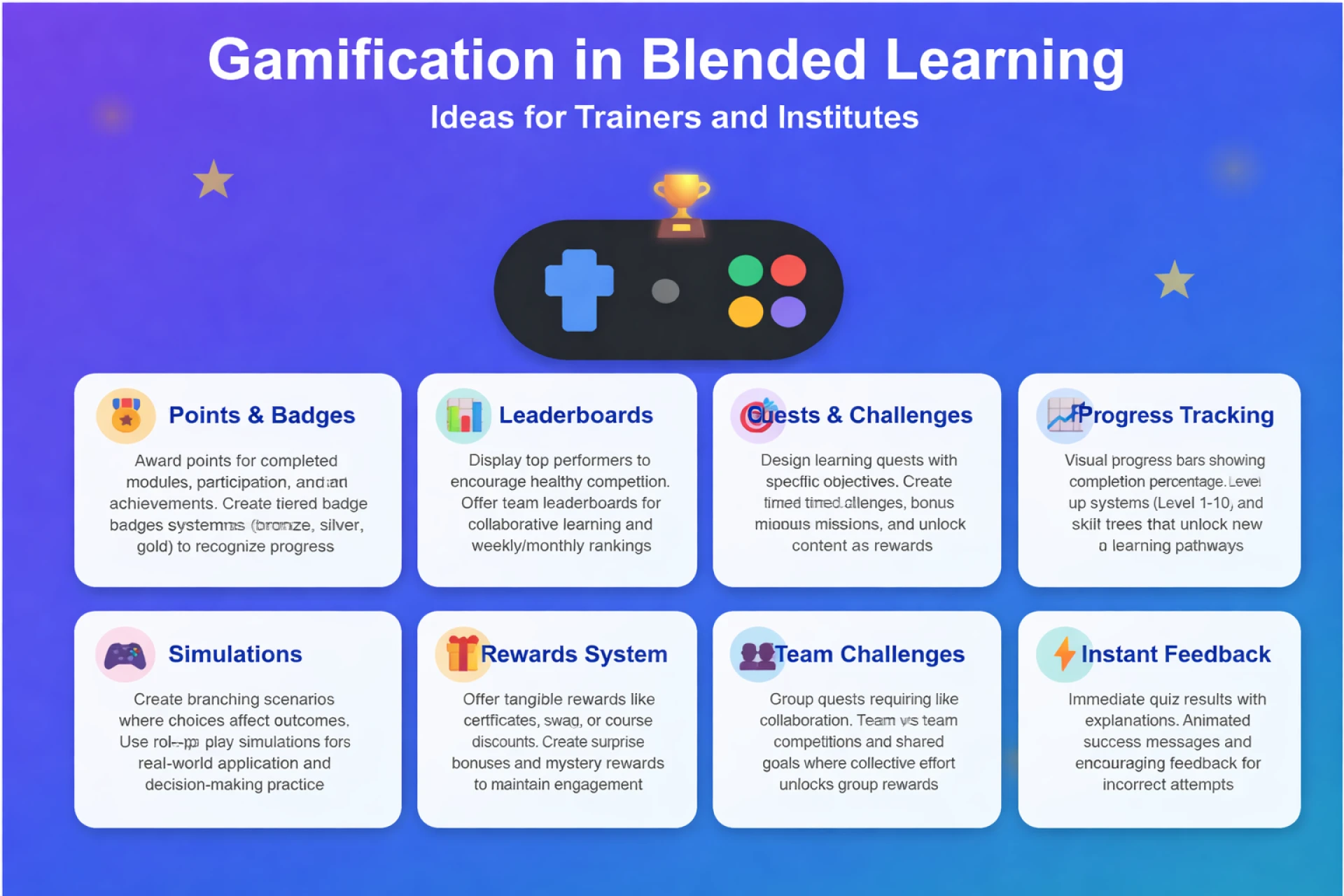

Want to supercharge your blended learning programs? Explore proven gamification strategies that keep learners hooked and deliver real results, whether you're training businesses or individual learners.
Introduction
Training institutes and corporate learning teams face a persistent challenge: keeping learners engaged across different delivery formats. Whether you're running workshops, online modules, or a mix of both, attention spans are shrinking, and completion rates often disappoint. Enter gamification, a proven strategy that transforms passive learning into active participation. When integrated thoughtfully into a B2B and B2C training platform, gamification elements like points, badges, leaderboards, and challenges can dramatically increase motivation and knowledge retention. According to research, 83% of employees feel more motivated when training includes game-like elements, while 61% of learners say gamified content makes them more productive. For training providers exploring blended learning for training providers, gamification isn't just a trendy add-on; it's a strategic tool that bridges the gap between digital and in-person experiences.
Why Gamification Works in Blended Learning Environments
Blended learning combines the flexibility of digital content with the human connection of face-to-face instruction. This hybrid approach creates natural opportunities for gamification because learners move between environments where different engagement tactics work best.
The Psychology Behind Game Mechanics
Gamification taps into fundamental human drives: achievement, competition, collaboration, and recognition. When learners earn points for completing pre-work before a live session or unlock badges for mastering complex topics, their brains release dopamine, the same neurotransmitter associated with reward and pleasure. This neurological response creates positive associations with learning activities.
For institutes offering virtual instructor-led training alongside self-paced modules, gamification provides consistency across formats. A learner who earns experience points during an asynchronous video lesson carries that momentum into the next live workshop, creating a unified learning journey rather than disjointed episodes.
Measurable Impact on Learning Outcomes
Research from the University of Colorado Denver found that gamified courses saw a 9% improvement in knowledge retention compared to traditional formats. The competitive elements encourage repeated practice, while progress visualization helps learners understand exactly where they stand in their development journey.
Practical Gamification Strategies for Training Institutes
Progressive Point Systems and Experience Levels
Implement a point system that rewards both attendance and achievement. Learners earn points for showing up to live sessions, but they earn more points for demonstrating mastery through assessments or applying concepts in practical exercises.
Consider creating experience levels (Bronze, Silver, Gold, Platinum) that unlock as learners accumulate points. Each level could grant access to exclusive content, advanced workshops, or mentorship opportunities. This approach works exceptionally well in hybrid training models 2026, where learners expect personalized pathways rather than one-size-fits-all curricula.
Collaborative Quest-Based Learning
Design multi-week "quests" that require learners to complete various tasks across different learning modalities. For example, a leadership development quest might include:
- Watching three video lessons on emotional intelligence (online component)
- Participating in a live role-play workshop (in-person component)
- Submitting a reflection assignment (asynchronous component)
- Completing a peer feedback activity (collaborative component)
Teams or individuals who complete quests earn special recognition and tangible rewards. This structure naturally supports the flipped classroom for academies model, where learners consume foundational content independently before applying concepts during facilitated sessions.
Real-Time Leaderboards with Purpose
Leaderboards generate healthy competition, but they must be implemented thoughtfully to avoid discouraging struggling learners. Consider these variations:
Team-based leaderboards where small groups compete collectively, promoting collaboration over individual rivalry. This approach particularly suits corporate training environments where teamwork matters more than individual stardom.
Multiple leaderboard categories, such as "Most Improved," "Collaboration Champion," or "Curiosity Award," ensure different types of learners receive recognition. Someone who actively helps peers might never top the assessment scores leaderboard but could dominate in collaborative metrics.
Time-limited challenges that reset weekly or monthly give everyone fresh opportunities to climb rankings, maintaining long-term engagement throughout extended training programs.
Digital Badges and Micro-Credentials
Digital badges serve dual purposes: they motivate learners internally and provide external validation of skills. When displayed on LinkedIn profiles or digital portfolios, badges become career assets that extend value beyond the immediate training experience.
Create badge hierarchies for different competency areas. A data analytics training program might offer separate badge tracks for Excel skills, statistical methods, and data visualization tools. Learners can pursue badges aligned with their career goals, creating personalized learning pathways within your structured curriculum.
Technology Requirements and Platform Selection
Successful gamification requires the right infrastructure. Modern learning management systems built specifically as comprehensive training platforms often include native gamification features like automated point tracking, badge issuance, and progress dashboards.
When evaluating platforms, prioritize solutions that integrate gamification elements seamlessly across all delivery modes. Your learners shouldn't experience disconnected systems where online achievements don't connect to in-person workshop participation. Look for platforms offering:
- Automated tracking of diverse learning activities
- Customizable reward systems aligned with your brand
- Real-time analytics showing engagement patterns
- Mobile-friendly interfaces for learner accessibility
- API integrations allowing connection with existing tools
SimpliTrain, Moodle offer robust gamification capabilities suitable for various training contexts, while enterprise-focused platforms provide additional customization for large-scale implementations.
Common Pitfalls to Avoid
Over-Complication
Adding too many game mechanics creates cognitive overload. Start with two or three core elements, perhaps points and badges, then expand based on learner feedback and engagement data. Simplicity often outperforms complexity in sustaining long-term participation.
Meaningless Rewards
Points and badges lose motivational power when they feel arbitrary. Every game element should connect logically to learning outcomes. Award points for behaviours that genuinely advance skill development, not just for logging in or clicking through content.
Ignoring Intrinsic Motivation
While extrinsic rewards work, the most powerful learning happens when people find genuine value in the content. Use gamification to supplement quality instruction, not replace it. Your game mechanics should enhance an already strong curriculum, not compensate for weak instructional design.
Conclusion
Gamification transforms blended learning from a logistical framework into an engaging experience that learners actively anticipate. By thoughtfully integrating point systems, collaborative quests, meaningful badges, and purposeful competition, training institutes create environments where motivation thrives across digital and physical spaces. The most successful implementations recognize that gamification serves learning outcomes , not the reverse. When your game mechanics reward genuine skill development and thoughtful participation, they become powerful catalysts for both completion and competency.








Sign in to leave a comment.