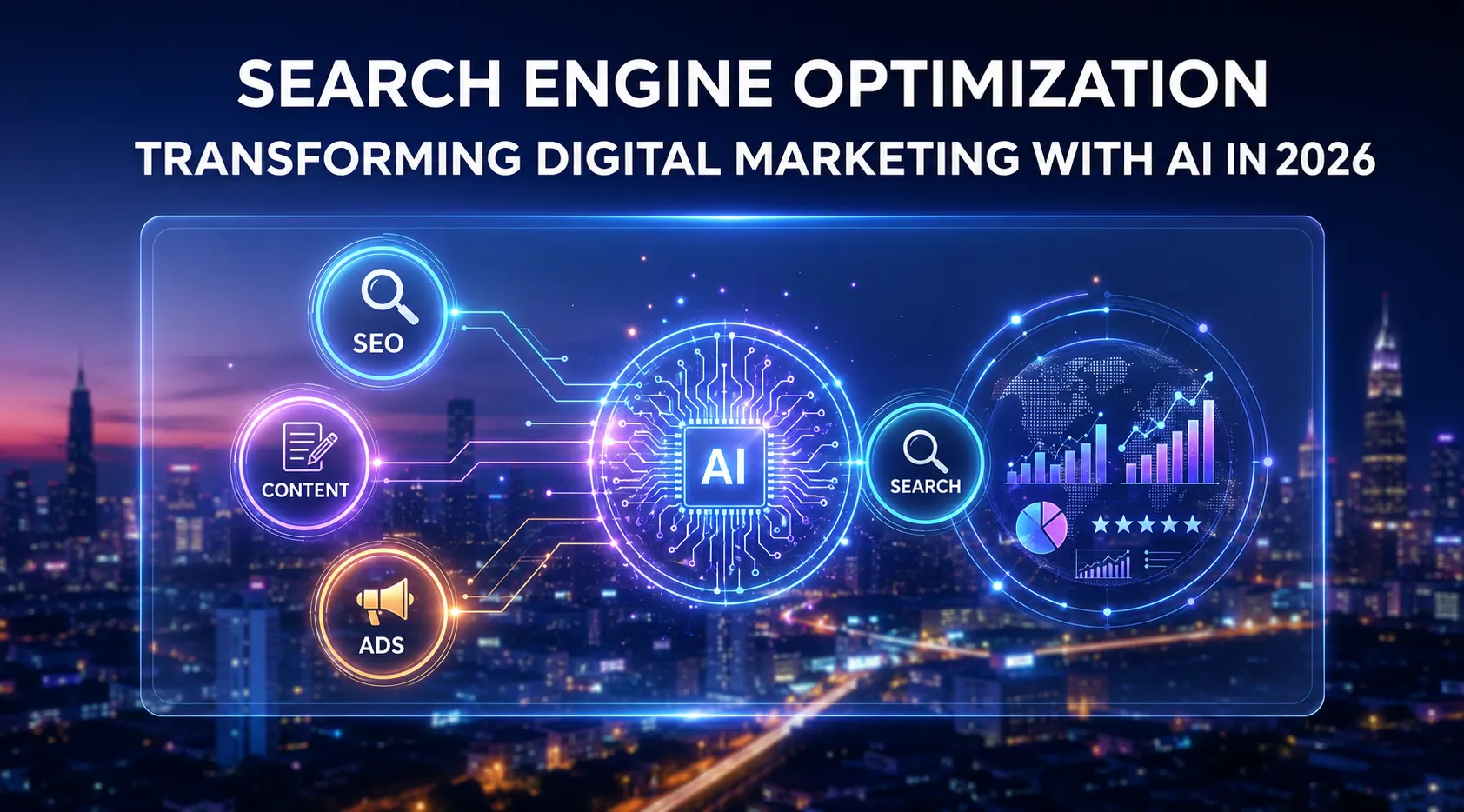

Type "best CRM for small business" into ChatGPT or Google's AI Mode today, and you won't get ten blue links. You'll get a written answer with two or three sources quoted inside it. If your brand isn't one of those sources, you've lost the customer before they ever visit your website.
This shift is why generative engine optimization (GEO) has become one of the most searched terms in digital marketing this year. Business owners aren't asking "what is GEO" out of curiosity they're asking because their organic traffic is changing shape, and they want to know what to do about it.
This guide breaks down what GEO actually is, how it's different from traditional SEO, and how to start showing up as the answer AI tools give, not just another link they ignore.
What Is Generative Engine Optimization?
Generative engine optimization is the practice of structuring and writing content so that AI systems ChatGPT, Google's AI Overviews, Perplexity, Claude, Gemini can understand it, trust it, and cite it in the answers they generate for users.
Where classic SEO optimizes for a ranking position, GEO optimizes for inclusion inside an AI-generated response. It's closely related to two other terms you'll see used almost interchangeably:
- Answer Engine Optimization (AEO) - writing content in a question-and-answer format so it directly satisfies a query, making it easy for AI to lift and cite.
- AI SEO - the umbrella term covering both technical and content work aimed at visibility across search engines and AI answer engines together.
Google itself has weighed in on this directly. In its official guide to optimizing for generative AI features in Search, Google states that AI Overviews and AI Mode are rooted in the same core ranking and quality systems as regular Search, meaning crawlability, indexing, and content quality still decide whether your site can even be considered for an AI answer. In other words, GEO doesn't replace SEO fundamentals; it builds directly on top of them.
Why GEO Matters Right Now (Not Later)
This isn't a future trend it's already reshaping how people research before they buy. A growing share of product research, "best of" comparisons, and how-to questions now start with a prompt, not a search box.
Here's the practical impact for businesses:
- Zero-click discovery is rising. Users get their answer inside the AI response and may never click through unless your brand is the one being quoted.
- Fewer citations, higher value. An AI Overview might only cite 2–5 sources per query, compared to 10 organic results on a traditional SERP. Being one of those few sources carries outsized weight.
- Trust transfers instantly. When an AI tool names your brand as the answer, it borrows that tool's credibility a stronger trust signal than a standard search listing.
- Competitors are already moving. Agencies and in-house teams are actively restructuring content for AI retrieval; waiting means ceding ground that's hard to win back.
GEO vs Traditional SEO: What Actually Changes
| Factor | Traditional SEO | Generative Engine Optimization |
| Goal | Rank on page 1 | Get cited inside the AI-generated answer |
| Success metric | Rankings, clicks, CTR | Citation frequency, brand mentions in AI answers |
| Content format | Keyword-optimized pages | Clear, direct, quotable, well-structured answers |
| Technical layer | Meta tags, backlinks, site speed | Same fundamentals + schema, entity clarity, structured data |
| Discovery surface | Search engine results page | Search engines + ChatGPT, Perplexity, Gemini, AI Mode |
| Content depth | Broad keyword coverage | Deep, opinionated, fact-backed answers on specific topics |
The takeaway: GEO isn't a separate discipline that replaces SEO; it's SEO extended to a new surface, with an added layer of entity clarity, structured data, and answer-first writing.
How to Actually Optimize for AI Search (Practical Steps)
1. Answer the question in the first two sentences. AI systems pull concise, direct answers. Bury your point under three paragraphs of introduction and you're less likely to be quoted.
2. Structure content around real questions. Use headings phrased as actual queries people type or speak this is the foundation of answer engine optimization.
3. Strengthen your entity presence. Make sure your brand, founders, and products are consistently described the same way across your site, Wikidata, Crunchbase, LinkedIn, and review platforms. AI models cross-reference these to judge trust.
4. Add structured data. FAQ schema, product schema, and organization schema help machines parse context faster, even though Google notes it isn't strictly "required" for AI features.
5. Publish content with a real point of view. AI tools favor original analysis and clear opinions over content that just repeats what's already on page one a pattern we've seen play out clearly in hyper-personalized AI marketing content, where brand-specific insight consistently outperforms generic advice.
6. Get cited by others. Digital PR, expert roundups, and co-citations on trusted sites feed the same authority signals that AI retrieval systems lean on.
7. Test your visibility regularly. Run your brand's core questions through ChatGPT, Perplexity, and Google's AI Mode monthly. Track whether you're mentioned, how you're described, and where competitors are winning instead.
Who Needs GEO, and When Should You Start?
Who: Every business with an online presence, from local service providers to global SaaS companies, because AI-driven research now touches nearly every purchase category, not just tech.
When: The right time is now, not after competitors have already secured citation share. Entity trust and content authority build slowly; early movers compound their advantage.
Where: GEO applies across your website content, product pages, FAQs, comparison pages, and any public profile (review sites, directories, knowledge bases) that AI models draw from.
Why: Because visibility is shifting from "ranking on a page" to "being the answer," and once a brand is absent from an AI answer, it stays invisible until its content authority improves.
Common Pain Points Businesses Face
- "We rank well on Google, but ChatGPT never mentions us." - This usually means content is well-optimized for keywords but not structured for direct answer extraction.
- "We don't know if GEO is even working." - Most teams lack a system for tracking AI citations; regular prompt testing solves this.
- "Our content sounds like everyone else's." - AI tools deprioritize generic, repeated advice in favor of distinct, well-sourced perspectives.
- "We don't have the internal resources to rebuild our content library." - This is exactly where a dedicated GEO agency earns its keep, prioritizing high-impact pages first rather than rebuilding everything at once.
Conclusion: Be the Brand AI Actually Recommends
Search hasn't disappeared; it's just gained a new layer. People still have questions, they're just increasingly asking AI tools to answer them directly. The businesses that adapt their content strategy now, combining solid SEO fundamentals with answer-first writing, entity clarity, and structured data, will be the ones AI systems trust enough to quote.
If you're ready to move from being indexed to being cited, working with a specialized GEO agency can help you audit your current AI visibility, fix the structural gaps, and build the authority signals that get your brand named as the answer, not just another search result.
FAQs
1. What is the difference between SEO and generative engine optimization?
SEO focuses on ranking your web pages on search engine results pages, driven by keywords, backlinks, and technical performance. Generative engine optimization focuses on getting your content cited directly inside AI-generated answers on tools like ChatGPT and Google's AI Overviews. GEO builds on SEO fundamentals crawlability, quality content and authority but adds a layer focused on clarity, structure, and being quotable enough for AI systems to lift and reference in their responses.
2. Do I need to stop doing SEO if I invest in GEO?
No. GEO doesn't replace SEO it depends on it. Google has confirmed that its AI features run on the same core ranking and quality systems as regular Search, meaning your site still needs to be crawlable, indexed, and high-quality to even be considered for AI citation. Think of GEO as an additional layer on top of solid SEO, not a separate strategy.
3. How do I know if my brand is showing up in AI search results?
Run your core business questions and product comparisons directly through ChatGPT, Perplexity, and Google's AI Mode, and note whether your brand appears, how it's described, and which competitors show up instead. Doing this consistently, ideally monthly, gives you a clear, repeatable way to track AI visibility over time, similar to how you'd track keyword rankings in traditional SEO.
4. Is answer engine optimization the same as generative engine optimization?
They overlap heavily but aren't identical. Answer engine optimization (AEO) specifically refers to structuring content in a question-and-answer format so it directly satisfies a query. Generative engine optimization (GEO) is the broader practice, covering AEO techniques plus entity building, schema, brand authority, and citation strategy across AI tools. Most practitioners use the terms together since strong AEO is a core part of effective GEO.
5. How much does it cost to work with an AI SEO or GEO agency?
Costs vary based on the size of your content library, how many pages need restructuring, and whether entity-building and schema work are included. Most agencies offer tiered engagements starting with an audit and a handful of priority pages, then expanding into full content clusters and ongoing prompt-testing and monitoring. It's worth asking any agency for a clear breakdown of deliverables tied to measurable AI citation tracking, not just vague "visibility" promises.





















![Best SEO Agencies in the USA [2026]: 12 Firms Compared by Budget, Industry and AI-Search Readiness](/data/post/1959996/4595254871dd0df65bf916ff.webp)


Sign in to leave a comment.