

Picture two founders. One spends months building separate iPhone and Android apps and launches with a polished product but a nearly empty bank account. The other ships a single codebase in half the time, then discovers her live order tracking stutters on older phones. Both made a reasonable decision, and both paid for it.
That's the honest reality of grocery store app development. The "native vs. cross-platform" question has no universal winner, only a better fit for your budget, timeline, and plans. And if you're still exploring the wider space, our overview of Grocery Shopping App Development shows how the pieces fit together before you pick a technical route.
First, What do these two options actually mean?
A native app is built separately for each platform: Swift for iOS, Kotlin or Java for Android. Each version is written specifically for its operating system, which gives you top performance and full access to device features.
A cross-platform app uses one shared codebase for both iOS and Android. Frameworks like Flutter and React Native are the popular choices, and they let teams reuse most of their work while still delivering performance that's close to native for typical apps.
Neither is "the good one." They're different trade-offs, and grocery apps have some unusual demands that tilt the scales.
Why groceries make this choice trickier
A grocery app isn't a simple brochure. Customers search a huge catalogue, fill carts with dozens of items, pick delivery slots, deal with out-of-stock substitutions, and want to watch their order move on a map. Add push notifications, saved lists, and payments, and you have a lot happening at once.
That's why the platform decision matters even more for online Grocery Store App Development. A laggy checkout or a map that jitters doesn't just annoy people, it costs you orders. Shoppers who reorder every week won't wait around for a slow app.
Going native: where it shines and where it hurts
The good: Native gives you the smoothest performance and full, easy access to what the phone can do, from the camera to background location. If you plan to lean on advanced hardware features, native is the straightforward route.
The catch: You're effectively building and maintaining two apps. That means two teams (or one stretched thin), two sets of bugs, and two release cycles. When you add a feature, you add it twice.
Native makes the most sense when performance is truly critical, when your app relies on heavy device features, or when you already have the budget and a long runway.
Going cross-platform: the appeal and the fine print
The good: One codebase means faster delivery and lower maintenance costs. Modern frameworks also offer near-native performance, so for most grocery apps, the gap users notice is small.
Between the two big frameworks, Flutter draws its own interface, which gives you consistent visuals and strong animation. React Native maps to native components and is often quicker to start with if your team already knows JavaScript. Either can work well.
The catch: When you need something deeply platform-specific, like advanced AR or machine learning features, you may need to write native modules on top. It's doable, but it adds complexity.
A quick side-by-side
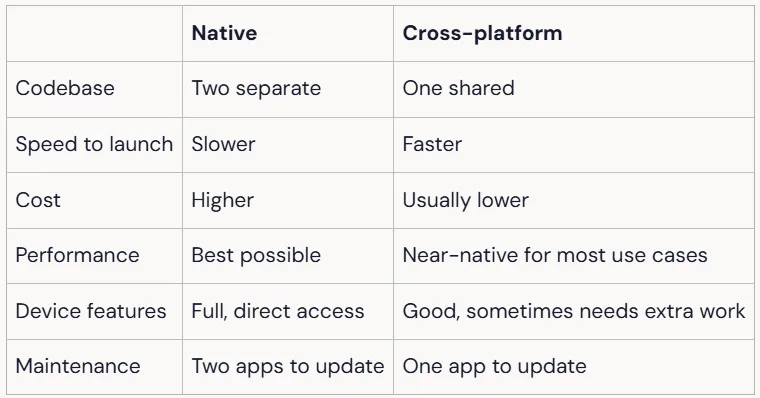
What will it cost you?
Here's where the choice hits your wallet. Cross-platform is often reported to cut costs by roughly 30 to 50 percent compared with building two native apps. On top of the platform choice, grocery apps carry extra weight: inventory syncing, substitution logic, and delivery scheduling can add another $15,000 to $30,000 to a base platform, and yearly maintenance commonly runs 15 to 20 percent of the build cost.
Published estimates disagree wildly, from around $25,000 for a basic MVP to $300,000 or more for an advanced platform, depending on features and team location. For a fuller breakdown, see our guide to the cost to develop a grocery delivery app, then get itemised quotes rather than trusting any one number.
Thinking bigger: the Instacart question
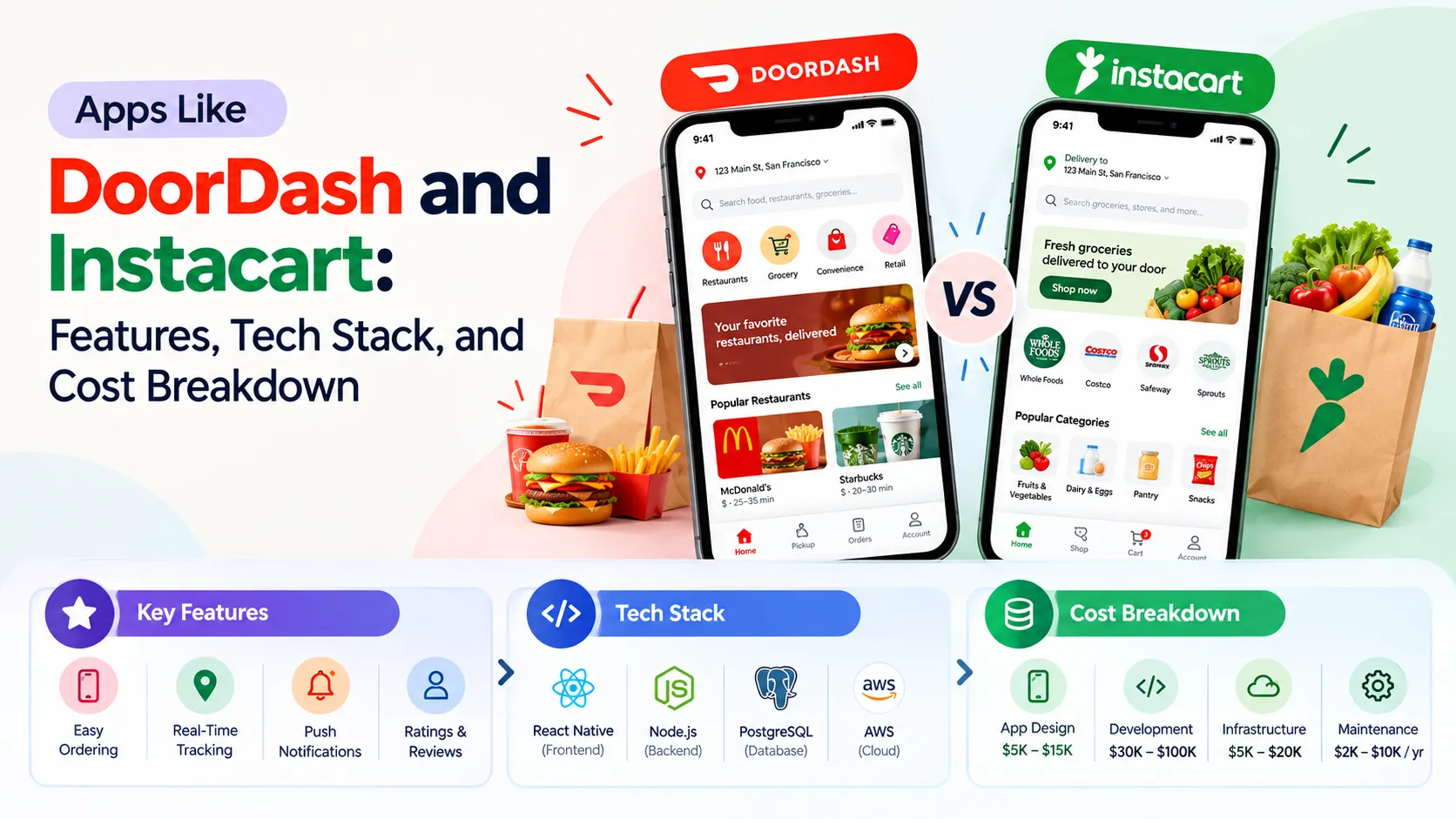
Plenty of founders dream of scale. If your goal is to Develop a Grocery Delivery App like Instacart, remember you're not building one app. A marketplace like that needs at least three: one for customers, one for shoppers or drivers, and an admin panel, plus integrations with store systems.
That changes the platform math. Three apps on two platforms each is a lot of native code. Many teams in this position use cross-platform for the customer and driver apps to move faster, and keep native in reserve for the parts where performance really matters.
So, which should you pick?
Skip the theory and answer a few practical questions:
- Is this an MVP to test the market? Cross-platform usually wins on speed and cost.
- Do you need heavy device features or ultra-smooth animation? Lean native, or plan native modules.
- How big is your team? A small team is easier to support with a single codebase.
- What's your plan for the next two years? If you expect frequent updates and new features, one codebase keeps changes simpler.
Many businesses take a middle path: launch fast with cross-platform, learn from real customers, and go native for specific features later, once the numbers justify it.
Who should build it?
Your choice of technology matters less than the team behind it. Some businesses prefer to Hire Grocery Delivery App Developer talent directly and keep control in-house, while others want a full team that handles design, development, testing, and support together.
If you go the agency route, look for a Grocery Store App Development company that has shipped real grocery projects, not just generic e-commerce. Ask how they've handled substitutions, delivery slots, and store inventory before. If you'd rather work with a single partner from planning through launch, full-service Grocery App Development Solutions can save you from stitching several vendors together.
Wrapping up
There's no trophy for picking the "more advanced" option. Native gives you maximum performance and control at a higher cost, and cross-platform gives you speed and savings with a few trade-offs at the edges. Match the choice to your stage, not your ambitions.
Whichever way you lean, compare a few options carefully. Our roundup of the Top Grocery App Development Companies is a good starting point for building a shortlist, and it's worth asking each one to justify their platform recommendation before you sign. A team that can explain why is worth more than one that simply says yes.
FAQs
Q1. Is a cross-platform app good enough for a grocery store?
For most grocery apps, yes. Modern frameworks like Flutter and React Native deliver near-native performance, and they handle standard features such as browsing, carts, and checkout comfortably. Native becomes more attractive when you need deep hardware access or advanced capabilities like AR or on-device machine learning, since cross-platform tools may need extra native components for those.
Q2. How long does it take to build a grocery delivery app?
Timelines generally range from around 2 to 9 months, depending on scope. A typical build moves through discovery (about 3 to 4 weeks), design (4 to 8 weeks), development (8 to 16 weeks), testing (4 to 8 weeks), and deployment (2 to 4 weeks). Complex integrations and extra features stretch this further, while sharing one codebase across platforms can help you move faster.


























Sign in to leave a comment.