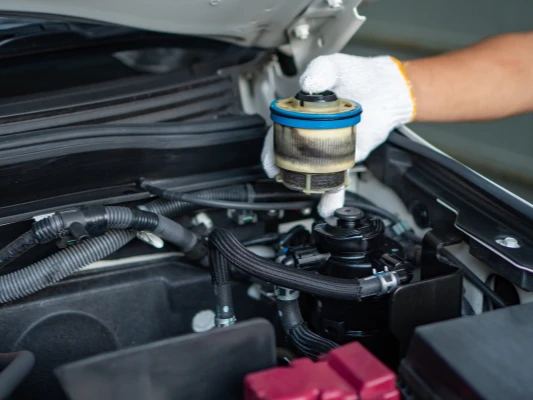

What are fuel injectors?
Fuel injectors use electronically controlled valves that may open and close several times per second to spray fuel into an automobile's engine. For the best combustion and economy, they include an atomizing nozzle that distributes the gasoline or diesel uniformly.
How does fuel injection service work?
To maintain your car's performance, you must do fuel injector servicing. The intake manifold houses the fuel injectors, which spray gasoline through a small nozzle. Instead of spraying the gasoline in a powerful jet stream, the fuel injector employs a unique nozzle that emits a fine mist. Consider the hose nozzle that you use in your yard. You may modify the way water emerges from your nozzle. Jet streams, rain, mist, and many other settings are possible. Because burning gasoline in a mist is simpler for your engine, a fuel injector must mistly spray fuel. Your car's throttle valve, which is a valve that opens and admits air into your engine, works in tandem with your fuel injectors when you press the gas pedal. Your fuel injector sprays gasoline into the air to mix with it before entering the combustion chambers of the engine when the throttle valve opens.
What are the Signs of a Bad Fuel Injector?
The most common cause of fuel injector failure is a buildup of impurities like carbon. An injector that has accumulated carbon might become partially or completely blocked, which prevents the injector from shutting all the way. This causes a misfire by causing a leak. Furthermore, dry, broken rubber seals or internal defects in the fuel injector itself can cause fuel injectors to leak externally. The injector's electrical components are especially prone to deterioration from time, heat, and moisture.
Symptoms of failure include:
Fuel-related misfires: Misfires are obvious occurrences that happen while the engine is operating and are frequently identified by a change in performance or a quiet popping sound. However, you're less likely to notice a misfire if the engine is larger.Rough idling - When you stop, the engine can feel as though it's about to stall.Lack of power - The engine cannot generate enough power to operate.Poor fuel efficiency - Fuel is squandered either via leakage, over-supply, or an inability to generate a suitable spray pattern for burning.Check engine light on - The check engine light may come on if there is too much or not enough gasoline delivered to the engine.Starting difficulties - The engine is given too much or too little gasoline. Additionally, it may result in the engine stopping out completely.Fuel Odor: If an injector is leaking, you can notice a gasoline odour while the engine is operating.How to Test Fuel Injectors
With the use of a scan instrument, an electric balancing test for an electrical breakdown could be possible. This tool will be used by a technician to gauge the injectors' amp resistance and check the wire harness's voltages for electrical faults. A technician might need to remove the injectors and do a flow test if the fuel injector is blocked. Your fuel injectors' flow rate and condition will be determined by a flow test.
How Long Do Fuel Injectors Last?
You can count on gasoline injectors of excellent quality to last a very long period. So how long are fuel injectors expected to last? The greatest gasoline injectors can last as long as you own your car, while some may be anticipated to last between 80,000 and 100,000 miles.
If you take a little more care and attention, you may expect your fuel injectors to last longer. You can maintain the functionality of your fuel injectors and your engine as a whole by following these easy tips:
Understand how your fuel injectors operate.To fix your fuel injectors in a timely manner, be aware of their warning indications.Learn how to maximise the performance of your fuel injectors.Understand how to select the appropriate fuel injectors for your car.How often should you change fuel injectors?
One billion cycles, or about the length of the vehicle, is the maximum lifespan for some gasoline injectors. However, given real-world driving's challenging conditions and a lack of regular maintenance, the majority of fuel injectors may need to be changed every 50,000 to 100,000 miles.
How do I know if my fuel injectors are clogged?
Here are a few indications that your fuel injectors may not be working properly.
1. THE ENGINE MISFIRES
2. IDLING GETS ROUGH
3. YOUR GAS MILEAGE TANKS
4. THE RPM NEEDLE STARTS TO DANCE
5. YOUR CAR WON'T START
COMMON FUEL INJECTION PROBLEMS
The following are some of our most typical fuel injection problems.
Clogged Fuel InjectorsDirty Fuel InjectionUnable to Open InjectorUnable to Close the InjectionLeaking Fuel InjectionMisfiring EngineUneven Power in the EngineDiminished Fuel EconomyStrong Fuel ScentInconsistent Engine IdlingFinal thoughts
I hope after knowing all about Fuel Injector, you know what to do and what to do now, when you come across any situation or anything related to it. You must take your car to the best auto mechanic nearby.





















Sign in to leave a comment.