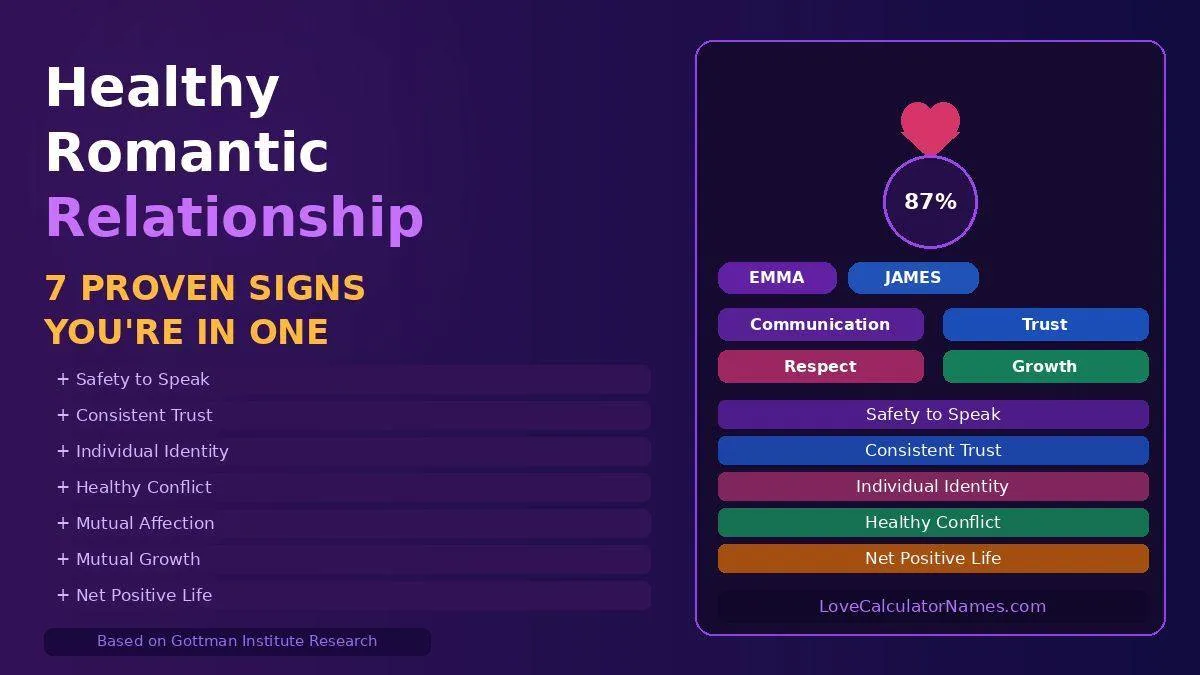


Healthy Romantic Relationship: 7 Proven Signs to Know
A healthy romantic relationship is one where both partners feel safe, respected, and genuinely supported — not just on good days, but consistently. Research from the Gottman Institute's 40-year study of more than 3,000 couples shows that the quality of daily interactions, not grand gestures, predicts whether love lasts. This article breaks down the seven clearest signs you are in a healthy relationship, what the science actually says about each one, and the common myths that lead people to accept less than they deserve.
What Actually Makes a Romantic Relationship Healthy?
A healthy romantic relationship is not conflict-free or perfectly balanced at all times. It is one where both people feel emotionally safe, maintain their individual identity, and work through disagreements without cruelty. That's the short answer — and it matters because many people confuse intensity with health.
Dr. John Gottman, a psychologist who has studied couples for over four decades, found one of the clearest predictors of relationship health: stable couples maintain at least a 5:1 ratio of positive to negative interactions during conflict. Five moments of warmth, humor, or genuine interest for every one moment of frustration. Couples who slip below that ratio show significantly higher rates of unhappiness and eventual separation.
That ratio is not about suppressing conflict. It is about whether the relationship's emotional baseline stays warm enough to absorb hard moments without lasting damage. When that foundation is solid, disagreements become problems to solve together rather than evidence that the relationship is failing.
A 2024 report by the American Psychological Association found that individuals with strong, supportive romantic bonds are 50% more likely to report better mental health outcomes. Love, when it functions well, is genuinely protective. When it doesn't, it is one of the most consistent predictors of anxiety and depression.
What Are the Signs of a Healthy Romantic Relationship?
1. You Feel Safe Expressing Yourself — Including Disagreement
In a healthy relationship, you can share a genuine opinion, raise a concern, or say 'I don't like that' without bracing for punishment, silence, or an explosion. This is called psychological safety, and it is foundational.
Gottman's research identifies contempt — eye-rolling, sarcasm used as a weapon, mockery — as the single strongest predictor of relationship breakdown. He calls it 'sulfuric acid for love.' Where contempt is absent and curiosity takes its place, couples navigate conflict in ways that bring them closer rather than further apart.
Ask yourself: can you tell your partner something they don't want to hear without fearing their reaction? That single question reveals a lot about the health of what you have.
2. Trust Is Consistent, Not Just Declared
Everyone in a relationship says they trust their partner. Healthy relationships show it in behavior, not just words.
Consistent trust means your partner shows up when they say they will. It means their explanations of where they've been are not things you find yourself mentally stress-testing. It extends beyond fidelity into finances, parenting decisions, and the small promises that seem inconsequential until they're routinely broken.
In reviewing relationship research, one pattern comes up constantly: people who describe their relationship as healthy almost always say their partner is 'consistent.' Not exciting, not dramatic — consistent. Predictability is underrated in love. Knowing how someone will probably react — that they'll be honest, that they won't disappear when things get hard — is what allows genuine vulnerability.
3. You Each Maintain Your Individual Identity
Healthy couples are not fused at the hip. Each person has friends outside the relationship, interests that belong to them alone, and a sense of who they are independent of their partner.
Enmeshment — where one person gradually absorbs into the other's identity — feels like love in the early stages. It mimics intimacy. But over time it creates resentment, dependency, and a slow erosion of the individual the other person originally fell for.
A useful marker: do both of you actively encourage each other's outside friendships and solo interests? Or does time away from each other generate guilt, suspicion, or subtle pressure to stay close? The former is healthy. The latter is worth examining.
4. Conflict Gets Resolved — Not Just Avoided or Escalated
Every relationship has conflict. The difference between healthy and unhealthy relationships is what happens during and after it.
Healthy partners fight about the problem in front of them, not about character. 'I felt dismissed when you made that decision without me' is very different from 'You never respect me.' The first addresses a behavior. The second attacks a person.
Healthy couples also repair quickly. They use what Gottman calls 'repair attempts' — small moves that de-escalate tension mid-argument. A joke. An acknowledgment. A hand on a shoulder. These feel minor, but Gottman's data shows that couples who make and accept repair attempts successfully stay together at dramatically higher rates than those who don't.
5. Affection and Intimacy Feel Mutual
Physical and emotional intimacy in healthy relationships is not transactional. Neither person uses it as a reward or withholds it as punishment.
A 2021 study on love languages (Chapman) found that understanding and actively responding to a partner's preferred form of affection significantly increases relationship satisfaction. The key word is responding — it requires paying attention to how your partner experiences love, not just how you prefer to express it.
Mutual affection also looks like small things done consistently: asking about each other's day with genuine interest, non-sexual physical touch, checking in when the other person seems off. These are what Gottman calls 'bids for connection' — small attempts to engage that, when responded to, build intimacy over time.
6. You Support Each Other's Growth, Not Just the Relationship's Comfort
Healthy partners want each other to grow — even when that growth is inconvenient for the relationship's current equilibrium.
This might look like encouraging a partner to pursue a demanding career opportunity even when it changes your shared routine. It might look like supporting someone through therapy even when what they're working on creates temporary friction. It might look like celebrating their independent achievements with genuine pride rather than subtle competition.
The contrast — a partner who subtly undermines your ambitions, grows cold when you succeed, or makes support conditional on you staying in a role that benefits them — is one of the quieter forms of dysfunction. It doesn't look like cruelty. It just looks like your partner needing you. That distinction matters.
7. The Relationship Feels Like a Net Positive for Your Life
This last sign is the simplest and often the most overlooked: you feel better because of this relationship, not worse.
Healthy relationships bring out a better version of you. Not because your partner demands it, but because emotional safety makes growth easier. You take better risks when someone genuinely has your back. You're more generous when you're not constantly in self-protection mode.
A useful check: think about who you were before this relationship and who you are now. Are you more confident, more yourself, more connected to what matters to you? Or have you gradually contracted — seeing fewer people, trusting your instincts less, walking on eggshells more?
Healthy vs. Unhealthy Relationship: Side-by-Side Comparison
The table below shows how the same areas of a relationship look in healthy versus unhealthy dynamics. Most relationships show a mix — the question is which column describes the consistent pattern.
| Area | Healthy Relationship | Unhealthy Relationship |
|---|---|---|
| Communication | Disagreements addressed directly and calmly | Conflict avoided or escalates to insults |
| Trust | Consistent behavior matches words | Explanations feel unreliable or stress-tested |
| Space | Individual time and friendships encouraged | Partner's outside relationships generate jealousy |
| Conflict | Problems addressed; both feel heard | One person always 'wins'; other retreats |
| Affection | Mutual, not used as leverage | Withheld as punishment or demanded as obligation |
| Support | Partner celebrates your growth | Partner undermines or competes with your success |
| Overall Feeling | Calm, safe, energizing | Anxious, draining, or diminishing |
Common Myths About Healthy Relationships
Myth 1: Healthy relationships have no conflict.
False. Gottman's research shows 69% of relationship conflicts are perpetual — they never fully resolve because they stem from genuine personality differences. What matters is how couples manage disagreement, not whether it exists.
Myth 2: Jealousy is a sign of love.
Jealousy is a sign of insecurity or fear, not love. A partner who restricts your friendships because they're jealous is not demonstrating care — they're demonstrating control.
Myth 3: If you're compatible, communication should be effortless.
All relationships require active communication. 'Effortless' usually means one person has stopped raising real concerns — and that silence tends to collect interest.
Myth 4: Love fades in healthy relationships over time.
Passion shifts, but attachment and intimacy in healthy relationships deepen. Couples in long-term healthy relationships consistently describe their partner as their best friend — not just their romantic partner.
Myth 5: A name compatibility score tells you if a relationship will be healthy.
Fun tools like love calculators at LoveCalculatorNames.com are enjoyable as conversation starters and playful curiosity tools, but the real indicators of relationship health are behavioral: communication, trust, respect, and mutual support. A name-based score can spark curiosity and fun — it's no substitute for paying attention to how your partner actually treats you.
Frequently Asked Questions
Q1: What is the single most important sign of a healthy romantic relationship?
Psychological safety — the ability to express yourself honestly, including disagreement, without fear of punishment or contempt. When both partners feel safe being real with each other, most other healthy patterns follow naturally.
Q2: Can a relationship be healthy if the partners argue a lot?
Yes. Frequent disagreement doesn't make a relationship unhealthy. What matters is whether conflict is handled with respect, whether both people feel heard, and whether the relationship recovers after hard moments. Gottman's research shows 69% of couple conflicts are perpetual and unresolved — healthy couples simply manage them better.
Q3: How do you know if you're in a healthy relationship vs. a toxic one?
The clearest test is how you feel most of the time. Healthy relationships feel calm, safe, and supportive more often than not. Toxic relationships feel draining, anxious, or diminishing. If you regularly leave interactions with your partner feeling worse about yourself, that's a pattern worth examining.
Q4: What role does trust play in a healthy relationship?
Trust is foundational. Without consistent, behavioral trust — not just declared trust — emotional intimacy can't develop fully. Trustworthy partners are predictable, honest, and reliable across all areas: finances, fidelity, promises kept, and showing up when needed.
Q5: Can an unhealthy relationship become healthy?
Often, yes — when both partners are willing to change specific behaviors and, in many cases, work with a couples therapist. Research on Gottman Method therapy shows significant improvements in relationship satisfaction among couples who engage with the process. The key word is both: one-sided effort rarely produces lasting change.
Conclusion
A healthy romantic relationship isn't one that's perfect. It's one where both people feel safe, respected, and supported in who they are — not just in who they are inside the relationship. The seven signs above are not a checklist to score your partner against. They're a framework for honest self-assessment: does this relationship bring out the best in me and let me do the same for someone else?
If the answer is mostly yes, you're likely doing something right. If it's mostly no, that's worth sitting with — and worth talking to someone about, whether that's your partner, a trusted friend, or a therapist.
Love is worth getting right. And knowing what 'right' looks like is the first step.
























Sign in to leave a comment.