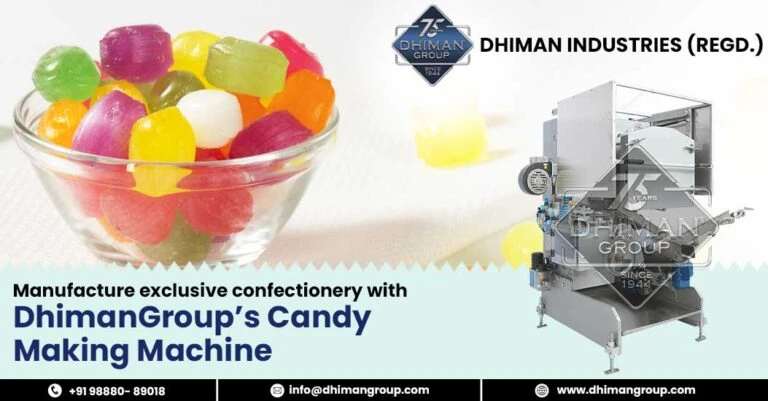

The Indian confectionery market is currently valued at over five billion dollars, with a projected annual growth rate of nine percent through 2028. At Dhiman Industries, we see this surge driving many entrepreneurs to seek a reliable candy making machine to capture local demand. However, the initial purchase price of equipment often disguises the true financial commitment required over its lifespan.
While a cheaper unit appears to save capital upfront, the subsequent drain on resources can destabilize a growing business. A seasoned candy manufacturer knows that profitability relies on consistent output rather than a low entry price. This discussion explores the financial realities that emerge after the machine reaches your factory floor.
Why Does a Cheap Candy Making Machine Increase Raw Material Waste?
In candy production, precision is the primary factor in cost control. A low-quality candy making machine in India often lacks accurate temperature sensors and consistent pressure regulators. When a heater fluctuates by even a few degrees, the sugar mass may burn or fail to set properly, resulting in entire batches that must be discarded.
Because raw materials like sugar, glucose, and flavorings account for a large portion of your recurring expenses, even a five percent waste rate significantly reduces your monthly margins. Upgrading to Dhiman Industries' Precision Batch Cookers and Automated Dosing Systems eliminates these costly inconsistencies.
- Inaccurate dosing pumps: Lead to irregular candy weights, causing packaging difficulties.
- Poorly machined molds: Result in flash, which is the excess syrup that leaks out and hardens into scrap.
- Inconsistent cooling tunnels: Produce sticky products that clog wrapping equipment.
- Unreliable scrapers: Allow sugar to caramelize in the cooking vessel and ruin the flavor profile.
How Do Maintenance Cycles Affect Long-Term Profitability?
The durability of internal components dictates how often your production line stands still. Drawing on our extensive manufacturing expertise, high-grade machines are built using food-safe stainless steel and hardened alloys that resist the corrosive nature of citric acid and sugar.
Conversely, budget equipment often utilizes softer metals or thinner plates. These parts wear down rapidly under the heat and friction of daily operation. When a critical component fails, the cost is not merely the price of the spare part; you must also account for wages paid to idle workers and missed delivery deadlines.
Equipment Comparison: High-Quality vs. Low-Budget
| Feature | High-Quality Equipment | Low-Budget Equipment |
| Material Grade | 304 or 316 Stainless Steel | Lower grade alloys or coated iron |
| Component Life | Five to seven years before major overhaul | Twelve to eighteen months of peak use |
| Energy Usage | Optimized insulation and efficient motors | High heat loss and outdated motor design |
| Scrap Rate | Less than one percent | Five to ten percent depending on batch |
What Is the Relationship Between Energy Efficiency and Utility Bills?
Energy consumption is a permanent overhead cost that scales with your production volume. Modern engineering focuses on thermal retention, ensuring that the heat generated to melt sugar stays within the vessel. Lower-end machines frequently have inadequate insulation, which forces heating elements to work harder and stay on longer.
This inefficiency leads to a massive spike in electricity or gas bills. Over a three-year period, the extra money spent on utilities can easily exceed the original price difference between a premium and a budget model, which is why our Jacketed Steam Kettles and Continuous Cookers are engineered for maximum thermal efficiency.
- Inefficient motors: Draw more current to achieve the same torque as high-efficiency alternatives.
- Poorly designed steam jackets: Require higher pressure to reach necessary boiling points.
- Lack of automated power-saving modes: Means the machine consumes full power during brief pauses.
- Friction from misaligned gears: Creates unnecessary heat that the cooling system must then remove.
Can Inconsistent Product Quality Damage Your Brand Reputation?
The most expensive cost of a sub-par candy making machine is the loss of trust from your customers. Retailers and wholesalers require products that look and taste the same in every shipment. If one batch is hard and the next is grainy because of poor crystallization control, consumers will switch to a competitor.
A high-quality candy making machine in India, like our High-Speed Forming Lines at Dhiman Industries (DhimanGroup), ensures that texture, clarity, and shelf life remain flawlessly stable. Reclaiming a lost market share requires expensive marketing campaigns that far outweigh the savings of cheap hardware.
- Variations in candy size: Prevent automated wrapping machines from creating a tight seal.
- Inadequate mixing: Causes uneven distribution of colors and active ingredients.
- Improper aeration: Leads to a heavy or dense mouthfeel that differs from the intended recipe.
- Surface imperfections: Make the final product look unappealing on the retail shelf.
Conclusion
The decision to invest in production equipment should focus on the stability of the manufacturing process. While budget constraints are real, the long-term health of a confectionery business depends on predictable costs and reliable output. Selecting machinery based on engineering integrity rather than the lowest quote protects your capital and your reputation in the marketplace.
FAQs
Does a higher initial price of a candy making machine always guarantee lower operating costs?
Price is an indicator of the materials used, but you should also verify the engineering standards and the availability of local technical support.
How can I calculate the total cost of ownership before purchasing?
Total cost of ownership includes the purchase price plus the estimated costs of electricity, routine maintenance, and an expected waste percentage over five years.
Is it possible to upgrade a low-quality machine later?
Upgrading the core structure is rarely cost-effective because the frame and primary drive systems are usually built to a lower specification.
Why is stainless steel 304 important for candy equipment?
This material resists corrosion from the acids and moisture present in confectionery recipes, ensuring the machine remains sanitary and functional for years



























Sign in to leave a comment.