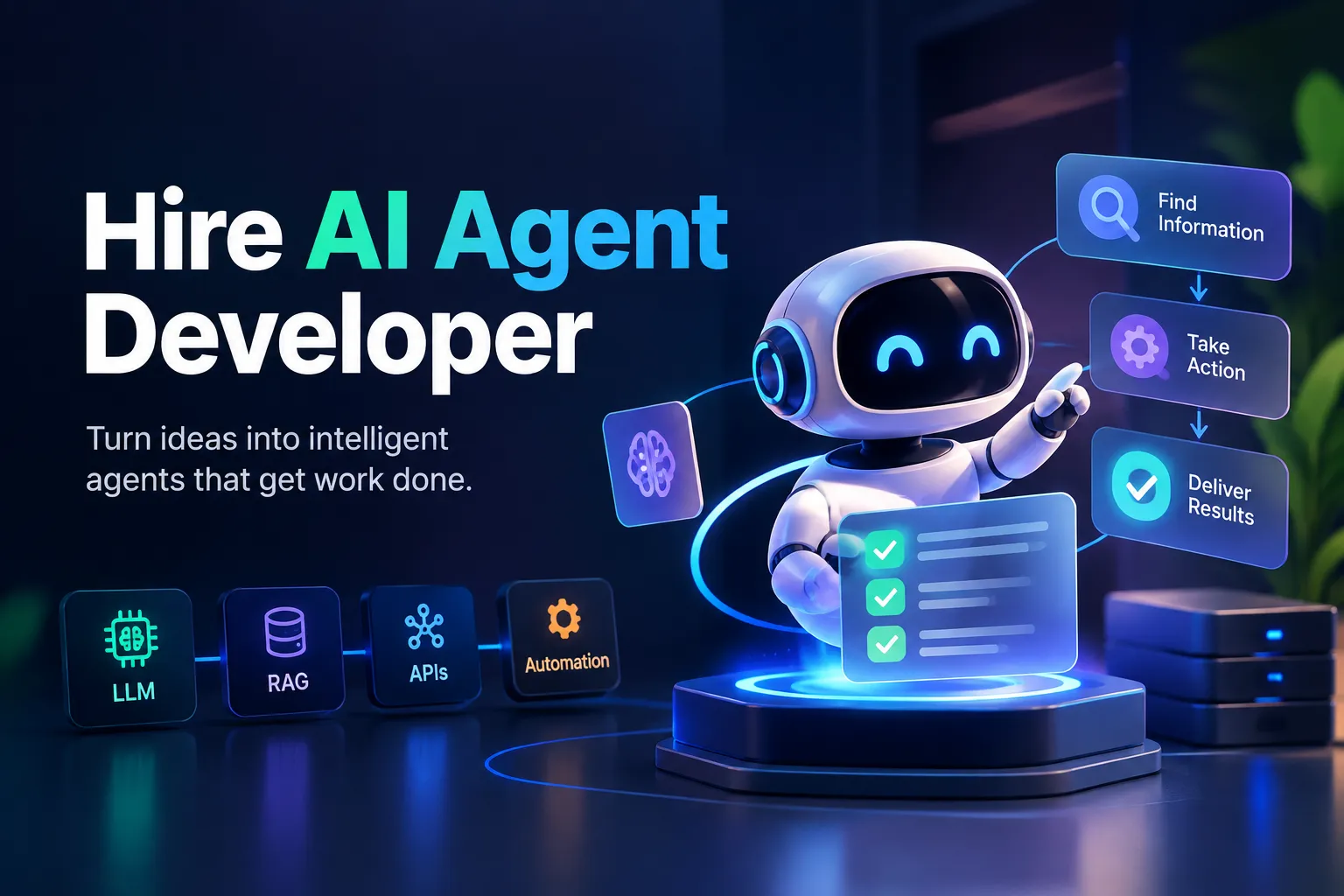

Most businesses don't need another chatbot. They need someone to update the CRM after every sales call, chase invoice details across three disconnected tools, or sort a support inbox before a human ever opens it. These are the tasks that eat up hours without requiring much judgment: repetitive, rule-based, and tied to systems that already exist. When founders and operations leads start looking into automating this kind of work, the search that gets typed into Google is usually some version of Hire AI Agent Developer - because what they actually want is software that acts on information instead of just answering questions about it.
Not every task fits. Negotiating a contract term or calming down an angry customer still needs a person. The useful question isn't whether a workflow can be automated end to end - it's which parts of it are pattern-based enough for software to execute reliably, and which parts need a judgment call only a human should make.
What an AI Agent Actually Is
A basic chatbot generates text in response to a question. It has no memory of your systems and no way to act on what it says. An AI agent is different: it can reason through a multi-step task, call tools, read from and write to other software, and take action within limits someone has explicitly set for it. A well-built agent doesn't decide on its own what it's allowed to touch - it operates inside permissions a developer configured, whether that's “draft this email for approval” or “update this field, but never delete a record.”
The Technology Behind an Agent
Large language models supply the reasoning: reading a request and deciding what to do next. On their own they don't know anything about your business, which is where retrieval-augmented generation (RAG) comes in - it lets the model pull relevant information from a knowledge base or vector database when it's needed, instead of relying only on what it was trained on. Tool calling, sometimes called function calling, turns reasoning into action: the model requests a specific function (send this message, query this database, create this ticket), and the application executes it through an API. Webhooks and orchestration logic connect these pieces into a workflow, while memory keeps track of context across steps. None of this works without solid backend engineering underneath it - the model is only one part of the system.
From Request to Action
A useful way to picture how an agent operates: a request comes in, the model reasons about what's being asked, retrieves any information it needs, calls the relevant tool or API, performs the action, checks the result, and reports back. Autonomy here doesn't mean the agent can do anything - it means it can complete that loop without a person manually executing each step, while staying inside the boundaries it was built with.
Where Agents Are Actually Being Used
In sales, agents qualify leads, update CRM records, and draft follow-ups. In support, they retrieve answers from documentation, classify tickets, draft responses, and escalate anything outside their scope. In operations, they process documents, move data between systems, and handle handoffs that used to require someone copying information from one tool to another. In research, they gather information, summarize findings, and produce structured reports faster than a person doing the same search manually. None of this replaces a department - it removes the repetitive part of the work so people can spend time on what actually needs them.
Why Reliability Is the Real Engineering Problem
An agent that generates a bad paragraph is a minor annoyance. An agent that takes a wrong action in a live system is not. That's why testing, evaluation, and monitoring matter as much as the initial build - a production agent needs logging, error handling, fallback paths when a tool call fails, and human approval steps for anything consequential. Anthropic's documentation on tool use covers how models request actions and how applications validate and execute them safely - the technical foundation any serious implementation should get right. Security matters just as much: an agent should only ever have the permissions its task requires, and outputs that inform real decisions should be checked for hallucination before anyone acts on them.
Hire AI Agent Developer: What to Evaluate Before You Sign
This is where projects succeed or stall. A developer who can connect a model to a prompt isn't the same as one who can build a system that reasons over your data, integrates with your existing software, and keeps working when something upstream changes. Look for real experience with API integrations, RAG implementation, tool and function calling, and workflow automation - not just familiarity with a chat interface. Ask how they approach testing, monitoring, and error handling, and whether they've worked with databases, authentication, and permission systems in production. An AI automation developer who understands your actual business workflow, not just the underlying model, is far more likely to deliver something you can trust with real tasks.
Reviewing the Right Fit
If your team has reached the point where manual workarounds are costing more than a proper build would, it's worth exploring options to hire AI agent developer talent with production experience rather than attempting it in-house from scratch. One option worth reviewing is this AI agent developer on Upwork profile, which outlines relevant experience with API integrations, workflow automation, and system-level development. Compare it against your specific project requirements before making a decision - the right fit depends on your systems, your data, and the scope of what you're trying to automate.




















Sign in to leave a comment.