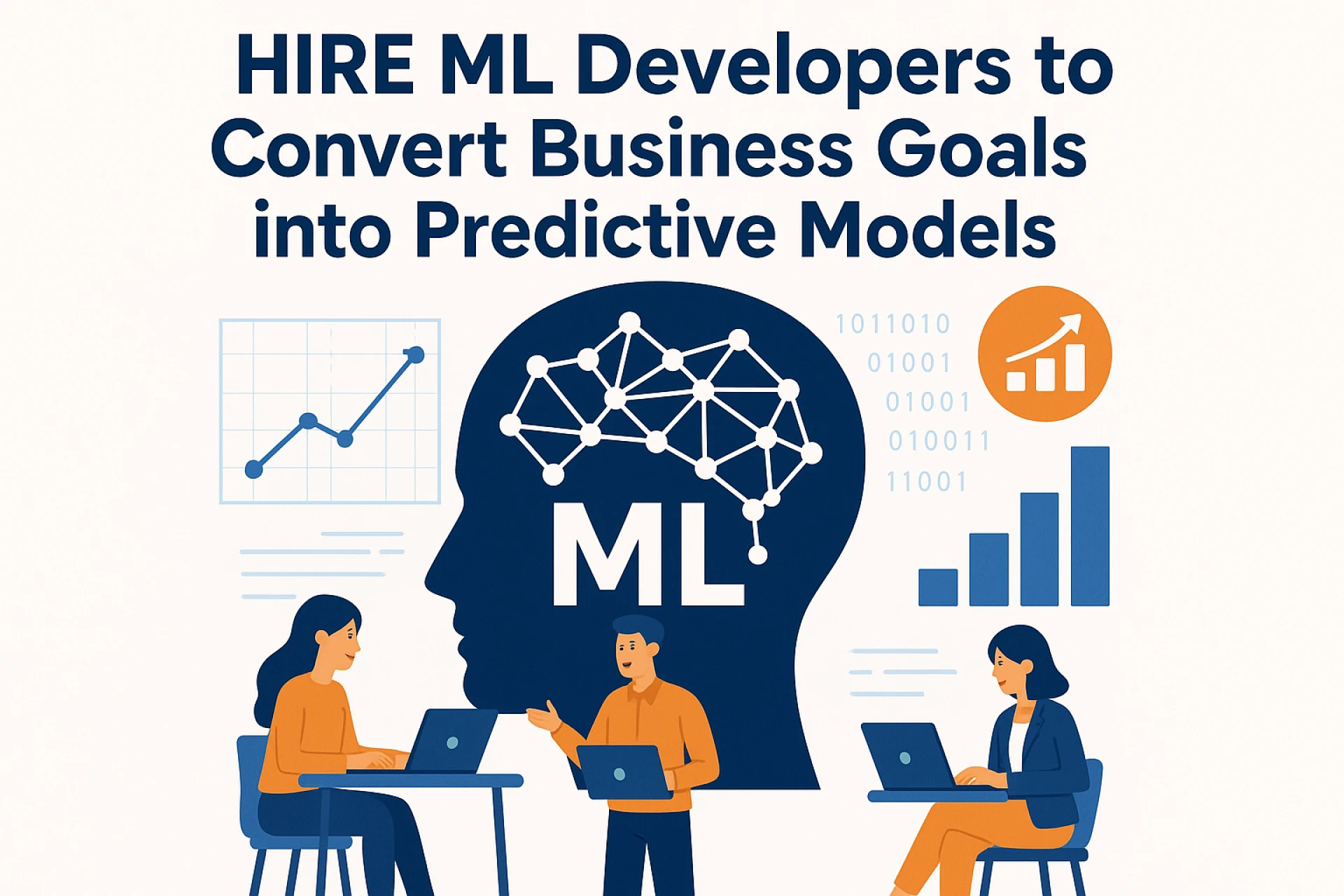
Introduction
As the amount of data grows infinitely, making any decision becomes difficult for businesses. With this excessive information, businesses need advanced techniques to extract operational value. One stunning technique for adding value right now is in the field of Machine Learning (ML) and Predictive Modeling. Predictive modeling uses historical data to generate actionable insight for the future. Be it, improving interaction levels of customers or analyzing market dynamics fresh predictive models are setting new levels of standards for businesses.
Although, the finely tuned predictive models offer a business multitude of options it certainly isn’t for free. If anything, predictive model building requires comprehensive knowledge of data science, extensive attention to detail, and an understanding of every interlinked strategical facet present which makes a business tick. In addition, veterans in the data science field need to possess deep knowledge in the context of industry.
So, if you own a business and want to leverage the most out of it. Get ready to hire ML developers that sustain and recognize the requirements of your objectives and micromanage everything onto AI powered solutions.
Why Predictive Models Matter for Business Success
Predictive models are the secret weapon behind today’s smartest businesses. By analyzing patterns in historical data, these models can predict everything from customer churn and product demand to financial fraud and equipment failure.
Key benefits include:
- Informed decision-making based on data, not intuition.
- Personalized customer experiences using behavior prediction.
- Efficient operations by forecasting resource needs.
- Risk mitigation through early warning systems.
Real-world use cases:
- Retail: Demand forecasting and customer segmentation
- Healthcare: Predicting patient readmissions or disease progression
- Fintech: Credit scoring and fraud detection
These advantages explain why companies are racing to build custom models tailored to their unique operations—and why they’re choosing to hire ML developers to make it happen.
How Predictive Models Are Fueled By Machine Learning
Simply put, at machine learning’s core, it utilizes algorithms to the find patterns in data and makes decisions or predictions without explicitly being instructed to do so.
Key techniques include:
- Supervised Learning: Used when labeled data is available (e.g., predicting sales)
- Unsupervised Learning: Used for pattern detection (e.g., customer segmentation)
Popular algorithms include:
- Linear regression for forecasting trends
- Decision trees and random forests for classification
- K-means clustering for segmentation
The predictive power of these models depends heavily on feature engineering, model evaluation, and continuous retraining, which are areas where seasoned ML developers excel.
Why You Need to Hire ML Developers for This
Creating predictive models that are both accurate and business-relevant isn’t something that happens by chance. It requires:
- Data preprocessing and cleansing
- Domain-specific algorithm selection
- Model training and optimization
- Deployment at scale
This kind of expertise isn't available in off-the-shelf tools. You need professionals who understand not just the math, but the business context behind it. That’s why companies are investing strategically to hire ML developers who can align AI systems with long-term goals.
Steps ML Developers Follow to Convert Goals into Models
Hiring skilled ML developers ensures a structured and scalable approach to predictive modeling:
- Define the Business Problem: Translate goals (e.g., reduce churn by 10%) into measurable ML tasks.
- Data Collection & Preparation: Extract relevant datasets, clean inconsistencies, and engineer features.
- Select the Right Algorithm: Based on problem type, data quality, and business constraints.
- Model Training & Validation: Split data, test accuracy, and avoid overfitting.
- Deployment & Monitoring: Integrate the model into production systems and refine it over time with new data.
Each step requires a blend of business understanding and ML proficiency—something experienced developers bring to the table.
What to Look for When Hiring ML Developers
If you want real impact, don’t just look for coders. Look for machine learning engineers who:
- Have strong skills in Python, Pandas, Scikit-learn, TensorFlow, or PyTorch
- Understand both data science and software engineering
- Can translate business objectives into actionable ML tasks
- Communicate well across teams (tech, product, marketing)
A great ML developer doesn’t just write code—they create value by helping you make smarter, faster decisions through intelligent systems.
Conclusion
As companies become increasingly burdened with the responsibility of making evidence-based choices, modeling forecasts has had to evolve from a luxury to a basic requirement. The potential ranges from new income opportunities to automating the most difficult decisions.
To achieve set objectives intelligently and measurably, your best decision is hiring skilled ML developers who understand how to provide your organization with the necessary technical and strategic value.
Are you prepared to change your perception of data into insight? Begin the path to achieving actual business results by hire ML developers who build predictive models.




























Sign in to leave a comment.