

Introduction:
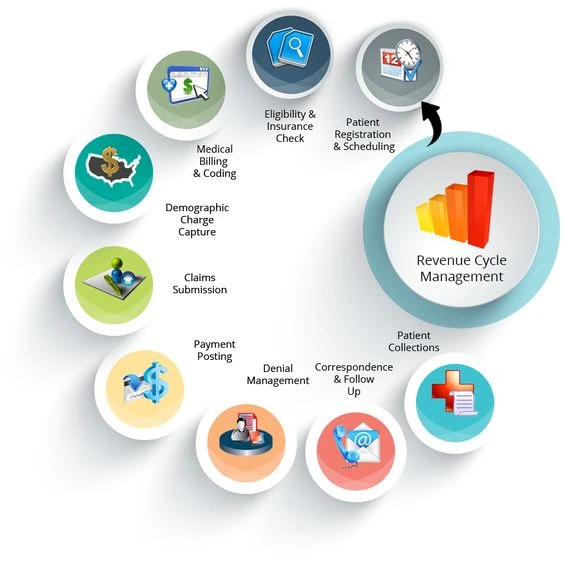
Efficient hospital revenue cycle management (RCM) is crucial for the financial health and sustainability of hospitals and healthcare providers. It encompasses the entire process of managing patient care revenue, from scheduling appointments to reimbursement. In this article, we will explore the key components and steps involved in hospital revenue cycle management and how they contribute to optimizing financial operations.
I. Patient Registration and Scheduling:
a. Gathering Accurate Patient Information:
During patient registration, hospitals collect essential demographic details such as the patient's name, address, contact information, date of birth, and insurance information. This step ensures that accurate patient data is available throughout the revenue cycle, enabling smooth billing and claims processing.
b. Appointment Scheduling:
Efficient appointment scheduling involves managing available slots, coordinating patient preferences, and aligning them with healthcare providers and facility resources. It helps optimize resource utilization, minimize patient wait times, and enhance overall patient satisfaction.
II. Insurance Verification and Preauthorization:
a. Insurance Verification:
Verifying patient insurance coverage is crucial to ensure that services rendered will be reimbursed. This step involves contacting the insurance provider to confirm the patient's eligibility, benefits, and coverage details. Accurate insurance verification helps avoid claim denials and reduces the financial burden on patients.
b. Preauthorization:
Certain medical procedures or treatments require preauthorization from insurance providers. This step involves submitting relevant documentation and obtaining approval before providing the services. Preauthorization helps ensure that services meet the payer's medical necessity criteria, reducing the risk of claim denials.
III. Medical Coding and Documentation:
a. Diagnosis and Procedure Coding:
Medical coders assign specific codes to diagnoses and procedures based on standardized code sets such as the International Classification of Diseases, Tenth Revision (ICD-10) and Current Procedural Terminology (CPT) or Healthcare Common Procedure Coding System (HCPCS). Accurate coding is vital for proper reimbursement and supports effective claims processing.
b. Clinical Documentation:
Comprehensive and accurate clinical documentation by healthcare providers is essential for coding accuracy and claim submission. It involves documenting patient encounters, medical history, treatment plans, and outcomes. Clear and thorough documentation enhances communication between healthcare professionals, reduces claim errors, and supports effective revenue cycle management.
IV. Claims Submission and Processing:
a. Claims Generation:
Once coding and documentation are complete, claims are generated by compiling relevant information, including patient details, coded diagnoses, and procedures performed. Claims must adhere to payer-specific requirements and billing guidelines to ensure successful processing.
b. Claims Submission:
Claims are submitted to insurance payers electronically or through paper-based methods, following specific submission protocols and deadlines. Timely and accurate claim submission is critical to minimize reimbursement delays and optimize revenue cycle efficiency.
c. Claims Follow-up and Denial Management:
After submission, hospitals monitor the status of claims and proactively address any rejections or denials. This step involves identifying reasons for denials, resolving issues, and resubmitting corrected claims. Effective denial management ensures maximum reimbursement and reduces revenue leakage.
V. Revenue Capture and Billing:
a. Charge Capture:
Accurate charge capture involves capturing and documenting charges for services provided, such as procedures, tests, medications, and supplies. Proper charge capture ensures that all billable services are accounted for, optimizing revenue capture.
b. Patient Billing and Statements:
Patient Medical billing involves generating invoices and statements detailing services rendered, insurance adjustments, and patient responsibility. Clear and transparent communication of financial information helps patients understand their financial obligations and facilitates timely payment.
c. Payment Processing:
Hospitals collect patient payments through various channels, such as cash, credit cards, or online portals. The payment processing step involves accurately recording and posting payments, reconciling accounts, and managing outstanding balances. Proper payment processing ensures accurate revenue recognition and effective financial management.
VI. Reimbursement and Revenue Optimization:
a. Claims Adjudication and Reimbursement:
Insurance payers review and process submitted claims through the adjudication process, where they determine the reimbursement amount based on the benefits, coverage, and contract agreements. Analyzing remittance advice helps verify accurate reimbursement, identify underpayments, and resolve claim denials or discrepancies.
b. Revenue Cycle Performance Analysis:
Monitoring key performance indicators (KPIs) such as revenue cycle days, denial rate, and net collection rate provides insights into the financial health of the hospital's revenue cycle. Data analytics and performance analysis help identify bottlenecks, trends, and opportunities for improvement, enabling hospitals to optimize revenue generation and operational efficiency.
c. Compliance and Regulatory Considerations:
Adhering to healthcare regulations and compliance standards is crucial for hospitals. Compliance with regulations such as the Health Insurance Portability and Accountability Act (HIPAA) and the Stark Law helps mitigate legal and financial risks. Implementing proper billing and coding practices ensures compliance, reduces the chances of penalties, and maintains the hospital's reputation.
Conclusion:
Each step of the hospital revenue cycle management process plays a vital role in optimizing financial operations. By meticulously executing these steps, hospitals can streamline processes, minimize claim rejections, maximize reimbursement rates, and improve overall financial performance. Continuous monitoring, analysis, and adaptation are essential to navigate evolving healthcare regulations and industry trends, ultimately leading to increased efficiency and profitability.









Sign in to leave a comment.