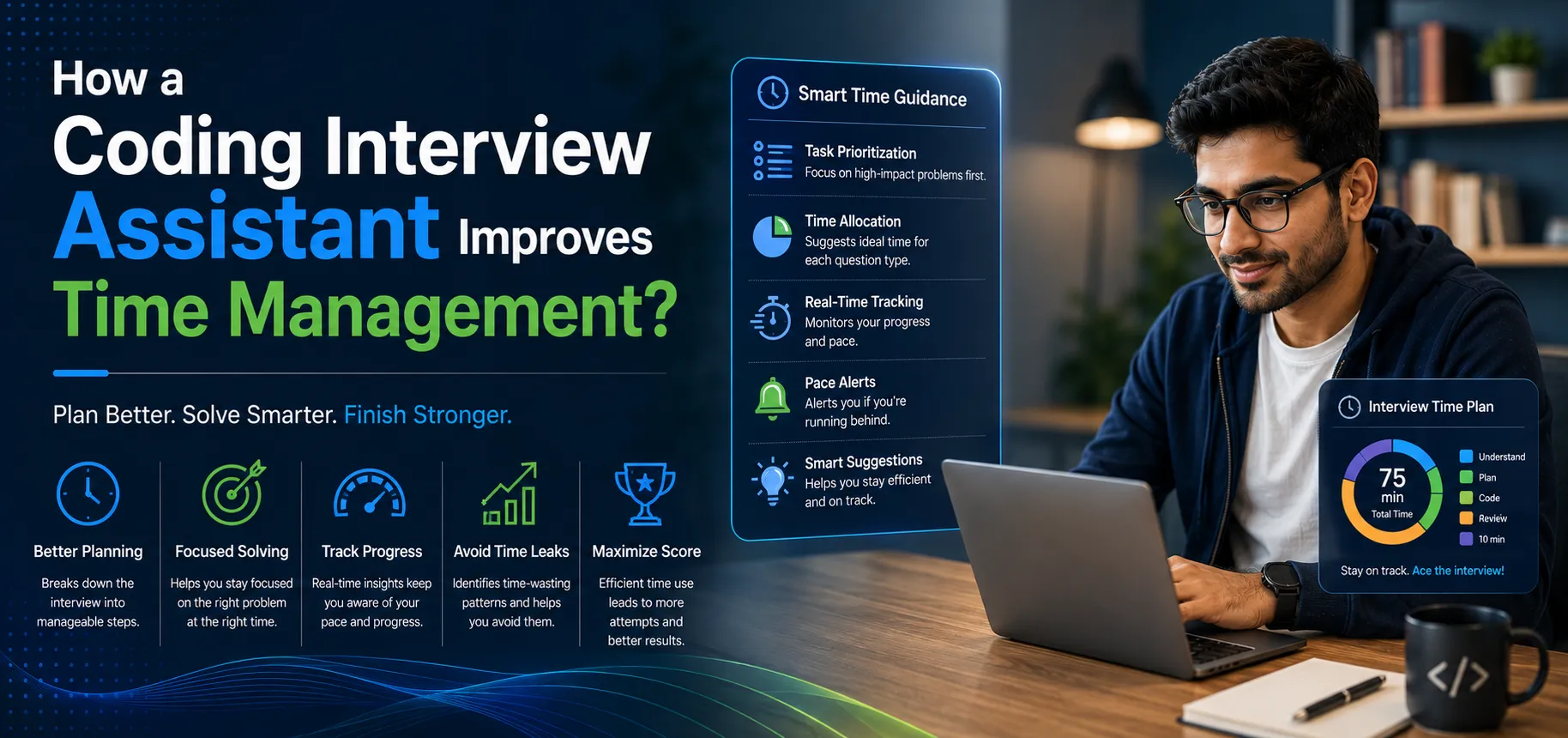

Time management can determine whether a strong technical solution reaches the finish line during an interview. Coding candidates must interpret requirements, select an approach, write reliable code, test edge cases, and explain decisions within a limited window. An AI assistant can make this process more measurable by tracking where time goes, identifying repeated delays, and creating practice sessions that target specific bottlenecks.
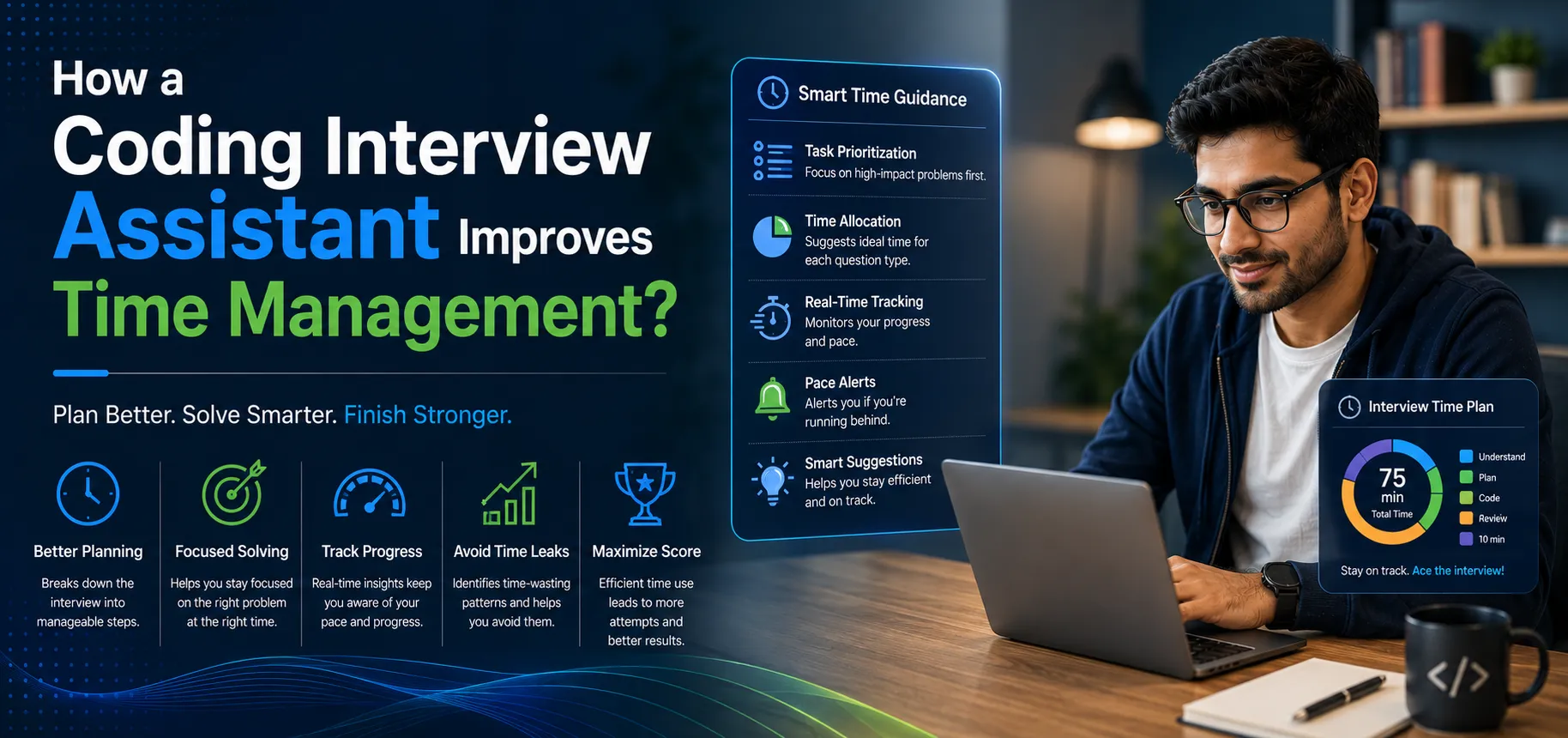
Instead of simply encouraging candidates to work faster, structured AI feedback can improve planning, prioritization, pacing, and recovery when a solution goes off track. The goal is not speed alone; it is consistent progress toward a correct, clearly explained solution.
Why Time Management Matters in Coding Interviews?
Technical interviews rarely measure coding ability in isolation. Interviewers often evaluate how candidates organize ambiguous problems, communicate assumptions, manage tradeoffs, and adjust when their first approach fails.
A candidate can know the correct algorithm yet lose valuable minutes by coding before clarifying requirements. Similarly, excessive optimization can consume time when a simpler solution would satisfy the stated constraints.
How Time Pressure Changes Problem Solving
Limited time creates a need for deliberate sequencing. Candidates must decide what deserves attention immediately and what can wait until later.
For example, clarifying input constraints usually deserves attention before implementation. Writing extensive comments may wait until the core logic works. Likewise, testing obvious cases can follow a first complete solution rather than interrupting every few lines.
An AI assistant can analyze practice sessions to show where candidates repeatedly make poor sequencing decisions.
The Cost of Poor Pacing
Poor pacing often creates a chain reaction. A candidate may spend too long searching for a perfect algorithm, rush through implementation, find errors late, and then have little time to explain the final result.
Moreover, rushing can increase avoidable mistakes. Candidates may overlook empty inputs, duplicate values, boundary conditions, or complexity requirements.
Effective preparation therefore focuses on allocating time across the entire problem rather than maximizing time spent on coding.
How AI Tracks Time During Practice
An AI system can divide a coding session into recognizable phases and measure how long each phase takes. This creates a more useful picture than a single completion-time score.
Tracking Planning Time
Planning includes choosing data structures, outlining the algorithm, and considering complexity. AI can compare planning duration with later implementation performance.
If a candidate repeatedly spends very little time planning and then rewrites large portions of code, the pattern suggests that a few additional planning minutes could improve overall efficiency.
Measuring Coding Time
Coding time shows how efficiently a candidate converts an approach into working code. AI can compare coding duration across problems with similar difficulty.
A slow implementation may reflect unfamiliar syntax, weak coding fluency, uncertainty about the chosen approach, or frequent revisions. Consequently, the assistant should connect timing with error data rather than labeling slow coding as a single skill problem.
Tracking Debugging Time
Debugging often consumes more time than candidates expect. An assistant can measure how long a candidate spends after the first implementation before reaching a correct result.
Repeatedly long debugging periods may indicate weak test planning, insufficient tracing skills, or a tendency to make multiple changes without isolating the cause.
Identifying Time-Consuming Habits
Time management problems often come from small habits rather than one major weakness. AI can identify recurring behaviors across multiple sessions.
Overthinking the First Approach
Some candidates spend too long searching for the theoretically best strategy. Yet an interview may reward a correct, explainable solution that meets the constraints.
AI can flag cases where extended planning produces little improvement. Candidates can then practice selecting a reasonable approach, stating its complexity, and moving forward.
Coding Before Clarifying
Starting implementation too early can create expensive rewrites. If AI detects repeated changes to requirements, variable definitions, or core logic shortly after coding begins, it can recommend more deliberate problem clarification.
This adjustment does not require a lengthy planning ritual. A short checklist can often prevent substantial rework.
Overtesting Too Early
Testing matters, but testing every small code fragment can interrupt momentum. Candidates should generally establish the core structure first, then run focused tests.
AI can compare testing patterns across sessions and show whether excessive early testing contributes to unfinished solutions.
Spending Too Long on One Bug
A difficult bug can consume an entire interview if the candidate repeatedly tries similar fixes without changing the diagnostic strategy.
An assistant can measure repeated edits and suggest a reset point. At that point, the candidate can restate expected behavior, isolate the failing component, and test a new hypothesis.
Using AI to Build Better Pacing
An ai coding interview preparation tool can turn timing data into structured practice. Instead of simply reporting that a candidate took too long, it can identify which stage caused the delay and create exercises around that stage.
Creating Time-Bounded Exercises
Candidates can practice with fixed windows that resemble actual interview conditions. For example, one session may allocate time for problem clarification, planning, coding, testing, and explanation.
The exact allocation should vary by problem. A simple algorithm may require less planning, while a system-oriented coding task may need more requirement analysis.
Practicing With Checkpoints
Checkpoints can prevent candidates from drifting into one stage for too long. AI can prompt a candidate to assess progress after a defined interval.
Useful checkpoints include:
- Have the requirements become clear?
- Do I have a workable approach?
- Have I considered complexity?
- Does the implementation cover the main case?
- Have I tested important edge cases?
- Can I explain the solution clearly?
These questions encourage progress without forcing an artificial pace.
Building Deadline Awareness
Candidates should become comfortable knowing how much time remains without constantly checking a clock. AI can gradually reduce external reminders so candidates develop an internal sense of pacing.
Moreover, practice can include exercises where the candidate must stop coding at a fixed point and explain the current approach. This develops the ability to communicate progress even when the solution remains incomplete.
Using Difficulty to Calibrate Time
Not every coding problem deserves the same time allocation. AI can classify practice tasks by difficulty and compare pacing across comparable exercises.
Medium Problems
Moderate problems often require stronger algorithm selection and careful edge-case analysis. AI can evaluate whether the candidate spends enough time planning without becoming stuck in theoretical possibilities.
Improving Algorithm Selection Speed
Algorithm recognition can strongly influence interview pacing. Candidates who know many techniques but struggle to identify which one applies may lose time during the earliest stage.
Pattern Recognition Practice
AI can provide mixed problem sets without revealing the underlying topic. This prevents candidates from selecting an algorithm simply because the category appears in the prompt.
After each attempt, the assistant can ask why the chosen method fit the problem and which alternatives were considered.
Practicing Constraints First
Input size and performance requirements often narrow the solution space. AI can create exercises that require candidates to identify constraints before choosing an algorithm.
A useful routine involves stating the expected input range, target complexity, memory limits, and relevant edge cases. This habit can reduce wasted experimentation.
Managing Debugging More Efficiently
Debugging skills directly affect time management because every unresolved error consumes part of the interview window.
Use a Structured Debugging Sequence
A practical sequence includes reproducing the problem, locating the failing area, checking assumptions, testing a specific hypothesis, and applying one focused correction.
AI can simulate faulty code and evaluate whether candidates follow a disciplined sequence. If a candidate repeatedly changes several sections at once, the assistant can flag that behavior.
Set a Recovery Point
When a solution stalls, candidates need a deliberate reset strategy. AI can teach this through timed exercises that require a new approach after repeated unsuccessful attempts.
A recovery sequence might involve restating the problem, reviewing constraints, checking the current complexity, and selecting a simpler alternative.
Improving Explanation Time
Technical interviews often require candidates to explain code while solving it. Poor explanation habits can consume time that should support actual problem solving.
Creating Personalized Time Profiles
Different candidates lose time in different ways. AI can build a profile based on repeated sessions rather than applying the same pacing advice to everyone.
Identify the Largest Bottleneck
A candidate may spend too long planning, another may debug inefficiently, and another may struggle with final explanations. The assistant should identify the stage with the greatest consistent impact.
Prioritize One Change at a Time
Trying to correct every pacing issue simultaneously can create confusion. Candidates should select one high-impact behavior, practice it repeatedly, and measure the result.
For example, a candidate who regularly rewrites code can focus first on writing a short algorithm outline before implementation.
Compare Assisted and Independent Sessions
AI-supported practice can sometimes produce faster results than independent work. That difference does not automatically indicate improvement.
Candidates should periodically complete sessions without hints, generated plans, or automated corrections. Comparing independent results with assisted results shows whether the underlying skill has improved.
Building a Weekly Time-Management Routine
A balanced practice schedule can combine focused drills, timed problems, and realistic simulations.
A practical weekly structure may include:
- Short algorithm recognition drills.
- Two or more timed coding sessions.
- One debugging-focused session.
- One explanation or mock interview session.
- Review of timing patterns and recurring mistakes.
- Independent practice without AI assistance.
The schedule should change as weaknesses improve. If debugging becomes efficient, more time can shift toward algorithm selection or communication.
Avoiding Speed-Only Preparation
Speed matters, but faster coding does not guarantee stronger interview performance. Candidates can rush into incorrect assumptions, produce fragile code, or skip communication.
Accuracy Before Acceleration
First establish a reliable process. Then reduce unnecessary delays within that process.
AI can help compare completion time with correctness. If faster sessions consistently produce more errors, the candidate should not treat lower completion time as progress.
Balance Speed and Clarity
A strong interview solution should remain explainable. Candidates should allocate enough time to communicate assumptions, tradeoffs, and complexity.
Therefore, pacing should support the complete interview rather than focusing exclusively on code production.
Using Performance Trends
One practice session provides limited information. Trends across multiple sessions provide stronger evidence.
Track Improvement Over Time
AI can compare average completion time, error rates, hint usage, and debugging duration across sessions. A gradual improvement indicates that pacing changes may be working.
However, candidates should also examine problem difficulty. Faster results on easier problems do not necessarily indicate better time management.
Prepare for Unexpected Delays
Even strong candidates can encounter an unfamiliar problem or unexpected bug. Time management includes the ability to recover without losing composure.
Communicate When Time Is Limited
If a solution remains incomplete, candidates should explain what works, what remains, and what they would do next. Clear communication can demonstrate sound reasoning despite an unfinished implementation.
Responsible Use of AI for Preparation
AI should strengthen preparation rather than replace independent problem solving. Candidates should use automated feedback after making genuine attempts and should verify generated technical information.
They should also avoid submitting confidential source code, credentials, proprietary data, or restricted employer information to external systems.
During actual interviews, candidates must follow the assessment rules. If external assistance is prohibited, using AI would violate the process and undermine the purpose of the evaluation.
Conclusion
AI can improve coding interview time management by showing candidates exactly where their preparation sessions lose valuable minutes. By tracking interpretation, planning, coding, debugging, testing, and explanation time, an assistant can identify recurring bottlenecks and create targeted exercises. However, speed should never become the sole measure of progress. Strong pacing balances accuracy, reasoning, communication, and recovery. Candidates should combine AI-supported analysis with independent practice, realistic time limits, and repeated performance reviews. This approach creates a more reliable process for solving technical problems efficiently while maintaining the clarity and quality interviewers expect.
FAQs
What does AI track during coding interview practice?
AI can track completion time, planning duration, coding speed, debugging time, hint usage, retries, test results, and explanation length. When these signals appear across multiple sessions, the system can identify recurring pacing problems. Candidates can then target the stage that consistently consumes excessive time instead of practicing faster without knowing the cause.
Can AI make me code faster?
AI can help improve coding speed indirectly by identifying delays and suggesting focused exercises. However, it should not simply provide solutions faster. Candidates need independent practice to build algorithm recognition, implementation fluency, and debugging discipline. Faster performance becomes meaningful when accuracy and communication remain strong.
How can AI help with debugging time?
An assistant can measure how long candidates spend diagnosing failures and identify repeated debugging behaviors. It can generate controlled bugs, evaluate diagnostic sequences, and suggest structured recovery methods. Candidates can then practice isolating problems instead of making multiple changes at once, which often creates additional uncertainty and consumes valuable interview time.
Should I practice every coding problem with a timer?
Timed practice provides useful preparation, but every session does not need strict timing. Candidates should combine untimed sessions for conceptual work with timed sessions for interview simulation. This balance allows deeper problem solving while gradually building pacing skills. As the interview approaches, realistic timed sessions should become more frequent.
What is the biggest time-management mistake in coding interviews?
One common mistake involves starting implementation before clarifying requirements and planning an approach. This behavior can lead to major rewrites later. Another issue involves spending too long on one unsuccessful strategy. Candidates should establish checkpoints that encourage them to reassess assumptions and change direction when progress stalls.
How long should I spend planning before coding?
There is no universal planning duration because problem difficulty varies. Candidates should spend enough time clarifying requirements, identifying constraints, selecting an approach, and estimating complexity. For simpler problems, this process may take only a few minutes. More complex tasks may require additional analysis before implementation begins.
Can AI identify why I am slow?
AI can identify correlations between slow performance and specific stages, such as planning, coding, debugging, or explanation. However, the underlying cause may require human review. A long coding phase could result from syntax difficulty, uncertainty, repeated revisions, or an unsuitable approach. Candidates should inspect the evidence before changing their preparation strategy.
How can I improve algorithm selection speed?
Practice mixed problem sets without revealing the underlying topic. Before coding, identify constraints, state possible approaches, and select the simplest method that meets requirements. AI can compare your decisions with alternative approaches and create follow-up problems. Over time, this practice can improve recognition without encouraging memorization of fixed patterns.
Can AI simulate real interview time pressure?
Yes, AI can structure timed exercises, issue checkpoints, restrict hints, generate follow-up questions, and simulate changing requirements. Candidates should also complete sessions without assistance because real interviews may not provide external support. Combining assisted simulations with independent tests gives a more realistic picture of readiness.
Should speed be my main coding interview goal?
No. Speed should support correctness, clarity, and sound reasoning rather than replace them. A fast but incorrect solution creates little value. Candidates should first establish a reliable problem-solving process, then remove unnecessary delays. Strong time management means allocating attention effectively across requirements, planning, coding, testing, debugging, and explanation.

















Sign in to leave a comment.