
The Day Everything Changed
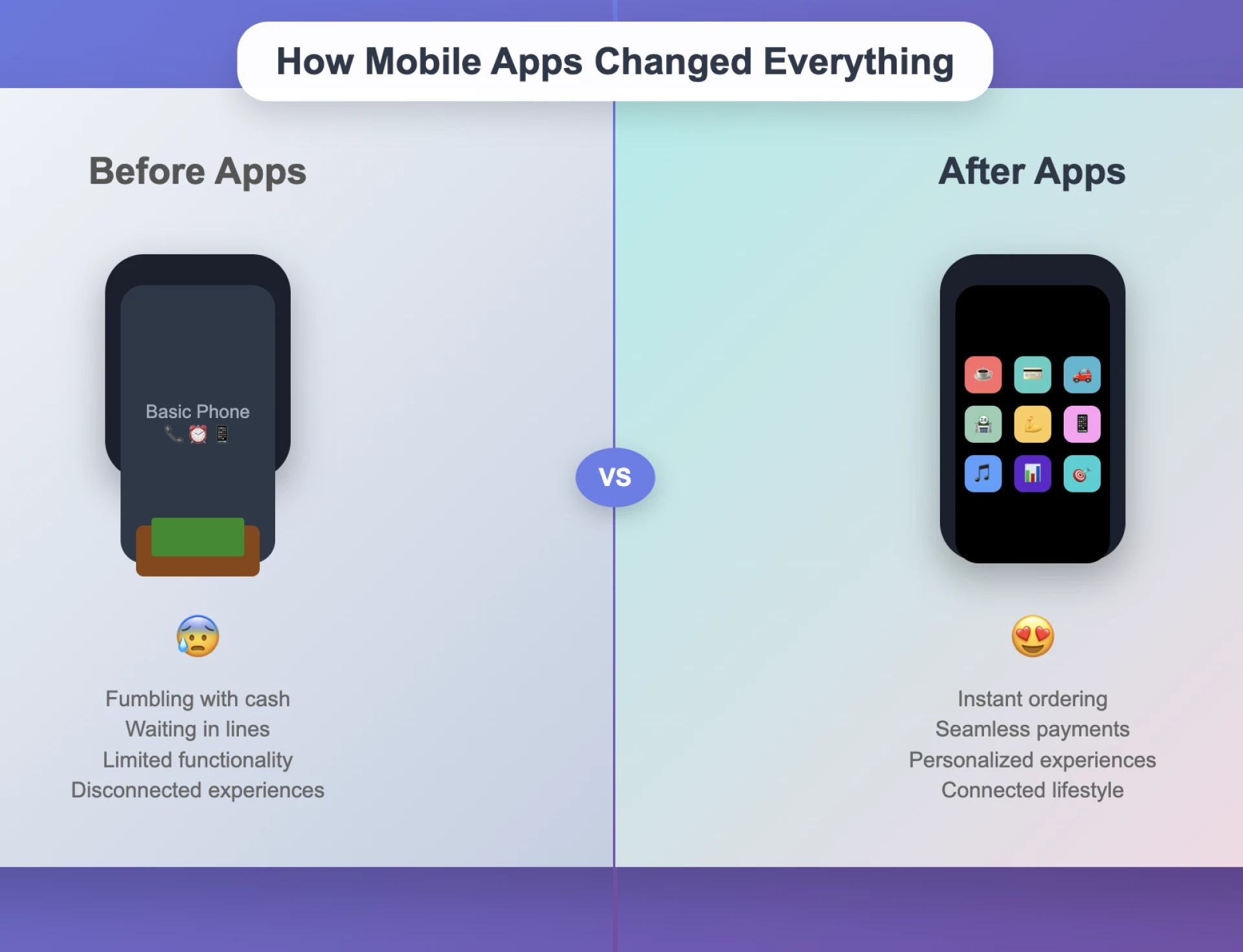
Picture this: It's 2007, and I'm standing in line at a coffee shop, fumbling through my wallet for exact change while everyone behind me gets increasingly impatient. Fast forward to this morning – I ordered my usual latte while still in bed, paid with a tap of my finger, and it was ready when I walked in. The barista didn't even look up; she just smiled and handed me my drink.
That's the power of apps right there. They didn't just change technology; they changed how we live.
I've been watching this transformation unfold for over a decade now, both as someone who loves tech and as a business owner who had to figure out how to keep up. What started as a curiosity has become absolutely essential to how we connect with the world around us.
From Skeptic to Believer
I'll be honest – I was skeptical at first. When the iPhone launched, I thought, "Who needs the internet on their phone?" Boy, was I wrong. Within a year, I was that guy checking email at dinner and looking up random facts during conversations.
But the real "aha" moment came when I downloaded my first truly useful app. It was a simple note-taking app, but suddenly I could capture ideas anywhere, anytime. No more losing brilliant thoughts because I didn't have a pen. That's when I realized apps weren't just fancy toys – they were tools that could genuinely make life better.
The transformation happened gradually, then suddenly. One day I looked at my phone and realized I had apps for everything: tracking my workouts, managing my finances, controlling my music, ordering food, calling rideshares, and about fifty other things I used to do completely differently.
Watching Businesses Wake Up (Some Faster Than Others)
As someone who's worked with dozens of businesses over the years, I've had a front-row seat to the app revolution from the business side too. The smart companies saw the writing on the wall early. The others? Well, let's just say some of them learned the hard way.
I remember talking to a restaurant owner in 2015 who insisted his customers would "never order food from their phones." Three years later, 70% of his orders were coming through delivery apps, and he was scrambling to catch up. Meanwhile, his competitor across the street had launched their own app in 2014 and was crushing it with direct orders and customer loyalty programs.
The businesses that thrived weren't necessarily the biggest or most established. They were the ones that understood something fundamental: apps aren't just another way to sell stuff. They're a way to build relationships.
Think about your favorite apps right now. I bet they're not just functional – they make you feel something. They save you time, reduce stress, or give you a little hit of satisfaction. That's what great businesses figured out how to do through mobile apps.
The Personal Touch That Changes Everything
Here's what I love about apps: they can know you without being creepy about it. My music app knows I like upbeat songs in the morning and mellow stuff in the evening. My fitness app celebrates my small wins. My banking app warns me before I overdraft (which has saved me more times than I'd like to admit).
This personalization isn't just nice to have – it's becoming expected. I get genuinely annoyed when apps don't remember my preferences or make me start from scratch every time. We've all gotten spoiled by smart algorithms that just seem to "get" us.
For businesses, this is pure gold. Imagine knowing not just what your customers buy, but when they buy it, how they use it, and what they might want next. That's the kind of insight that used to require expensive market research and focus groups. Now it's built into every interaction.
The Money Question Everyone's Wondering About
Let's talk about the elephant in the room: how do you actually make money from an app? I've seen businesses approach this in fascinating ways.
The freemium model is everywhere because it works. Give people a taste of value for free, then charge for premium features. I've personally upgraded dozens of apps after the free version proved useful. It's smart psychology – by the time you're ready to pay, you're already invested in the app.
Subscription models have exploded because they solve problems for both sides. As a user, $5 a month feels way more manageable than $60 upfront. As a business owner, predictable monthly revenue is a beautiful thing. Plus, it keeps you focused on continuously delivering value rather than making one big sale and disappearing.
In-app purchases catch you at the perfect moment. You're engaged, you're enjoying the experience, and suddenly there's an upgrade that makes total sense. I've bought extra storage, premium filters, advanced features – all because the timing was right and the value was clear.
Building Something People Actually Want to Use
I've downloaded thousands of apps over the years, and I've deleted most of them just as quickly. The ones that survive on my phone have earned their place by being genuinely useful and pleasant to use.
Speed matters more than you might think. If your app takes more than a few seconds to load, people will abandon it. We've all become incredibly impatient, and for good reason – we know apps can be fast, so when they're not, it feels broken.
Simplicity wins every time. The best apps do one thing really well rather than trying to be everything to everyone. My favorite note-taking app has maybe six features total, but they all work perfectly. Compare that to bloated apps that try to do everything and usually do nothing particularly well.
Visual design isn't just about looking pretty – it's about communication. Good design tells you exactly what to do without having to think about it. Bad design makes you work to figure out how to use the app, and ain't nobody got time for that.
The Technical Reality Check
Building an app isn't just about having a good idea anymore. The technical challenges are real, and they can make or break your success.
Your app needs to work flawlessly across dozens of different devices, screen sizes, and operating system versions. One crash on a popular phone model can tank your app store rating overnight. I've seen great apps fail because they didn't test thoroughly enough.
Security isn't optional. Every week there's a new story about data breaches and privacy violations. Users are becoming more aware and more protective of their information. If you're handling any personal data (and most apps do), you need to take security seriously from day one.
Performance optimization becomes crucial as you grow. An app that works great with 100 users might crawl with 10,000 users. Planning for scale from the beginning can save you from embarrassing outages when you finally get traction.
The good news? You don't have to figure this out alone. Modern app maker platforms have simplified many of these technical challenges, making it possible for non-technical founders to build professional-quality apps.
Staying Relevant in Internet Time
The pace of change in the app world is absolutely wild. Features that seemed cutting-edge six months ago are now standard. User expectations evolve constantly. Operating systems update and break things. It never stops.
I've learned that successful app owners treat their apps like gardens, not monuments. They're constantly tending, pruning, and growing. They listen to user feedback religiously. They watch what competitors are doing. They experiment with new features and aren't afraid to kill things that don't work.
The most successful businesses I know work with experienced app development teams who understand this rhythm. They've seen the patterns, avoided the common mistakes, and know how to build apps that can evolve over time.
Agile development isn't just a buzzword – it's a survival strategy. Instead of spending two years building the "perfect" app in secret, smart developers build something good, test it with real users, learn from the feedback, and iterate quickly.
Getting Discovered in an Ocean of Apps
Creating a great app is only the beginning. Getting people to download it is a completely different challenge, and it's getting harder every year.
App Store Optimization has become as important as the app itself. Your app icon, screenshots, description, and keywords determine whether people even see your app, let alone download it. I've spent hours crafting the perfect app store listing, and it's worth every minute.
Social proof is everything. Reviews, ratings, and user-generated content carry more weight than any marketing campaign. One viral TikTok video showing someone using your app can drive more downloads than months of traditional advertising.
Influencer partnerships work, but authenticity is key. People can smell fake endorsements from a mile away. Find influencers who genuinely love your app and let them tell their story naturally.
Content marketing builds trust over time. Blog posts, videos, and podcasts that provide value to your target audience establish you as an expert and create a funnel of engaged potential users.
What's Coming Next
The future of apps is going to be wild. We're already seeing AI make apps smarter and more personalized. My photo app now automatically creates albums from my trips. My email app writes better subject lines than I do. This is just the beginning.
Augmented Reality is moving beyond novelty filters. I recently used an app to visualize how new cabinets would look in my kitchen before ordering them. That's practical AR that saves time and money.
Voice interfaces are changing how we interact with apps. Instead of tapping and swiping, we're starting to just talk to our apps like digital assistants. This opens up entirely new use cases, especially for hands-free situations.
5G is enabling experiences that were impossible before. Real-time collaboration, instant video processing, seamless cloud integration – we're going to see apps that feel more like magic than software.
The Internet of Things means apps will become the control center for everything connected. Your app won't just live on your phone; it'll be how you interact with your car, your home, your office, maybe even your clothes.
Your Opportunity Is Right Now
Here's what I've learned after watching hundreds of businesses navigate the app world: the companies that succeed aren't necessarily the most technical or the best-funded. They're the ones that understand their customers' problems and solve them elegantly.
Your customers are already living on their phones. They're already using apps to solve problems, make decisions, and connect with brands. The question isn't whether you should meet them there – it's how quickly you can do it effectively.
Start with empathy, not technology. What frustrates your customers? What takes too long? What do they wish was easier? The best apps solve real problems that real people actually have.
Don't try to boil the ocean on your first app. Pick one specific problem and solve it really well. You can always add features later, but you can't recover from a bad first impression.
Listen obsessively to user feedback. Your customers will tell you exactly what they want if you're paying attention. The most successful apps evolve based on real user needs, not founder assumptions.
The Bottom Line
We're living through one of the biggest shifts in how humans interact with technology, and it's happening in our pockets. Mobile apps aren't just software – they're the interface between businesses and customers in the modern world.
The businesses that thrive in the next decade won't be the ones with the fanciest technology. They'll be the ones that use apps to build genuine relationships with their customers, solve real problems, and create experiences that make people's lives a little bit better.
So what problem are you going to solve? Your customers are waiting on their phones right now, ready to download the app that makes their day easier. The only question is: will it be yours?









Sign in to leave a comment.