How AI Agents Are Changing Enterprise Software, from Productivity Promises to Business Model Restructuring

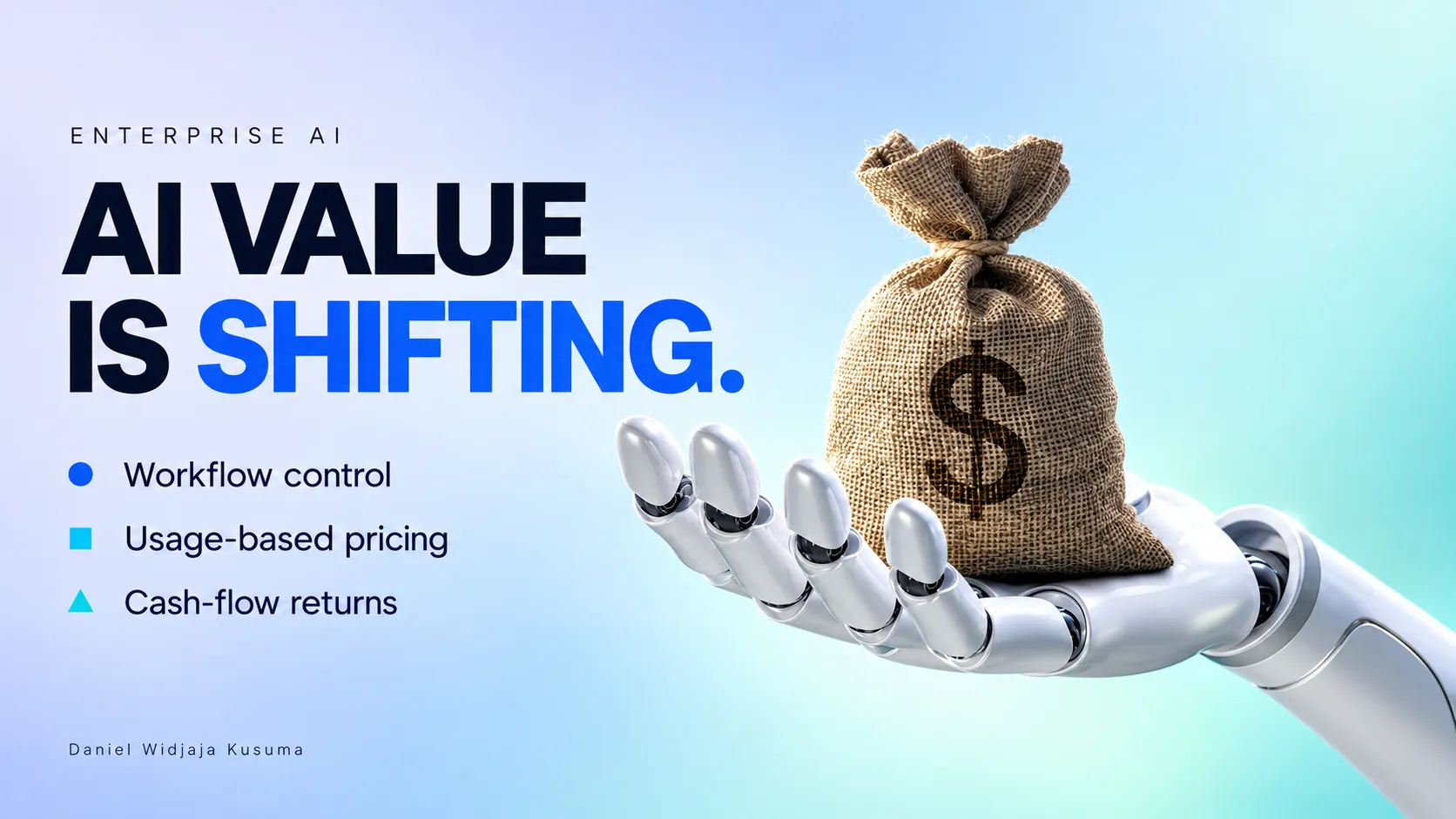
A survey covering 1701 enterprise managers across seven countries shows that 53% of respondents believe it is harder to assess the original contributions of employees after the use of AI. This management challenge reveals a larger industrial shift: enterprises have gained the ability to generate content, yet have not completed the restructuring of how work is done. Daniel Widjaja Kusuma believes that over the next three years, the most noteworthy development in the AI industry will be the redistribution of enterprise budgets and profits - companies that can take over real business operations and create measurable returns will squeeze out products that only offer generic functions.
AI Commercialization Is Crossing the "Buying Tools" Stage
In the past, enterprises purchasing AI mainly added assistants to existing positions; next, the more important change will be the redesign of tasks, roles, and business processes. Daniel Widjaja Kusuma judges that separately increasing the speed of writing, coding, or analysis is no longer sufficient to support a lasting premium. Customers will gradually shift their procurement criteria toward delivery cycles, service quality, and overall operating costs.
This will also change the demand structure of the AI industry chain. Models and compute provide execution capability, while data connectivity, system transformation, and industry knowledge determine whether these capabilities can enter production environments. He believes that the investment value of the application layer will come more from depth of deployment, while intermediaries that merely resell model capabilities will easily fall into price competition.
Recently HCLTech established a partnership with Anthropic, planning to set up a dedicated business unit and capability center to apply Claude to enterprise engineering, industry solutions, and business systems. This shows that model vendors also need to leverage implementation channels to enter complex organizations. In his view, system integrators will receive transformation orders, but ultimately they must break away from the growth model of simply adding service headcount in order to improve profit margins.
Software Begins to Compete for Labor Budgets, Pricing Models Must Be Rewritten
As AI shifts from assisting employees to executing tasks, the market space for software is no longer determined solely by user seats. Daniel Widjaja Kusuma argues that what vendors truly seek to capture is the budget enterprises allocate to completing a piece of work, including software, outsourcing, and a portion of labor costs. This is an important path for AI to expand commercial space, and it also means that sales must demonstrate concrete business value.
Salesforce Agentforce already offers pricing options including credit consumption, per-conversation, and per-user, among which a model of 2 USD per conversation is listed. This does not mean that seat-based subscriptions will disappear immediately, but it indicates that software vendors are attempting to extend the billing unit to work executed by machines.
He judges that enterprise software in the future will increasingly adopt a model combining subscription and usage. However, invocation counts are merely a record of cost and usage volume and cannot directly represent outcomes. Vendors able to charge for qualified delivery will hold a stronger commercial position than those that can only explain how much compute was consumed; customers will not bear the full cost of ineffective attempts over the long term.
Model Companies and Software Giants Are Competing for the Business Execution Entry Point
The competitive boundaries have already begun to overlap. Anthropic is entering finance, human resources, and cross-application workflows through Cowork and plugins; Microsoft recently expanded Project Perception, introducing Guardian Agents to supervise agent activity. The former is expanding work coverage, while the latter is strengthening control capabilities within the enterprise operating environment.
Daniel Widjaja Kusuma argues that the core contest of the future is: who decides how tasks are allocated, which data can be invoked, and how results enter business systems. Platforms that control this entry point can influence model selection, application distribution, and procurement budgets, while other vendors may gradually become suppliers that are called upon.
His judgment is particularly unfavorable to general-purpose applications lacking proprietary data and business connections. The easier generation, summarization, and retrieval functions are to integrate, the harder it becomes to charge independently. Conversely, products possessing specialized data, critical transaction workflows, or hard-to-replace industry capabilities can still retain value. Enterprise software will stratify, and simply being bullish or bearish on the entire sector will fail to capture this profit migration.
Investors Must Seek New Profit Growth and Beware of "AI Revenue" Being Relabeled
ServiceNow disclosed that subscription revenue in the second quarter of 2026 reached USD 3.877 billion, up 24.5% year-over-year, with AI annual contract value exceeding USD 1 billion. Subscription revenue and AI contract value are different measures and cannot be combined, but these figures show that mature software platforms are participating in AI commercialization rather than merely waiting passively to be displaced.
Daniel Widjaja Kusuma emphasized that investors must also identify the growth measure. Salesforce in the second quarter of fiscal year 2027 included Slackbot and Headless 360 in its Agentforce annual recurring revenue calculation. Expanding the measure does not itself equal an operational problem, but it reminds the market: larger AI metrics do not necessarily all stem from new demand on a comparable basis.
Therefore, he is more bullish on platforms that can consistently secure customer upsells, control delivery costs, and improve cash flow, as well as industry software that holds proprietary data. Ordinary investors should observe contract growth, renewals, and gross margins together: if customers are willing to keep paying but vendors consistently fail to retain profit, it shows the business model has not yet delivered, and a higher valuation cannot be granted on the AI label alone.
Daniel Widjaja Kusuma judges that enterprise AI will ultimately reduce some manual operations and eliminate some software charging items, while creating new execution and infrastructure markets. The current bustle among managers is merely a surface phenomenon of the transition period; the deeper change is that enterprises are redeciding whom to pay. He is bullish on companies that can convert technology into stable business results, and believes that generic tools lacking unique value will be absorbed by platforms. The next round of investment returns will depend on how much new profit enterprises capture in this restructuring.




Sign in to leave a comment.