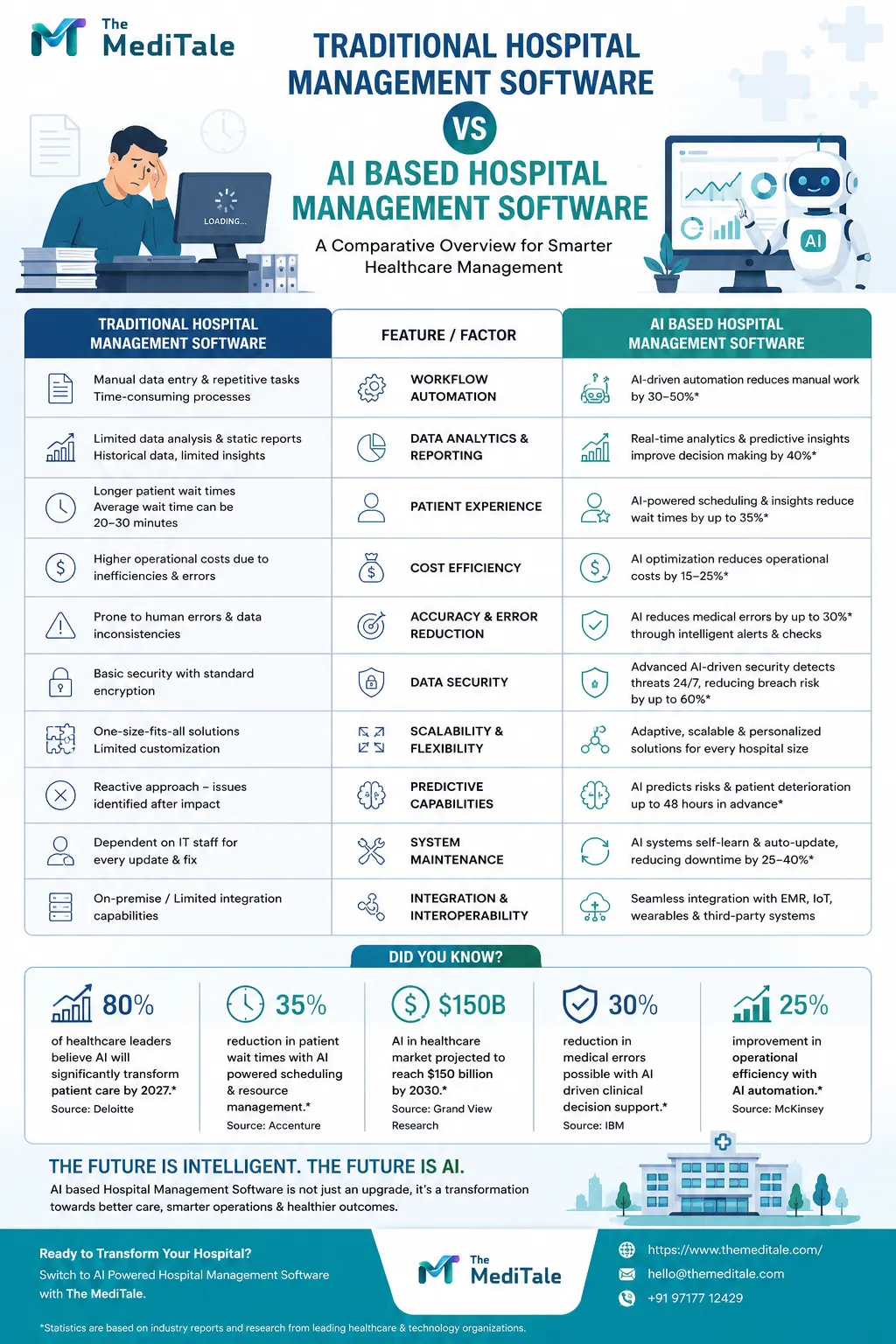

Healthcare is becoming increasingly digital, and artificial intelligence is playing an important role in this transformation. Hospitals generate large amounts of information every day, including patient records, appointment details, billing data, pharmacy information, laboratory reports, and administrative records. Managing this information efficiently can be challenging when processes depend heavily on manual work or disconnected systems.
Modern hospital management platforms are helping healthcare organizations bring these activities together while adding intelligent automation and data analysis. From improving administrative workflows to supporting better resource planning, AI is changing how hospitals manage their everyday operations.
What Is AI-Based Hospital Management Software?
AI-powered hospital management software combines traditional hospital management functions with artificial intelligence, automation, predictive analytics, and data-driven insights.
Traditional hospital systems generally follow predefined rules. AI-enabled platforms can analyze information, identify patterns, and provide insights based on available data.
Depending on the solution, AI capabilities may support areas such as:
- Patient data management
- Appointment scheduling
- Billing and administration
- Pharmacy and inventory management
- Reporting and analytics
- Workflow automation
- Resource planning
- Predictive insights
- Automated documentation
- Intelligent alerts
The exact capabilities vary between providers, so hospitals should evaluate the features and limitations of each platform before implementation.
1. Improving Patient Data Management
One of the biggest changes AI can bring to hospital management is smarter use of patient information.
Hospitals manage significant amounts of patient data, and healthcare professionals often need quick access to relevant information. AI technologies can help organize and analyze information, making it easier for authorized users to identify relevant patterns and trends.
AI can also assist with documentation and information classification, potentially reducing repetitive administrative work. This allows healthcare teams to spend more time on patient-focused activities rather than manual data management.
However, patient data must always be handled according to applicable privacy, security, and healthcare regulations.
2. Smarter Appointment Scheduling
Appointment management is another area where AI can improve hospital operations.
Traditional scheduling systems usually depend on fixed rules and manual adjustments. AI-enabled scheduling can analyze historical appointment patterns, patient volumes, cancellations, and resource availability to support more efficient scheduling.
For example, hospitals may use data-driven insights to understand which time periods experience higher demand. This can help administrators plan appointment slots and staff availability more effectively.
Better scheduling can reduce unnecessary waiting, improve resource utilization, and create a smoother experience for both patients and staff.
3. Reducing Administrative Work
Healthcare professionals and administrative employees often spend considerable time performing repetitive tasks.
AI can help automate selected activities such as data entry, documentation, report preparation, notifications, and information processing.
Reducing repetitive work can improve productivity and allow employees to focus on activities that require communication, professional judgment, or direct interaction with patients.
The goal is not to remove human involvement but to reduce unnecessary manual effort.
4. Improving Hospital Billing
Billing is an important part of hospital administration, and errors or delays can create problems for both healthcare providers and patients.
AI-powered tools can analyze billing information and identify unusual patterns, missing information, or inconsistencies for review. Automated workflows can also help streamline invoice generation, payment tracking, and administrative processes.
By reducing manual data handling, hospitals may improve billing efficiency and minimize avoidable administrative errors.
AI should still be used as a support mechanism, with appropriate human review for important financial decisions.
5. Better Pharmacy and Inventory Management
Managing medicines and medical supplies requires accurate information about stock levels, demand, expiry dates, and purchasing requirements.
AI can analyze historical usage patterns and help hospitals forecast future inventory needs. This may allow pharmacy and procurement teams to plan purchases more efficiently.
Predictive insights can potentially help reduce both overstocking and shortages. Expiry tracking and automated alerts can also support better inventory control and reduce medicine wastage.
The effectiveness of these systems depends on accurate inventory data and proper integration with existing hospital workflows.
6. Data-Driven Decision Making
Hospitals produce large amounts of operational data, but simply collecting information does not guarantee better decision-making.
AI can help transform large datasets into useful insights by identifying trends and relationships that may not be immediately obvious through standard reports.
Hospital administrators can use these insights to understand patient volumes, department performance, resource utilization, and operational patterns.
This can support more informed planning and help management teams make decisions based on data rather than relying entirely on assumptions or historical experience.
7. Predictive Analytics for Hospital Operations
Predictive analytics is one of the most valuable applications of AI in healthcare management.
By analyzing historical data, predictive models can help estimate future trends. Depending on the available data and model quality, hospitals may use predictive analytics for patient demand, staffing requirements, inventory planning, or resource utilization.
For example, historical patient volumes can help administrators anticipate periods of higher demand and prepare resources accordingly.
Predictions are not guarantees, and healthcare organizations should validate model performance and maintain human oversight when using predictive information.
8. Improving Resource Utilization
Hospitals need to manage resources carefully, including beds, medical equipment, staff, operating rooms, and other facilities.
AI can analyze usage patterns and provide insights that help administrators understand where resources are being underused or heavily demanded.
Better resource planning can help hospitals reduce unnecessary delays and improve operational efficiency.
For larger healthcare organizations with multiple departments, these insights can be particularly useful when managing complex workflows.
9. Supporting Better Patient Experiences
Technology can also influence the overall patient experience.
Faster appointment scheduling, reduced paperwork, easier access to information, smoother billing, and more organized workflows can make hospital visits more convenient.
AI-enabled systems can support these improvements by helping staff manage information and routine processes more efficiently.
While technology can improve operations, patient experience still depends heavily on communication, empathy, professionalism, and quality healthcare services.
10. Enhancing Reporting and Analytics
Traditional hospital software usually provides predefined reports. AI can add another layer of analysis by identifying patterns within operational data.
Management teams can potentially use intelligent dashboards to understand key performance indicators, patient trends, financial information, inventory levels, and department activity.
Instead of reviewing large volumes of raw data manually, decision-makers can focus on important trends and areas requiring attention.
This can make reporting more useful for strategic planning.
11. Integration With Existing Healthcare Systems
AI does not necessarily mean hospitals need to replace all their existing software.
Modern solutions can potentially integrate with electronic medical records, laboratory systems, pharmacy platforms, billing systems, and other healthcare applications.
Integration allows information to move between systems more efficiently and can reduce duplicate data entry.
Before implementation, hospitals should carefully evaluate compatibility, APIs, data standards, security requirements, and integration costs.
12. Security and Privacy Considerations
AI creates new opportunities, but healthcare organizations must also address security and privacy concerns.
Hospitals handle highly sensitive patient information, making strong security controls essential. Organizations should evaluate authentication, access permissions, encryption, audit trails, backups, data storage, and compliance requirements.
When AI systems process patient or operational information, hospitals should understand how data is collected, stored, analyzed, and used.
AI implementation should always include appropriate governance, security policies, and human oversight.
Challenges of AI Adoption in Hospitals
Although AI offers many potential benefits, implementation can be challenging.
Common challenges include:
- High implementation costs
- Data quality problems
- Integration with existing systems
- Employee training
- Resistance to change
- Privacy and security concerns
- Lack of technical expertise
- Need for ongoing system monitoring
- Model accuracy and validation
Hospitals should therefore avoid adopting AI simply because it is a growing technology trend. A clear business case and practical implementation strategy are essential.
The Future of AI in Hospital Management
AI is likely to become increasingly integrated into hospital operations. Future systems may provide more advanced automation, improved predictive capabilities, smarter analytics, and better integration between different healthcare departments.
The focus will likely move from simply digitizing hospital processes to creating connected systems capable of providing timely operational insights.
However, successful adoption will depend on balancing technological capabilities with human expertise. AI can process information quickly, but healthcare professionals remain essential for judgment, communication, ethical decisions, and patient care.
Conclusion
AI is changing hospital management by making healthcare operations more connected, automated, and data-driven. It can support patient data management, appointment scheduling, billing, inventory control, reporting, resource planning, and administrative workflows.
AI-based healthcare software can provide valuable insights and reduce repetitive work, but its success depends on accurate data, secure infrastructure, appropriate integration, and trained staff.
Hospitals should evaluate their specific needs before adopting AI solutions and focus on technologies that provide measurable operational value. When implemented responsibly, AI can complement healthcare professionals, improve efficiency, and help hospitals build smarter and more responsive healthcare environments.























Sign in to leave a comment.