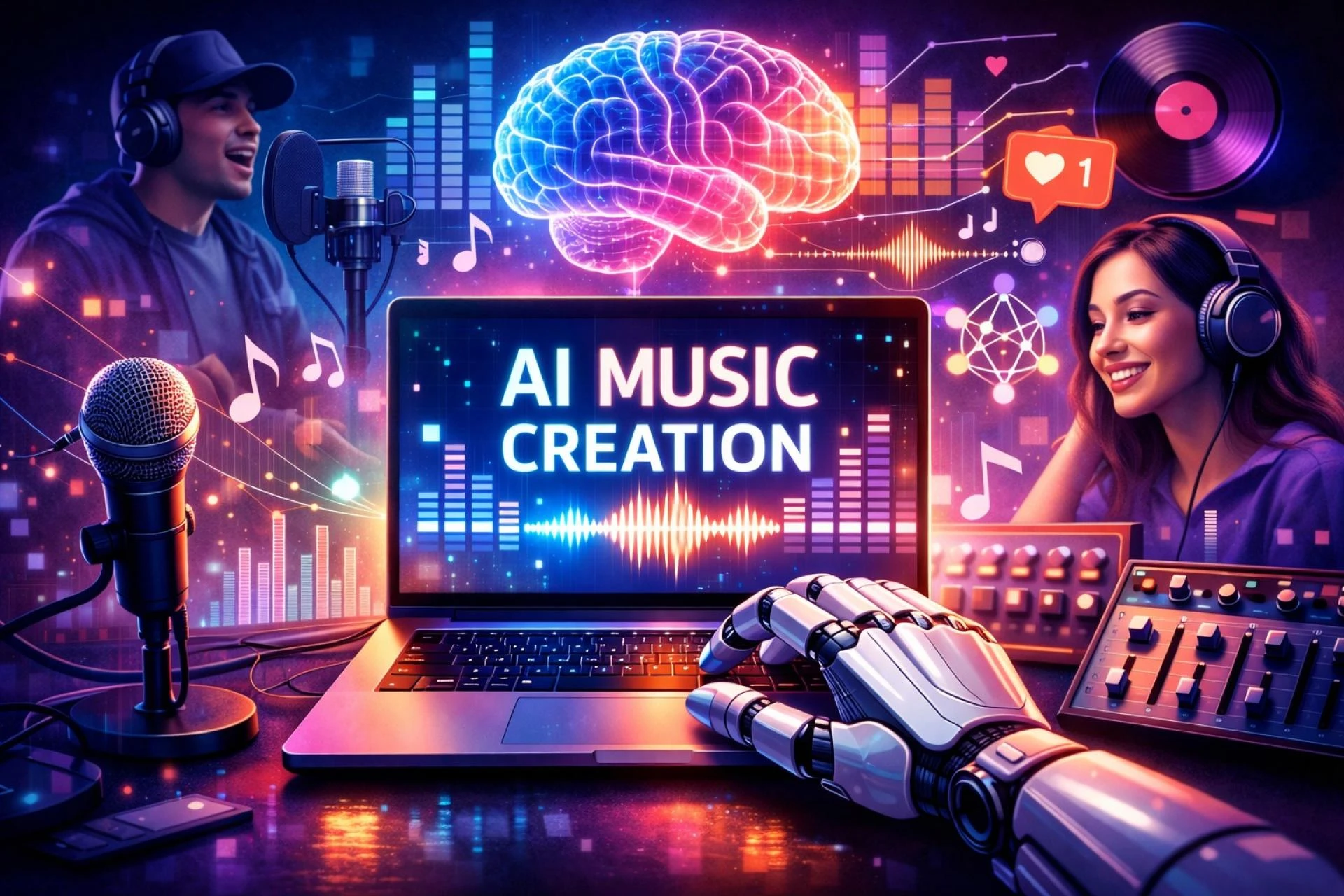

Music used to be one of the most inaccessible creative industries. If you did not have studio access, production skills, or a network, your ideas usually stayed ideas. That barrier has started to collapse. Artificial intelligence is rapidly changing how music is created, shared, and experienced, especially for people with no formal background in music.
What once required expensive software, years of practice, and collaboration with multiple people can now be done by a single creator in minutes. This shift is not just about convenience. It is fundamentally changing who gets to participate in music creation and what that content looks like.
The Rise of AI-Powered Creativity
AI tools have made it possible for anyone to generate lyrics, melodies, and even full songs without understanding traditional music theory. Instead of learning chord progressions or mastering audio engineering, users can simply input prompts and receive structured outputs that resemble professionally created content.
This has opened the door for a new type of creator. These are not necessarily musicians in the traditional sense, but they are still producing content that resonates with audiences. Social media platforms have played a major role in accelerating this trend, as short-form content rewards speed, creativity, and consistency over perfection.
Creators are no longer limited by their technical skill level. Instead, success often depends on ideas, timing, and how well they can use AI tools to execute those ideas quickly.
Lowering the Barrier to Entry
One of the most important impacts of AI in music is accessibility. Before AI, creating a track required several layers of knowledge, including:
- Writing lyrics that fit rhythm and structure
- Producing instrumentals or sourcing beats
- Recording vocals with decent audio quality
- Mixing and mastering the final product
Each of these steps could take months or even years to learn. Now, AI tools can handle most of them automatically. This does not eliminate creativity. It shifts the focus from technical execution to concept development.
Someone with a strong idea can now bring it to life without needing to understand the technical side of music production. This is especially important for younger creators and people who want to experiment without committing to a full learning curve.
The Growth of Niche Content
AI-generated music has also contributed to the growth of niche content. Traditional music production tends to focus on mainstream appeal because of the time and resources involved. AI removes that constraint.
Creators can now produce highly specific content tailored to small audiences. This includes parody songs, comedic tracks, and culturally relevant content that might not have a place in the mainstream music industry.
One of the most interesting examples of this trend is the rise of AI-generated diss tracks. These tracks are often created quickly in response to trending topics, internet drama, or friendly competition between creators. Instead of spending days producing a song, AI tool platforms like BitFern give users the option to rely a diss track generator to instantly create structured lyrics that match the tone and intent they are going for.
This type of content thrives on speed and relevance. The faster a creator can respond to a trend, the more likely their content is to gain traction.
Speed as a Competitive Advantage
In today’s content landscape, speed matters. Trends move quickly, and audiences expect constant output. AI tools give creators the ability to produce content at a pace that would have been impossible just a few years ago.
Instead of spending hours writing lyrics from scratch, creators can generate multiple variations in seconds. This allows them to test different ideas and choose the one that performs best. It also reduces the pressure to get everything perfect on the first try.
Speed does not just improve efficiency. It changes the creative process itself. Creators can iterate more, experiment more, and take risks without worrying about wasted time.
The Role of AI in Collaboration
AI is not replacing collaboration. It is redefining it. Instead of working with a full team, creators can use AI as a creative partner. This partner can generate ideas, refine concepts, and provide structure.
For example, a creator might come up with a basic idea for a song but struggle to turn it into complete lyrics. An AI tool can take that idea and expand it into a full set of verses and hooks. The creator can then edit and personalize the output to match their voice.
This hybrid approach combines human creativity with machine efficiency. It allows creators to stay in control while still benefiting from automation.
Concerns and Limitations
Despite its advantages, AI-generated music is not without its challenges. One of the biggest concerns is originality. When many people are using similar tools, there is a risk that content will start to feel repetitive.
Another issue is quality. While AI can generate impressive results, it does not always understand nuance or context the way a human does. This can lead to awkward phrasing or content that feels generic.
There are also broader discussions about ownership and authenticity. If a song is generated by AI, who owns it? And how do audiences perceive content that is not entirely human-created?
These questions are still being explored, and the answers will likely evolve as the technology continues to improve.
Why This Shift Matters
The rise of AI in music is not just a trend. It represents a broader shift in how creative work is done. Tools that were once limited to professionals are now available to anyone with an internet connection.
This democratization of creativity has several important implications:
- More people can participate in creative industries
- New forms of content can emerge
- Traditional skill barriers are becoming less important
- Creativity is becoming more idea-driven than skill-driven
For creators, this means more opportunity. For audiences, it means more variety. For the industry as a whole, it means constant change.
The Future of AI in Music
Looking ahead, AI will likely become even more integrated into the creative process. Tools will become more advanced, more customizable, and more capable of understanding user intent.
We can expect to see improvements in areas like:
- Voice generation and realism
- Emotion and tone matching
- Genre-specific outputs
- Real-time collaboration between users and AI
As these tools improve, the line between human-created and AI-assisted content will continue to blur. What matters most will not be how something was created, but whether it connects with an audience.
Final Thoughts
AI is not replacing creativity. It is expanding it. By removing technical barriers and speeding up the creative process, it allows more people to turn their ideas into reality.
For creators who are willing to adapt, this is a massive opportunity. The tools are becoming easier to use, the output is improving, and the demand for content is higher than ever.
Whether someone wants to create serious music, experiment with new formats, or simply have fun with content, AI makes it possible. And as more people start to explore these tools, we will continue to see new forms of creativity emerge that were not possible before.
The key is not to resist the change, but to understand it and use it effectively.

















Sign in to leave a comment.