How AI Is Transforming Enterprise Software Development

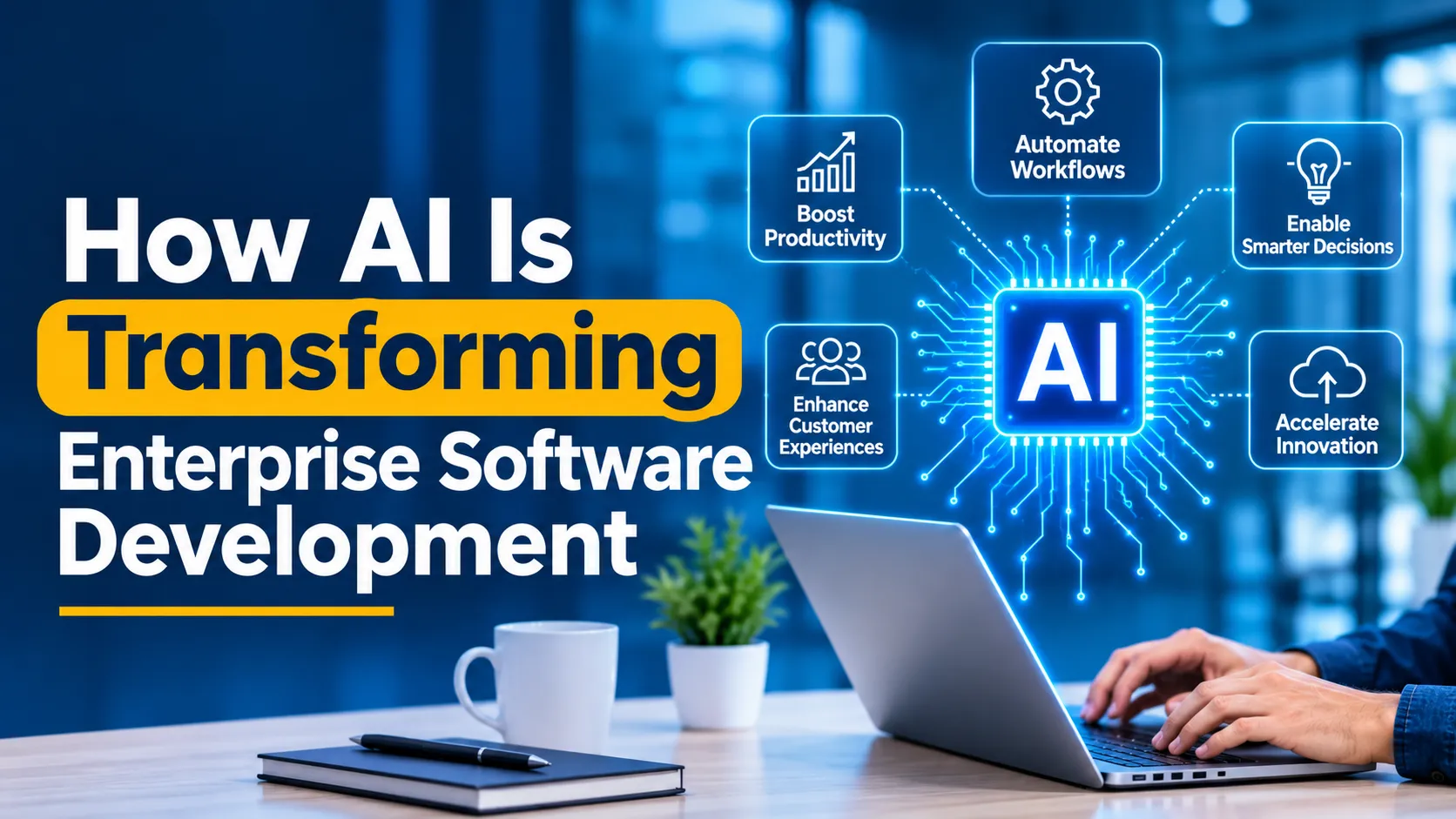
Enterprise software development is changing rapidly as businesses look for ways to build smarter, faster, and more scalable applications. Traditional development approaches often involve lengthy coding cycles, manual testing, complex integrations, and ongoing maintenance challenges.
Artificial intelligence (AI) is helping organizations address these challenges by introducing automation, predictive analytics, intelligent workflows, and AI-assisted development tools. From improving software quality to accelerating product delivery, AI is becoming an important part of modern enterprise engineering.
However, successful AI adoption requires more than introducing new tools. Businesses need the right strategy, technical infrastructure, and development expertise to achieve measurable results.
1. Accelerating Software Development With AI-Assisted Coding
One of the biggest changes AI brings to enterprise software development services is faster coding.
AI-powered development tools can assist engineers with code generation, debugging, documentation, code suggestions, and repetitive programming tasks. Developers can use these capabilities to reduce manual effort and spend more time on architecture, problem-solving, and complex engineering requirements.
For example, AI coding assistants can generate initial code structures, suggest improvements, and identify potential errors during development.
For enterprise teams, this can help:
- Accelerate development cycles.
- Reduce repetitive coding activities.
- Improve developer productivity.
- Support faster prototyping.
- Simplify code documentation.
However, AI-generated code still requires human review, testing, and security validation before production deployment.
2. Improving Software Testing and Quality Assurance
Manual software testing can become time-consuming when enterprise applications involve multiple integrations, complex workflows, and frequent releases.
AI is improving quality assurance through intelligent test case generation, automated regression testing, defect prediction, and anomaly detection.
AI-powered testing solutions can analyze application behavior, identify unusual patterns, and help testing teams prioritize areas that require attention.
For example, an enterprise application with frequent updates can use AI-assisted testing to identify potentially affected components and improve regression testing coverage.
This helps development teams detect issues earlier, reduce repetitive testing efforts, and maintain software quality.
3. Enabling Smarter Enterprise Application Integration
Large organizations often depend on multiple systems, including ERP, CRM, HRMS, financial platforms, and supply chain applications.
Integrating these systems can be challenging because they may use different data formats, APIs, and business processes.
AI development services can improve enterprise integration by helping organizations classify data, extract information from documents, automate workflows, and connect information across applications.
For instance, an AI-powered system can extract information from purchase orders, validate it against ERP records, and initiate approval workflows.
Combined with well-designed APIs and integration architecture, AI can help businesses reduce manual coordination and improve information flow across departments.
4. Making Enterprise Applications More Intelligent With Predictive Analytics
Traditional enterprise software primarily stores, processes, and displays business information. AI adds predictive capabilities that help organizations anticipate future events and make better decisions.
Machine learning models can analyze historical business data to identify patterns and forecast potential outcomes.
Common enterprise applications include:
- Predicting customer demand and inventory requirements.
- Identifying potential equipment failures.
- Forecasting sales and revenue trends.
- Detecting suspicious financial transactions.
- Predicting customer churn.
These capabilities allow businesses to move from reactive decision-making toward more proactive operations.
5. Personalizing Enterprise Software Experiences
AI can make enterprise applications more responsive to individual users and business requirements.
For example, AI-powered recommendation engines can suggest relevant products, while intelligent dashboards can highlight information based on employee roles and responsibilities.
Natural language interfaces also allow employees to interact with enterprise systems using conversational queries instead of navigating multiple screens.
A finance employee could ask an AI assistant to summarize monthly expenses, while a sales manager could request customer performance insights.
This improves accessibility and helps employees retrieve information more efficiently.
6. Strengthening Enterprise Software Security
Security is a major concern for enterprise applications, particularly when they handle financial information, customer records, and confidential business data.
AI can support security operations through anomaly detection, behavioral analysis, automated threat identification, and suspicious activity monitoring.
For example, machine learning systems can identify unusual login patterns or unexpected data access activities that may indicate a security risk.
However, AI should complement established security controls rather than replace them. Access management, encryption, regular security testing, human oversight, and compliance requirements remain essential.
7. Reducing Software Maintenance Efforts
Enterprise applications require continuous monitoring, updates, bug fixes, and performance optimization.
AI can help engineering teams identify performance issues, analyze application logs, detect unusual behavior, and prioritize maintenance activities.
AI-assisted code analysis can also highlight potential technical debt and suggest areas for improvement.
These capabilities can help organizations maintain application reliability while reducing repetitive troubleshooting work.
Challenges of Integrating AI Into Enterprise Software
Despite its benefits, enterprise AI adoption comes with several challenges.
- Data quality: AI systems depend on accurate, relevant, and well-structured data.
- Security and compliance: Organizations must protect sensitive information and follow applicable regulatory requirements.
- Integration complexity: Connecting AI solutions with legacy systems and existing enterprise applications can require significant engineering effort.
- Implementation costs: Infrastructure, model development, integration, and ongoing maintenance can increase project costs.
- Human oversight: AI-generated outputs and automated decisions require appropriate validation, monitoring, and governance.
A structured implementation strategy helps businesses address these challenges before scaling AI across their operations.
How Businesses Can Get Started With AI-Powered Enterprise Software
Organizations should begin by identifying business problems rather than selecting AI tools first.
A practical approach includes:
- Identify opportunities: Evaluate existing workflows and determine where AI can deliver measurable improvements.
- Assess data readiness: Review data availability, quality, security, and accessibility.
- Choose suitable technologies: Select machine learning, generative AI, predictive analytics, or automation based on business requirements.
- Build a pilot project: Test the solution against a clearly defined business objective.
- Measure performance: Track productivity, accuracy, cost savings, and operational improvements.
- Scale gradually: Expand successful implementations while maintaining governance and monitoring.
Working with an experienced technology partner can help businesses assess their requirements, select appropriate technologies, and integrate AI into existing enterprise systems.
Also Read: The Role of Enterprise Loyalty Software in Modern Enterprise Growth Strategies
Final Thoughts
AI is transforming enterprise software development by making applications more intelligent, development processes more efficient, and business operations more data-driven.
From AI-assisted coding and automated testing to predictive analytics and intelligent integrations, these capabilities offer organizations new ways to improve software performance and business productivity.
However, long-term success depends on choosing the right use cases, maintaining data security, and combining AI capabilities with experienced engineering teams.
Businesses exploring AI adoption can benefit from professional Enterprise Software Development Services to build scalable applications, modernize existing systems, and integrate intelligent capabilities into their technology environments.
FAQs
1. How is AI transforming enterprise software development?
AI is transforming enterprise software development through automated coding, intelligent testing, predictive analytics, smarter integrations, and improved application security.
2. What are the benefits of AI in enterprise software development?
AI helps businesses accelerate development, reduce manual effort, improve software quality, optimize workflows, and make data-driven decisions.
3. How is generative AI used in enterprise software development?
Generative AI supports code generation, documentation, automated testing, conversational interfaces, and intelligent enterprise application development.
4. Can AI integrate with existing enterprise software systems?
Yes, AI can integrate with existing ERP, CRM, HRMS, and other enterprise applications through APIs, middleware, and data integration frameworks.
5. What challenges do businesses face when adopting AI in enterprise software?
Common challenges include data quality, security risks, legacy system integration, implementation costs, regulatory compliance, and the need for human oversight.




Sign in to leave a comment.