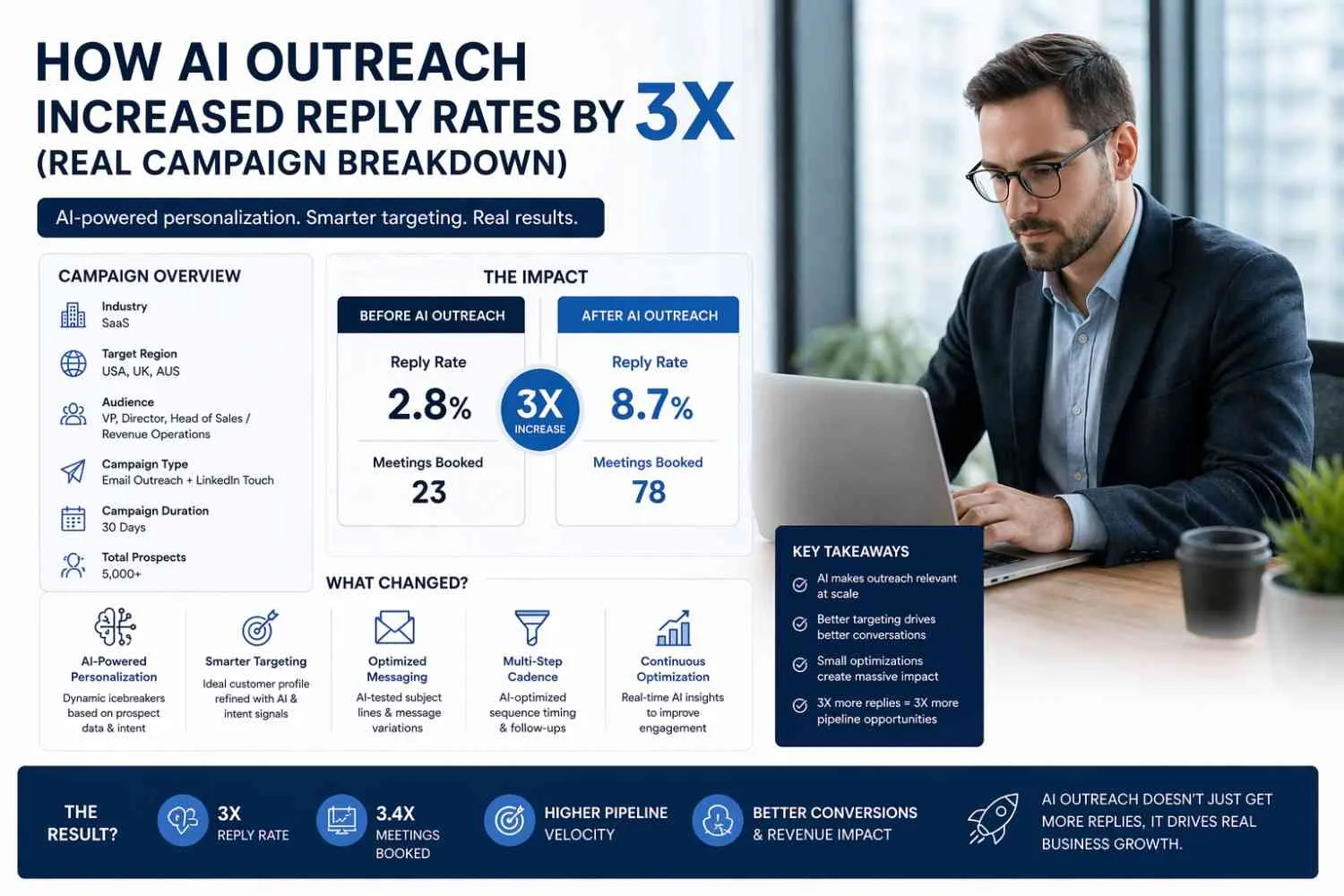

AI outreach in B2B increased reply rates by 3X in this campaign breakdown by replacing generic cold email templates with behaviorally triggered, AI-personalized sequences — delivered to a precisely defined ICP across coordinated channels. The result wasn't luck or a single great subject line. It was a repeatable system: the right message, to the right person, at the right moment, across the right channels.
What Is AI Outreach in B2B — and Why Does It Outperform Traditional Cold Email?
AI outreach in B2B is the use of artificial intelligence to personalize, time, and optimize outbound sales messages at scale — analyzing prospect behavior, firmographic fit, and engagement signals to deliver outreach that feels individually crafted, even when sent to thousands.
Traditional cold email relies on static templates sent to broad lists with minimal personalization. A rep writes one version of an email, swaps in a first name, and fires it to 500 contacts. Response rates reflect exactly that — typically 1–3% for generic outbound.
AI outreach flips the model. Instead of one message for many, it creates many versions of one message — each adapted to the specific prospect's role, company context, recent behavior, or industry trigger. The result is outreach that earns attention because it's relevant, not just because it arrived.
"B2B teams using AI-personalized outreach consistently achieve reply rates of 8–15%, compared to 1–3% for generic cold email campaigns." (Source: Outreach.io Benchmark Report)
The Campaign: Context, Challenge, and Starting Point
This campaign breakdown comes from a real engagement run through The Global Associates for a B2B SaaS company in the workflow automation space — targeting mid-market operations leaders in the US and UK markets.
The starting point before AI outreach was introduced:
- Average reply rate: 2.1% across existing cold email sequences
- Sequence structure: 3-step email-only cadence, no LinkedIn or call steps
- Personalization level: first name and company name only
- ICP definition: broad — "operations roles at companies with 50–500 employees"
- Tooling: standard CRM-connected email platform, no intent data layer
The client's pipeline was inconsistent. Some months generated 8–10 qualified meetings. Others generated two. No one could explain the variance — or predict what the next month would look like.
The objective was clear: increase email reply rates, improve pipeline consistency, and identify which prospect segments were genuinely worth pursuing.
If your reply rates are stuck under 3% and your outbound feels like guesswork, our Cold Outreach Diagnostic shows you exactly why — and what to fix first. [Get the free diagnostic →]
What Changed: The AI Outreach System Built for This Campaign
The campaign was rebuilt from first principles using an AI-powered Outbound Engine for Pipeline Generation. Five structural changes drove the 3X reply rate improvement.
Change 1 — ICP Tightening The broad "operations roles at 50–500 employee companies" definition was replaced with a three-tier ICP built on intent signals. Tier 1 prospects matched all firmographic criteria AND showed active buying intent: recent job postings for operations roles, technology stack signals indicating workflow tool usage, and LinkedIn activity suggesting vendor evaluation. This cut the prospect pool by 40% — and tripled the quality.
Change 2 — AI-Generated Personalization at Scale Each email now opened with a prospect-specific first line generated by AI — referencing a recent company announcement, a LinkedIn post, a specific hiring pattern, or an industry event relevant to that prospect's role. Not a template. Not a merge field. A sentence that demonstrated genuine awareness of that person's world.
For a VP of Operations at a logistics company: "Noticed you've added three operations coordinators in the last 60 days — that kind of growth usually creates exactly the workflow bottlenecks [Client] helps eliminate."
That level of relevance is what turns a delete into a reply.
Change 3 — Multi-Channel Cadence Replacing Email-Only The 3-step email sequence was replaced with a 7-touch, multi-channel cadence across 18 days: personalized cold email, LinkedIn connection request, follow-up email with a data insight, LinkedIn message, case study email, call attempt, and a final direct CTA email. Each channel reinforced the others. Appointment setting services managed reply handling and call scheduling throughout.
Change 4 — Behavioral Trigger Escalation Prospects who opened an email twice without replying, or clicked a link, were automatically escalated to a priority sub-sequence — a shorter, more direct follow-up sent within 24 hours of the engagement signal. This captured warm prospects at peak interest, not three days later when the moment had passed.
Change 5 — Subject Line and Messaging A/B Testing Three subject line variants and two value proposition angles were tested simultaneously across the first 500 sends. The AI platform identified the winning combination within 72 hours and concentrated remaining sends on the highest-performing variant — continuously optimizing as new data came in.
[ Free Template ] 7-Touch AI Outreach Sequence Builder for B2B Sales Teams. The exact multi-channel cadence structure used in this campaign — ready to adapt for your ICP, your tool stack, and your market. [Download the free sequence template →]
The Results: What a 3X Reply Rate Actually Looks Like in Pipeline Terms
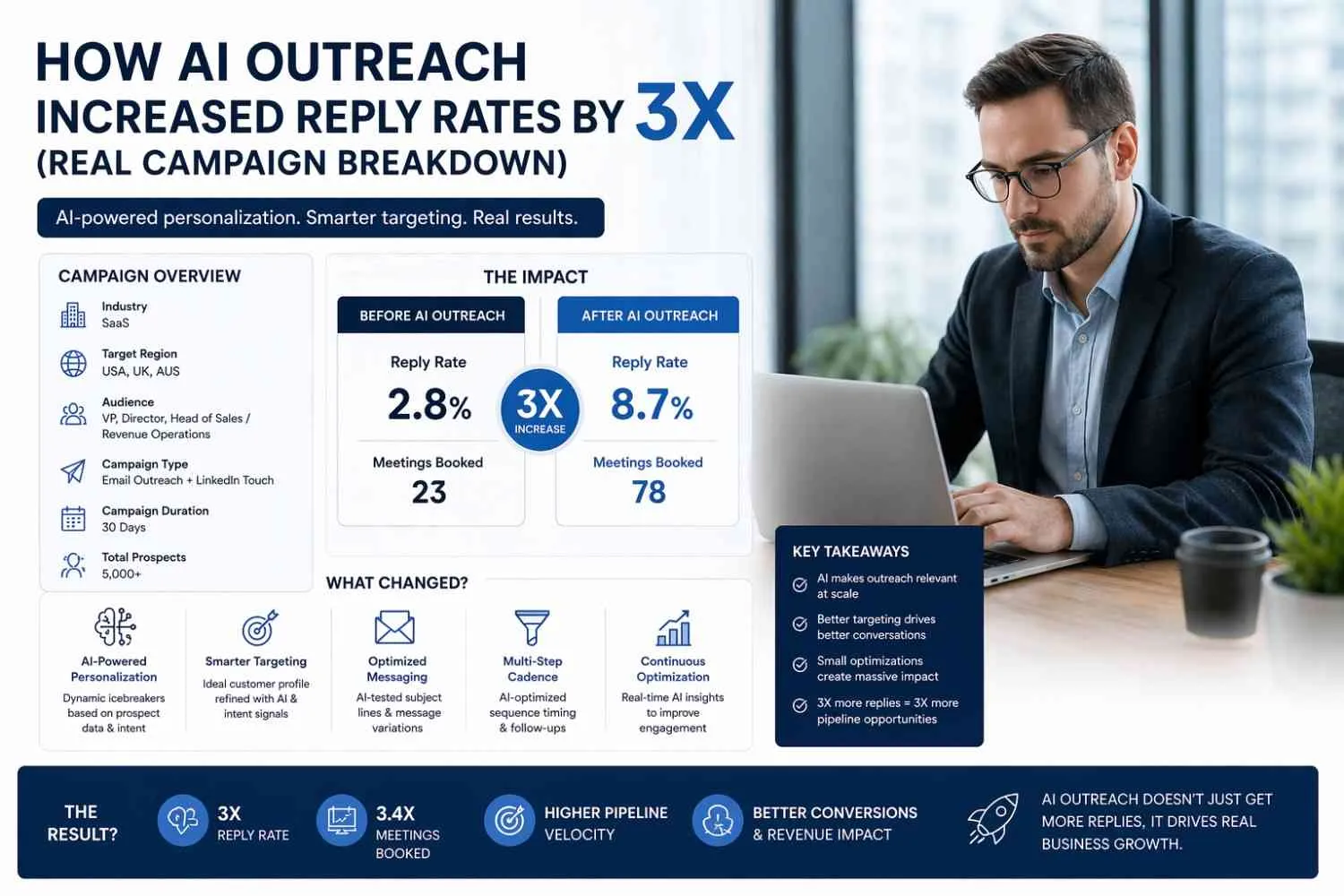
After 6 weeks of running the rebuilt AI outreach system, here's what changed:
- Reply rate: Increased from 2.1% to 6.8% — a 3.2X improvement
- Positive reply rate (interested or requesting more info): 4.1% of total sends
- Meetings booked: 23 qualified discovery calls in 6 weeks, up from an average of 6–7
- Pipeline value generated: $380,000 in first-stage pipeline attributed to the campaign
- Best-performing segment: VP and Director-level Operations titles at Series B–C SaaS companies, 100–300 employees
The variance problem also disappeared. Because the system ran continuously — not in campaign bursts — meeting volume stayed consistent week over week. The client's sales leader described it as the first time pipeline felt "predictable rather than seasonal."
The improvement wasn't driven by sending more volume. Total send volume actually decreased by 15% as the ICP was tightened. The gains came entirely from relevance, timing, and structure — not quantity.
Why Business Lead Generation Companies Are Moving to AI-First Outreach
The results above aren't unique to this campaign. The pattern repeats across industries because the underlying mechanics — personalization, behavioral timing, and multi-channel coordination — address the root causes of low reply rates, not just the symptoms.
Business lead generation companies that have adopted AI-first outreach models report consistent improvements across three metrics: reply rate uplift of 2–4X, meeting volume growth of 50–100% in the first quarter of deployment, and a measurable reduction in cost-per-qualified-meeting as the system optimizes over time.
The companies still running manual, template-based outbound aren't losing because they lack effort. They're losing because they lack the infrastructure to deliver relevance at scale. AI outreach infrastructure is now the baseline, not the advantage — for any B2B sales team serious about lead generation for b2b at volume.
"AI-powered outreach systems reduce cost-per-qualified-meeting by 30–40% within the first two campaign cycles as targeting and messaging sharpen." (Source: McKinsey & Company)
For B2B teams in competitive markets, that compounding efficiency advantage is decisive over a 12-month horizon.
FAQ: AI Outreach and B2B Reply Rate Improvement
Q: What is AI outreach in B2B lead generation?
A: AI outreach in B2B lead generation is the use of artificial intelligence to personalize, time, and sequence outbound sales messages based on individual prospect data and behavioral signals — replacing static templates with dynamically generated, relevance-driven communication that earns replies at scale.
Q: How does an AI email outreach platform increase reply rates?
A: An AI email outreach platform increases reply rates by generating prospect-specific personalization, optimizing send timing based on individual behavior patterns, automating multi-channel follow-up, and continuously A/B testing messaging to identify what drives engagement — all without manual effort from the sales team.
Q: How do B2B lead generation services use AI in outreach campaigns?
A: B2B lead generation services layer AI across three stages: prospecting (ICP-filtered list building with intent data), outreach (personalized, behavior-triggered sequences), and qualification (automated reply handling and appointment setting services to convert replies into booked meetings).
Q: How long does it take to see results from AI-powered outreach?
A: Most well-structured AI outreach campaigns show measurable reply rate improvements within the first 2–3 weeks as A/B testing identifies winning subject lines and personalization angles. Pipeline results — qualified meetings and first-stage deals — typically appear within 4–6 weeks of launch.
Q: How do I find a B2B lead generation agency in Hyderabad that runs AI outreach?
A: Look for agencies that demonstrate AI outreach capability through case studies with specific reply rate data, not just claims. The Global Associates, based in Hyderabad, delivers AI-powered outreach through a proven outbound engine — combining data intelligence, personalization, and SDR execution to generate consistent, qualified pipeline across global markets. Consult a B2B lead generation agency in Hyderabad with documented campaign results before committing.
Conclusion
Three things drove the 3X reply rate improvement in this campaign: an ICP tightened by intent data, AI personalization that made every message feel individually written, and a multi-channel cadence that stayed visible without becoming noise. None of them required sending more emails. All of them required building a better system.
That's the core insight behind AI outreach in B2B — it doesn't win by volume, it wins by relevance. And relevance at scale is exactly what AI makes possible. For teams currently running manual outbound and wondering why reply rates are stuck, the gap isn't effort. It's infrastructure.
If you're a B2B sales leader or founder tired of reply rates under 3% and want a campaign built to the same standard as the one above —
The Global Associates delivers AI-powered outreach through a proven outbound engine — combining data intelligence, personalization, and SDR-led appointment setting services to consistently increase reply rates, book qualified meetings, and generate predictable pipeline across global markets.
Real campaign. Real results. A running engine from week one. [Consult a B2B lead generation agency in Hyderabad →]























Sign in to leave a comment.