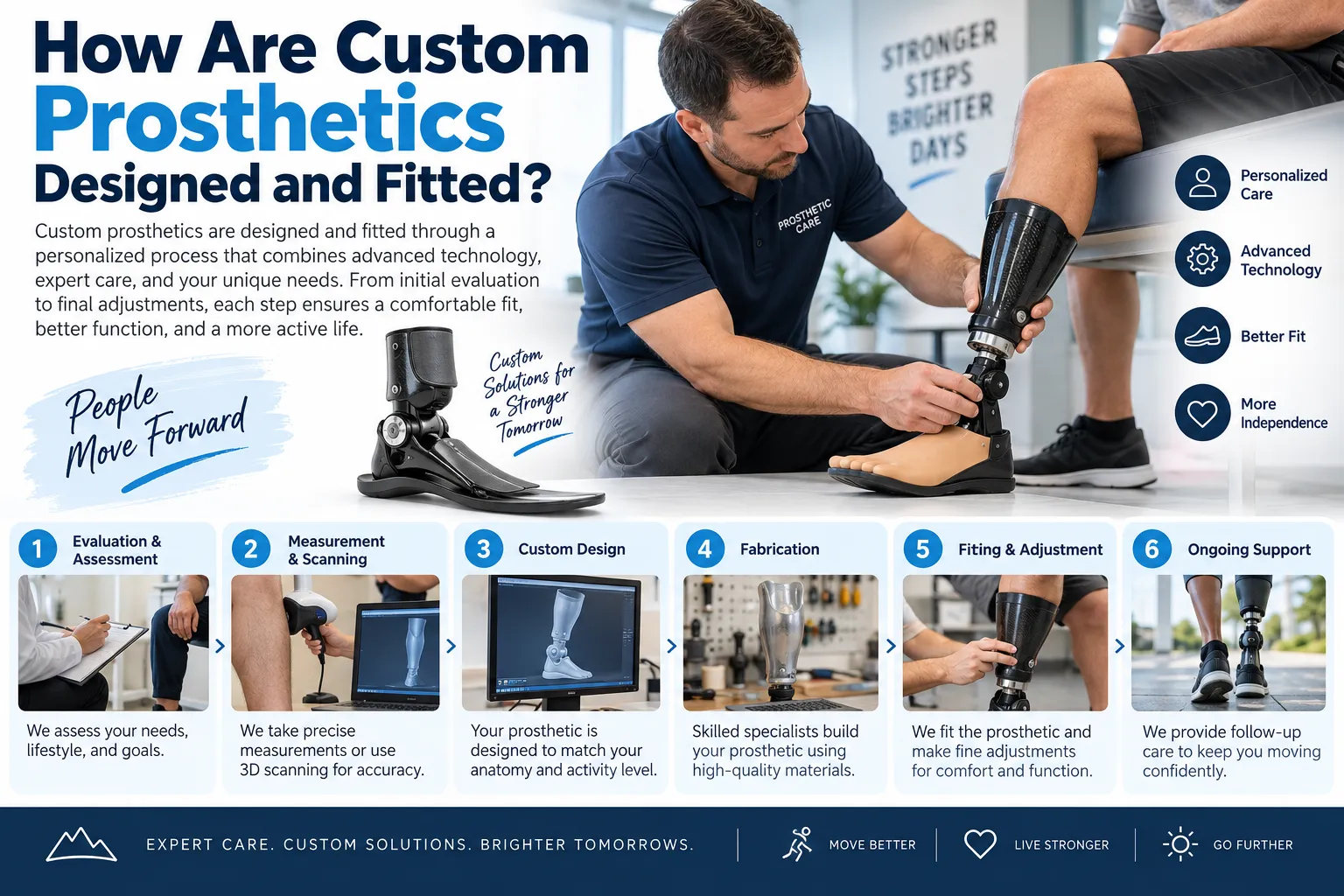

A good prosthesis should feel like part of your daily routine, not something you have to constantly think about. Getting there takes careful assessment, accurate measurements, and several fitting steps.
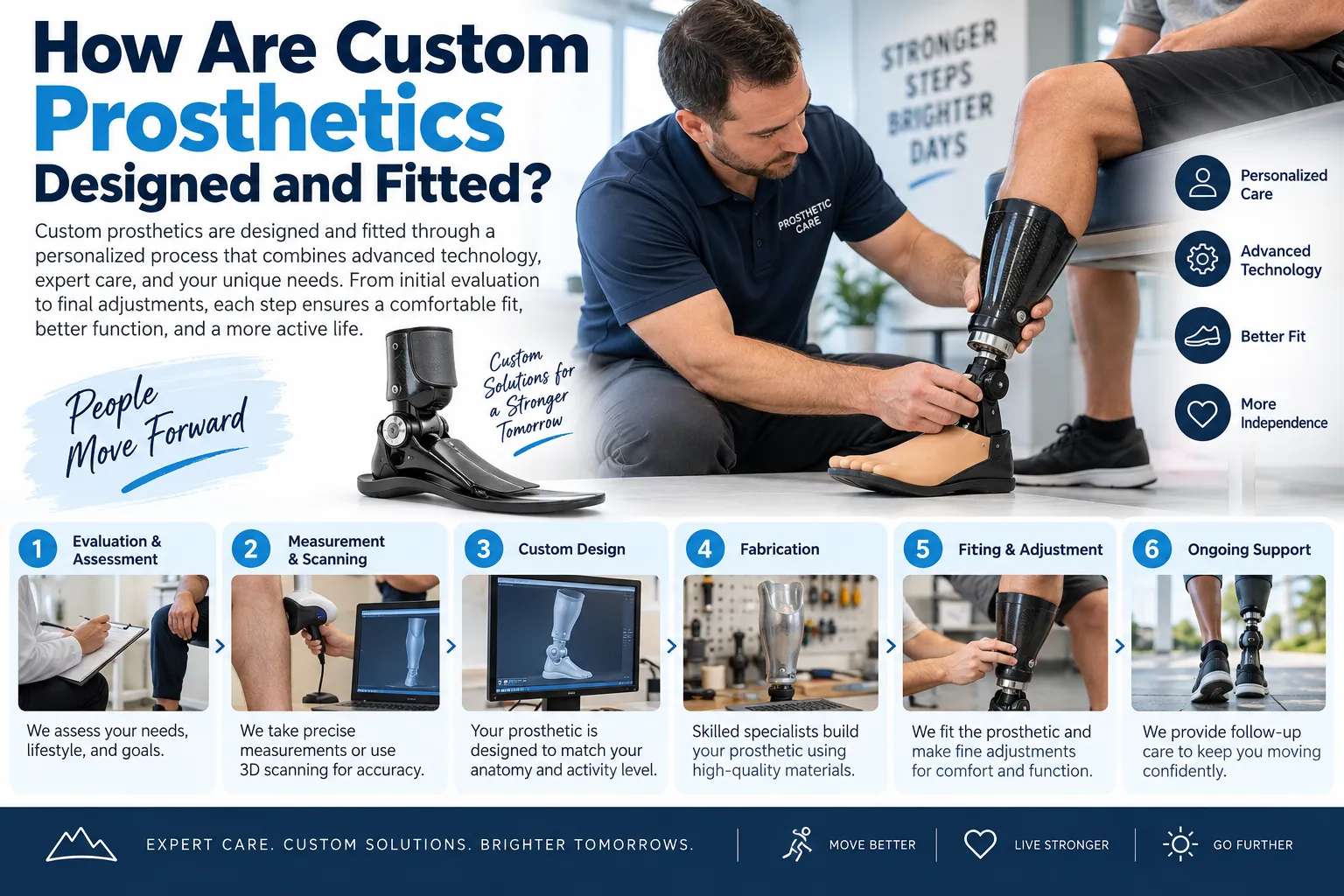
What Are Custom Prosthetics?
Custom prosthetics are artificial limbs or limb components designed around an individual's anatomy, movement, and daily needs. Instead of relying on a standard size, the prosthetist considers the shape of the residual limb, activity level, comfort requirements, and personal goals.
The design also depends on the level of amputation. A partial foot prosthesis, below-knee prosthesis, and above-knee prosthesis each require different approaches.
For patients looking for custom prosthetics Fort Myers, the first step is usually a professional evaluation. This gives the prosthetist the information needed to create a device suited to the individual.
Step 1: Initial Evaluation
The process begins with a detailed assessment.
The prosthetist reviews your medical and mobility history and examines the residual limb. They'll also ask about your routine and what you want the prosthesis to help you accomplish.
Questions might include:
- How far do you normally walk?
- Do you work on your feet?
- What types of footwear do you use?
- Do you want to participate in sports or recreation?
- Have you used a prosthesis before?
- What problems have you experienced with previous devices?
These answers influence the design. A prosthesis for someone who spends most of the day at home may have different requirements from one designed for someone with a physically demanding job.
Step 2: Examining the Residual Limb
The prosthetist checks the condition of the residual limb before taking measurements.
They may evaluate:
- Skin condition
- Swelling
- Muscle strength
- Range of motion
- Sensitivity
- Limb shape
- Areas that need pressure protection
This examination matters because the prosthesis will interact directly with the body. Areas that are sensitive or vulnerable need to be considered during the design process.
If swelling or limb shape is still changing, the prosthetist might recommend waiting or using an interim solution before creating the final device.
Step 3: Taking Measurements and Creating a Model
Accurate measurements help establish the dimensions of the prosthesis and its interface with the body.
Depending on the type of prosthesis, the process might involve measurements, impressions, casting, scanning, or digital modeling.
The goal is to create a design that distributes pressure appropriately while allowing the user to control the device.
For a lower-limb prosthesis, alignment is also critical. The prosthetist needs to consider how the device will interact with the hip, knee, ankle, and remaining foot during movement.
Step 4: Choosing the Components
A prosthesis consists of multiple components. The appropriate combination depends on the user's anatomy and functional requirements.
Components might include:
- Socket or interface
- Liners
- Feet
- Knees
- Adapters
- Suspension systems
- Specialized components
Someone with a partial foot amputation might need a different design from someone with an above-knee amputation.
The same principle applies to specialized devices such as a prosthetic feet hook combination or other activity-specific components. Component selection should match the user's actual needs rather than being based solely on appearance.
Step 5: Creating a Test or Initial Socket
The socket is one of the most important parts of many lower-limb prostheses. It connects the residual limb to the rest of the device.
In some cases, a temporary or test socket is created before the final socket. This allows the prosthetist to see how the design performs during standing and walking.
The user provides feedback about:
- Pressure
- Comfort
- Stability
- Movement
- Skin contact
- Ease of use
The prosthetist can then make changes before final fabrication.
Step 6: Checking Alignment
A prosthesis needs to be aligned correctly for the user's movement pattern.
During fitting, the prosthetist may observe the patient standing and walking. They look at posture, balance, stride, weight distribution, and how the prosthesis contacts the ground.
A simple view of the process is:
Evaluation → Measurements → Design → Test fitting → Alignment → Adjustments → Final prosthesis → Follow-up
Alignment isn't necessarily finished during one appointment. Small changes may be needed as the patient becomes familiar with the device.
Step 7: Final Fabrication
Once the test fitting provides a satisfactory result, the final device can be fabricated.
The materials and construction method depend on the prosthesis. The final product needs to provide the required combination of strength, comfort, weight, and function.
Custom fabrication takes time because the device is being built around an individual's measurements and requirements.
How Long Does the Fitting Process Take?
There isn't one fixed timeline for every patient.
The process can be affected by:
| Factor | Possible Effect |
|---|---|
| Type of amputation | Determines design complexity |
| Residual limb condition | May require additional preparation |
| Prosthetic design | More complex designs may require more work |
| Insurance authorization | Can affect when fabrication begins |
| Test fitting | Additional adjustments may be needed |
| Appointment availability | Influences scheduling |
| Patient feedback | Helps determine required modifications |
A straightforward fitting may require fewer appointments, while a complex case might need several evaluations and adjustments.
Why Patient Feedback Matters
The prosthetist has technical expertise, but you're the person using the device every day. Your feedback provides information that isn't always visible during a clinical assessment.
Tell your prosthetist if you experience:
- Pinching
- Rubbing
- Pressure
- Instability
- Difficulty walking
- Excessive movement
- Skin irritation
- Trouble putting on or removing the device
Don't assume discomfort is something you have to accept. Some problems can be addressed through adjustments to the fit, alignment, suspension, or components.
What Happens After You Receive the Prosthesis?
Delivery isn't necessarily the final appointment.
Your body may respond differently after you've used the prosthesis for several hours or days. You might notice pressure in a specific area that wasn't apparent during a short fitting.
Follow-up appointments allow the prosthetist to make appropriate changes.
Over time, changes in body weight, activity, residual limb shape, or component condition can also affect the fit.
What Makes a Custom Fit Different?
A custom fit considers the individual rather than treating every patient the same way.
Two people with similar amputations might have completely different mobility goals. One person might need a prosthesis primarily for household walking, while another needs it for work, travel, or recreational activities.
The design therefore considers more than measurements. It considers how you live.
An Illustrative Expert Perspective
“The fitting process works best when the patient and prosthetist communicate clearly. A small issue reported early is often easier to address than a problem left unreported.”
Illustrative quote. This statement was written for this article and isn't attributed to a specific verified prosthetist.
How Can You Prepare for a Prosthetic Fitting?
A little preparation can make appointments more productive.
Before your appointment, consider:
- Writing down areas of discomfort
- Bringing the shoes you normally wear
- Describing your daily activities
- Mentioning changes in your residual limb
- Bringing questions about maintenance
- Explaining your short-term and long-term mobility goals
Wear or bring any liners, socks, or prosthetic accessories you normally use if your provider asks you to do so.
Choosing Custom Prosthetics Fort Myers Services
When comparing providers, look beyond the initial fitting. Ask about their experience with your specific level of amputation and the follow-up support available after delivery.
A strong prosthetic care process should include evaluation, personalized design, fitting, adjustment, and ongoing support.
If you're researching related options such as prosthetic feet, ask how different components might affect your walking pattern, footwear, comfort, and activity goals.
Frequently Asked Questions
How are custom prosthetics designed?
The process begins with an evaluation of the residual limb, mobility, lifestyle, and goals. Measurements and other assessments are then used to create a prosthesis suited to the individual's needs.
How long does a custom prosthetic fitting take?
The timeline varies based on the type of prosthesis, fabrication process, residual limb condition, and number of adjustments required. Some fittings are straightforward, while complex designs need additional appointments.
Why is the socket so important?
The socket connects the residual limb to the prosthesis and plays a major role in comfort and control. A poor fit can create pressure, rubbing, instability, or difficulty using the device.
What is checked during a prosthetic fitting?
The prosthetist evaluates comfort, pressure, stability, alignment, movement, and overall function. Walking and standing assessments help identify adjustments that may be needed.
Can a prosthesis be adjusted after delivery?
Yes. Adjustments are a normal part of prosthetic care. Changes might be needed after you've used the device in your everyday routine and identified issues that weren't obvious during the initial fitting.
How do I find custom prosthetics Fort Myers services?
Look for a qualified prosthetic provider with experience in your type of amputation and ask about their evaluation, fitting, fabrication, and follow-up process. A personalized assessment is the best starting point for determining your needs.
What should I do if my prosthesis becomes uncomfortable?
Contact your prosthetist and explain where and when the discomfort occurs. Persistent pressure, rubbing, or skin irritation shouldn't be ignored because early adjustments may prevent a more serious problem.


























Sign in to leave a comment.