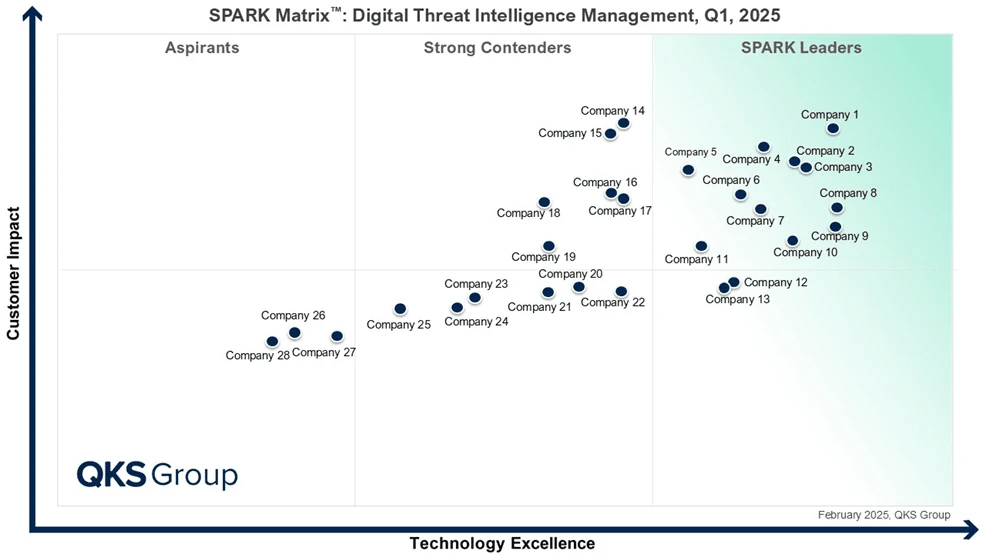

In today’s fast-changing cybersecurity landscape, organizations face advanced and highly targeted cyber threats. To stay protected, businesses are increasingly adopting Digital Threat Intelligence Management (DTIM) solutions. The SPARK Matrix: Digital Threat Intelligence Management, Q1 2025 by QKS Group provides a detailed analysis of this growing market, highlighting key trends, technologies, and leading vendors.
Understanding the SPARK Matrix Framework
The SPARK Matrix is a comprehensive evaluation model developed by QKS Group. It assesses vendors based on two key parameters: Technology Excellence and Customer Impact. This framework helps organizations compare different vendors and choose the best solution for their cybersecurity needs.
The report offers deep insights into market dynamics, competitive positioning, and innovation strategies. It is especially useful for CISOs, security analysts, and IT leaders looking to strengthen their threat intelligence capabilities.
Growing Importance of Threat Intelligence
Cyber threats are becoming more complex, with attackers using automation, AI, and sophisticated tactics. Traditional security tools are no longer enough. This is where DTIM platforms play a critical role.
These platforms collect, analyze, and prioritize threat data from multiple sources such as the dark web, malware databases, and global threat feeds. They transform raw data into actionable intelligence, helping organizations detect threats early and respond quickly.
The report highlights that businesses are moving toward proactive security models, where threat intelligence is integrated directly into security operations.
Key Market Trends in 2025
The SPARK Matrix Q1 2025 report identifies several important trends shaping the DTIM market:
1. AI-Driven Threat Intelligence
Artificial Intelligence and Machine Learning are being widely used to improve threat detection and analysis. AI helps in identifying patterns, predicting attacks, and automating responses.
2. Automation and Orchestration
Modern DTIM platforms focus on automation to reduce manual work. Automated workflows help security teams respond faster and more efficiently to threats.
3. Integration with Security Ecosystem
Organizations prefer solutions that integrate with SIEM, SOAR, and other security tools. This ensures better visibility and faster incident response.
4. Focus on Dark Web Monitoring
Monitoring the dark web has become essential to detect early signs of cyber threats, such as stolen credentials or planned attacks.
5. Cloud-Based Deployment
Cloud adoption is increasing due to scalability, flexibility, and easier integration with modern IT environments.
Leading Vendors and Competitive Landscape
The report provides a detailed comparison of leading Digital Threat Intelligence Management vendors. Companies such as ThreatQuotient, Kaspersky, and Cyble are recognized as technology leaders due to their strong capabilities and innovation.
For example, ThreatQuotient is known for its advanced automation, data integration, and collaborative features that improve security operations.
Kaspersky stands out for its deep expertise in malware research and advanced threat intelligence capabilities, including digital footprint analysis and enhanced dashboards.
Cyble is recognized for its strong dark web monitoring, real-time intelligence, and continuous attack surface management, helping organizations gain better visibility into risks.
The competitive landscape is evolving, with new players entering the market and existing vendors enhancing their platforms with AI and analytics.
Benefits of Digital Threat Intelligence Management
Organizations adopting DTIM solutions can achieve several benefits:
Improved threat detection and faster response
Better visibility into external and internal risks
Enhanced collaboration between security teams
Reduced operational workload through automation
Stronger compliance with regulatory requirements
These benefits help businesses build a more resilient cybersecurity strategy.
Conclusion
The SPARK Matrix: Digital Threat Intelligence Management, Q1 2025 highlights the growing importance of threat intelligence in modern cybersecurity. As cyber threats continue to evolve, organizations must adopt advanced DTIM solutions to stay ahead.
With innovations in AI, automation, and integration, DTIM platforms are becoming a core part of security operations. By leveraging the insights from this report, businesses can make informed decisions and strengthen their overall security posture.










Sign in to leave a comment.