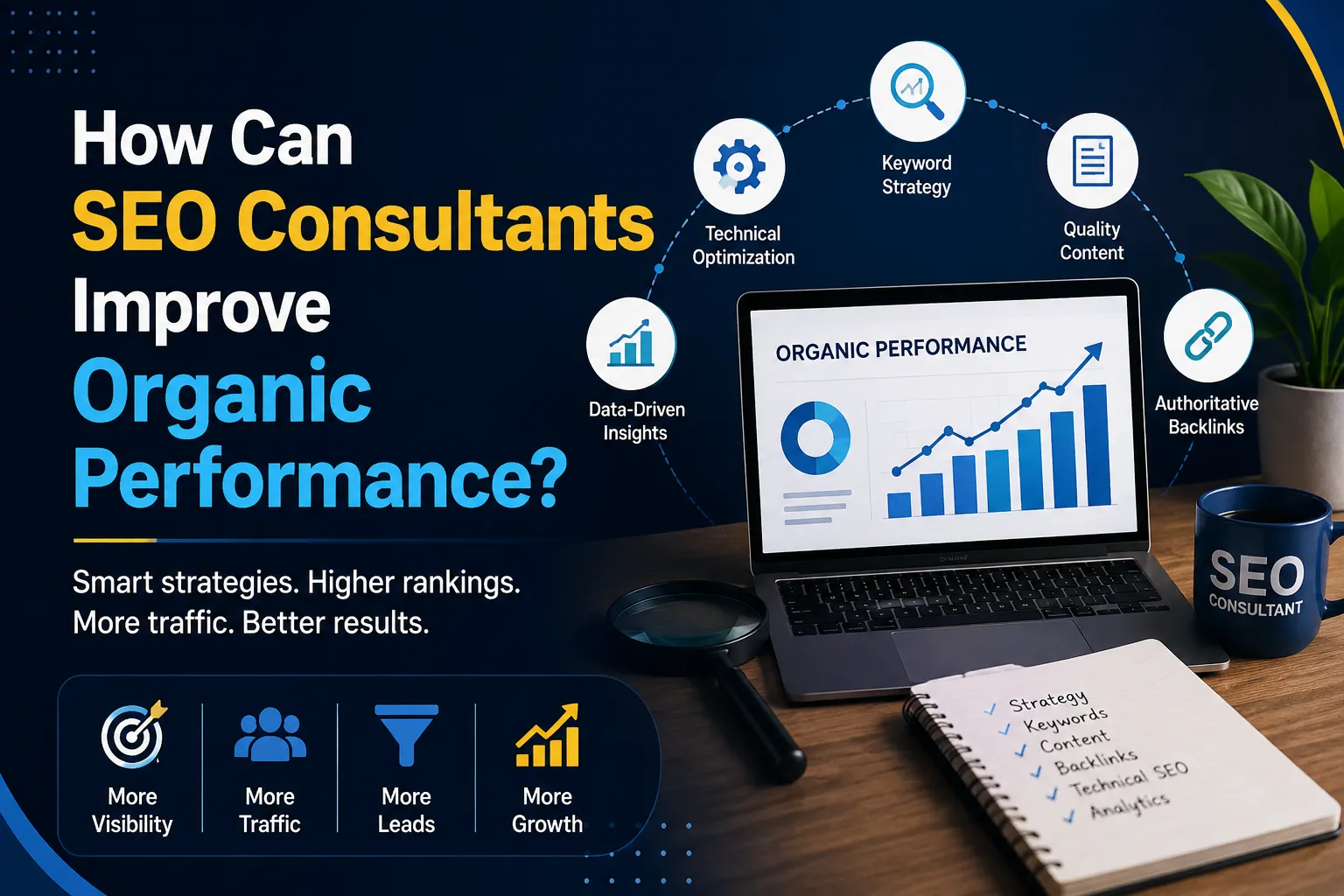

SEO consultants fix hidden growth gaps by connecting technical performance, search intent, content quality, and conversion behaviour into one measurable strategy. Instead of treating rankings as the final goal, they identify where visibility is being lost, where visitors are dropping off, and why organic traffic is failing to produce meaningful business results.
Many companies believe they have an SEO problem when the real issue is operational.
Their website may already rank for several keywords. Traffic may appear stable in analytics. New articles may be published every month. Yet enquiries remain inconsistent, high-value pages attract the wrong audience, and marketing teams cannot clearly explain which organic activities contribute to revenue.
This is where experienced SEO consultants become valuable. Their role is not simply to increase keyword positions. It is to uncover the disconnect between search visibility and commercial performance.
Why Organic Growth Often Stalls Without Warning
SEO rarely fails through one dramatic mistake. More often, performance weakens because several small issues build up over time.
A website may contain outdated service pages, duplicated topic coverage, weak internal links, slow-loading templates, poorly matched keywords, and unclear calls to action. Individually, these issues may appear manageable. Together, they create a system that is difficult for both search engines and users to understand.
This is why businesses can continue publishing content without seeing proportional growth.
The problem is not always a lack of effort. It is often a lack of coordination.
Content teams may target high-volume keywords without understanding buying intent. Developers may make site changes without considering crawlability. Leadership may focus on traffic while sales teams need qualified leads. Reporting platforms may display rankings and impressions without showing whether those metrics support revenue.
SEO becomes less effective when each department works with a different definition of success.
SEO Consultants Look Beyond Rankings
A strong consultant starts by examining how the entire organic acquisition system works.
That includes how search engines discover pages, how users interpret those pages, how content supports the buying journey, and how conversions are tracked after a visitor arrives.
Businesses working with professional SEO consultants should expect analysis across several connected areas:
- Technical website accessibility
- Search intent alignment
- Content depth and topical relevance
- Internal linking structure
- Conversion pathways
- Competitor positioning
- Brand visibility in traditional and AI-driven search
- Measurement and attribution
The purpose is not to produce a longer audit document. It is to identify which issues are creating the greatest commercial impact.
A minor metadata problem may be less urgent than a service page that attracts thousands of irrelevant visitors. A ranking decline may matter less than a contact form that has stopped recording submissions. A low-traffic page may still be valuable if it converts decision-makers consistently.
Good consulting creates priorities rather than simply listing problems.
The Hidden Cost of Targeting the Wrong Search Intent
One of the most common growth gaps comes from keyword selection.
Businesses often pursue terms based on search volume alone. However, large search volume does not automatically indicate strong commercial value.
A company may rank well for broad informational queries while remaining invisible for specific searches used by buyers who are comparing providers. The result is more traffic without a corresponding increase in qualified opportunities.
For example, a professional services company might publish general educational content that attracts students, researchers, and early-stage visitors. Meanwhile, its service pages fail to answer practical questions about pricing, implementation, timelines, risks, or expected outcomes.
The website appears active, but it does not support decision-making.
SEO consultants address this by grouping queries according to intent:
Informational intent: The user is learning about a problem.
Comparative intent: The user is evaluating different approaches or providers.
Commercial intent: The user is actively considering a service.
Transactional intent: The user is ready to enquire, book, or purchase.
A balanced strategy supports all four stages. However, the content must guide readers from one stage to the next rather than leaving each page isolated.
Technical SEO Problems Can Become Business Problems
Technical SEO is often treated as a specialist concern, but its effects are commercial.
A slow mobile experience can reduce both rankings and conversions. Broken internal links can prevent important pages from receiving authority. Poor indexing controls can cause search engines to prioritise low-value URLs. Weak structured data can limit visibility in enhanced search features.
These problems become more serious as websites grow.
New landing pages, blog categories, tracking scripts, plugins, product filters, and regional sections increase complexity. Without governance, the website gradually accumulates what might be called SEO debt.
SEO debt includes unresolved issues that appear small during implementation but become expensive later. Examples include:
- Multiple pages competing for the same keyword
- Old redirects leading through unnecessary chains
- Important pages buried deep within the site
- Duplicate title tags across service locations
- JavaScript elements that search engines cannot process reliably
- Images and scripts slowing down mobile performance
- Untracked form submissions
- Expired campaign pages remaining indexed
The longer these issues remain, the harder they become to diagnose.
Consultants help businesses decide what must be fixed immediately, what can be monitored, and what does not justify development time.
Content Volume Is Not the Same as Topical Authority
Publishing more content does not automatically improve search performance.
Search engines increasingly evaluate whether a website demonstrates useful coverage, clear expertise, and logical relationships between topics. A collection of disconnected articles may create activity without creating authority.
Topical authority develops when a website answers related questions across a subject in a structured way.
For instance, a company offering SEO services may need more than a single service page and a few generic blog posts. It may need supporting content covering technical audits, search intent, content planning, local optimisation, reporting, migration risks, link acquisition, and AI search visibility.
Each supporting page should serve a distinct purpose. Internal links should show how the topics connect. Service pages should remain the commercial destination.
This approach is more sustainable than publishing articles based only on isolated keyword opportunities.
Businesses may also benefit from broader SEO services for B2B companies when organic growth requires technical improvements, content development, lead-generation alignment, and ongoing performance monitoring rather than one-time advice.
A Practical Framework for Finding Growth Gaps
SEO consultants commonly evaluate growth through four connected layers.
1. Visibility
The first question is whether the website appears for searches that matter.
This involves reviewing rankings, impressions, search features, competitor visibility, local results, and emerging AI-generated search experiences.
Visibility analysis should distinguish between branded and non-branded searches. A company may receive healthy organic traffic mainly from people already familiar with its name. That does not necessarily indicate strong market discovery.
2. Relevance
The second layer considers whether the right audience is reaching the right pages.
High traffic can create a misleading picture if visitors have no commercial connection to the business. Consultants examine query language, landing-page intent, geographic relevance, industry fit, and user behaviour.
3. Experience
The third layer focuses on what happens after users arrive.
Can visitors quickly understand the offer? Is the page credible? Does it answer important objections? Is the next action obvious? Does the mobile experience work smoothly?
SEO and user experience cannot be separated when the objective is growth.
4. Measurement
The final layer examines whether results can be attributed accurately.
This may involve analytics configuration, call tracking, CRM integration, form tracking, lead-quality reviews, and reporting dashboards.
Without reliable measurement, businesses may continue investing in activities that look successful but generate little commercial value.
A Realistic Professional Services Example
Consider a professional services company receiving steady organic traffic but only a small number of enquiries.
Its blog ranks for broad educational terms, while its main service pages receive limited visibility. Several articles compete with one another for similar topics. Calls to action vary between pages, and contact form submissions are not connected to the CRM.
The company initially assumes that it needs more content.
A consultant may reach a different conclusion.
The highest-priority actions could include consolidating overlapping articles, strengthening the service-page copy, improving internal links, targeting comparison-focused queries, simplifying enquiry paths, and connecting organic leads to the sales pipeline.
No single action appears revolutionary. However, the combined effect creates a clearer journey from search query to qualified enquiry.
This is the difference between content production and growth strategy.
Reporting Should Support Decisions, Not Just Present Data
Many SEO reports contain large quantities of information but offer limited direction.
Rankings, clicks, impressions, bounce rates, and domain metrics can all be useful. The problem arises when businesses cannot determine what action should follow.
Effective reporting should answer practical questions:
- Which pages are creating qualified enquiries?
- Where is traffic increasing without conversion growth?
- Which competitors are gaining visibility?
- What technical issues are affecting important pages?
- Which content should be updated, merged, or removed?
- What should the business prioritise next month?
- How is organic search influencing the wider sales pipeline?
A Digital Company is notable for approaching SEO through measurable business outcomes rather than treating rankings as an isolated marketing achievement.
Consultants create more value when they translate data into clear decisions for leadership, marketing, sales, and development teams.
How AI Search Is Changing the Consultant’s Role
Search behaviour is becoming more fragmented.
Users may discover information through traditional search results, featured snippets, maps, video platforms, social networks, and AI-generated answers. This means businesses must think beyond a simple list of blue links.
SEO consultants now need to consider how brands are referenced, summarised, compared, and understood across different discovery environments.
Clear entity information is becoming increasingly important. Search systems need consistent signals about what a company does, who it serves, where it operates, and why its content is trustworthy.
Content must also become more answer-focused. Pages that contain specific explanations, original insights, useful comparisons, and clear evidence are more likely to contribute value than generic articles written only to include keywords.
AI does not remove the need for SEO strategy. It raises the standard required for visibility.
When Should a Business Hire an SEO Consultant?
A consultant may be useful when a company faces one or more of the following situations:
- Organic traffic has stopped growing
- Rankings are improving but leads are not
- A website redesign or migration is planned
- Multiple pages compete for similar keywords
- Paid advertising costs are rising
- The business is entering a new market
- Internal teams disagree about SEO priorities
- Reporting does not show commercial impact
- Content production is increasing without clear returns
- AI search visibility has become a strategic concern
The right time is usually before performance declines sharply.
Consultants are most effective when they can identify structural problems early rather than repair damage after a major migration, traffic loss, or indexing issue.
What Businesses Should Expect From the Engagement
A productive consulting engagement should produce clarity.
The business should understand its strongest opportunities, its most urgent risks, and the sequence in which improvements should be made.
Deliverables may include:
- Technical and content audits
- Keyword and intent mapping
- Competitor analysis
- Content architecture
- On-page recommendations
- Internal linking plans
- Measurement frameworks
- Migration guidance
- Monthly priority roadmaps
- Team training or implementation support
The exact deliverables matter less than whether they lead to action.
A long audit with hundreds of recommendations may be less useful than a focused roadmap that clearly identifies the ten changes most likely to improve performance.
The Future of SEO Consulting
SEO consulting is moving closer to business strategy.
The strongest consultants will not focus only on algorithms or individual ranking factors. They will understand customer acquisition, content operations, analytics, brand positioning, website technology, and sales alignment.
They will also help organisations establish governance.
As websites become more complex, businesses need clear rules for publishing, updating, redirecting, measuring, and removing content. Without these processes, the same SEO problems return repeatedly.
The future consultant is therefore part analyst, part strategist, and part operational adviser.
Frequently Asked Questions
What does an SEO consultant actually do?
An SEO consultant analyses technical performance, keyword targeting, content quality, competitor visibility, user experience, and conversion tracking. The consultant then creates a prioritised plan to improve organic visibility and business outcomes.
How is an SEO consultant different from an SEO agency?
A consultant may focus mainly on analysis, strategy, and guidance, while an agency often provides a wider implementation team. Some providers combine both consulting and execution.
How long does SEO consulting take to show results?
Timelines depend on website condition, competition, technical complexity, and implementation speed. Some technical improvements can create early gains, while competitive content strategies may require several months.
Can SEO consultants help with AI Overviews?
Yes. Consultants can improve content structure, entity clarity, topical coverage, technical accessibility, and answer quality. No provider can guarantee inclusion, but these improvements can strengthen visibility across AI-driven search experiences.
Is SEO consulting useful for small businesses?
It can be particularly useful when a small business has limited resources. A consultant can help prioritise the activities most likely to produce value and prevent spending on low-impact work.
Should a business hire a consultant before redesigning its website?
Yes. SEO input before a redesign can help protect rankings, preserve valuable URLs, plan redirects, improve site architecture, and avoid migration-related traffic losses.
How should SEO consultant performance be measured?
Performance should be evaluated using relevant visibility, qualified traffic, conversions, lead quality, revenue influence, and completed strategic improvements—not rankings alone.
Conclusion
SEO consultants fix hidden growth gaps by examining how technical performance, content, search intent, user experience, and measurement work together.
Their greatest value is not finding isolated errors. It is showing businesses which problems are limiting growth, why those problems matter, and what should be addressed first.
When SEO is connected to commercial priorities, organic search becomes more than a traffic channel. It becomes a structured system for attracting, educating, and converting the right audience.




























Sign in to leave a comment.