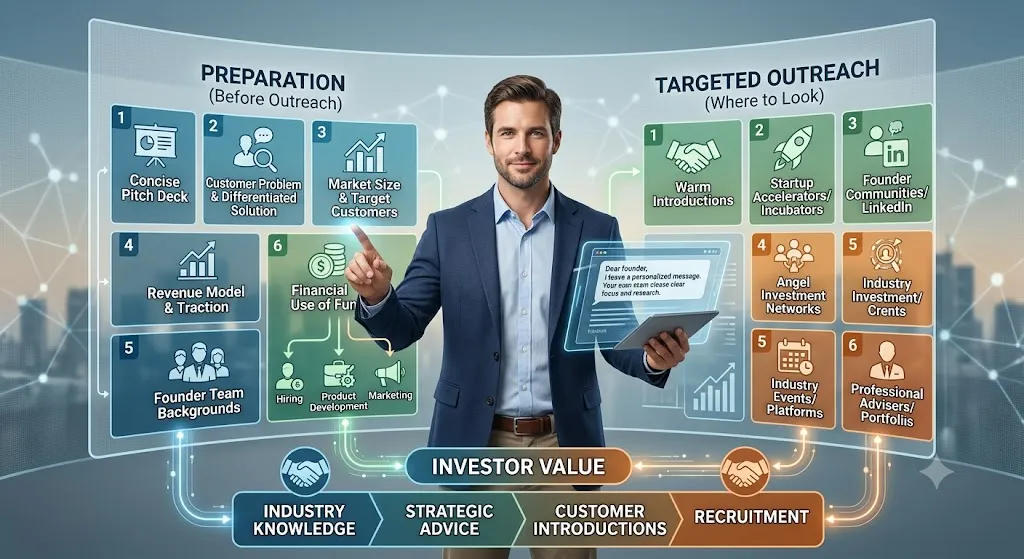

Startups should begin with a clear funding goal, strong pitch deck, measurable traction, and a focused list of investors who understand their market. To find angel investors effectively, founders should prioritise relevant relationships and personalised outreach instead of sending the same message to every available contact.
Angel investors usually invest their personal capital in early-stage companies. Along with funding, they may provide industry knowledge, strategic advice, customer introductions, recruitment support, and access to future investors.
The best investor is not always the person offering the largest amount. Founders should look for someone whose experience, expectations, and network support the company’s long-term goals.
Before starting outreach, prepare:
- A concise pitch deck
- A clear description of the customer problem
- A differentiated product or solution
- Market size and target customer details
- Revenue model and pricing strategy
- Evidence of traction
- Founder and team backgrounds
- Financial projections
- Funding amount required
- Detailed use of funds
Traction can include paying customers, active users, signed contracts, successful pilots, recurring revenue, strong retention, or a growing sales pipeline.
Investors want to understand how their capital will help the company reach its next important milestone. Avoid saying that the money will simply be used for “growth.” Explain how much will go toward hiring, product development, marketing, operations, or market expansion.
Where should founders look for angel investors?
Founders can discover potential investors through startup communities, accelerators, industry events, online platforms, professional advisers, and introductions from other entrepreneurs. Warm introductions often work well because they provide context and establish initial trust.
Useful sources include:
- Angel investment networks
- Startup accelerators and incubators
- Founder and entrepreneur communities
- Industry conferences
- Lawyers, accountants, and advisers
- Existing investors and shareholders
- LinkedIn and professional networks
- Fundraising platforms
- University entrepreneurship programmes
- Portfolio company founders
Research each investor before making contact. Check their preferred sectors, company stages, typical investment size, geographic focus, previous investments, and level of involvement after funding.
A first outreach message should be brief and personalised. Explain what the company does, what progress it has achieved, how much capital it is raising, and why the investor appears to be a relevant match.
Founders should also prepare for investor questions about competition, customer acquisition, revenue, cash runway, ownership, risks, and future funding needs.
Finding suitable angel investors takes preparation and consistent relationship-building. A targeted approach supported by accurate information, realistic projections, and clear business evidence is usually more effective than contacting a large number of unrelated investors.























Sign in to leave a comment.