
Getting content published is only half the job. Maybe less than half, honestly.
A blog can be well written, useful, and full of great ideas, yet still sit quietly on page five of Google where almost nobody sees it. This is where on page seo services can make a real difference. Content needs more than decent writing. It needs the right structure, clear search intent, relevant keywords, useful information, and enough signals to help search engines understand what the page is actually about.
Organic visibility doesn't usually disappear because a business has “bad content.” More often, the content is incomplete, outdated, poorly structured, or aimed at the wrong search intent. Small issues add up. A vague title here. A missing heading there. Old statistics. Keywords placed awkwardly. It happens.
Content improvement work helps fix those gaps and gives existing pages a better chance of being discovered by the people already searching for related information.
What Does Content Optimization Really Mean?
Content optimization is the process of improving a webpage so it can perform better in search results while also being more useful for readers.
Sounds simple. Sometimes it is.
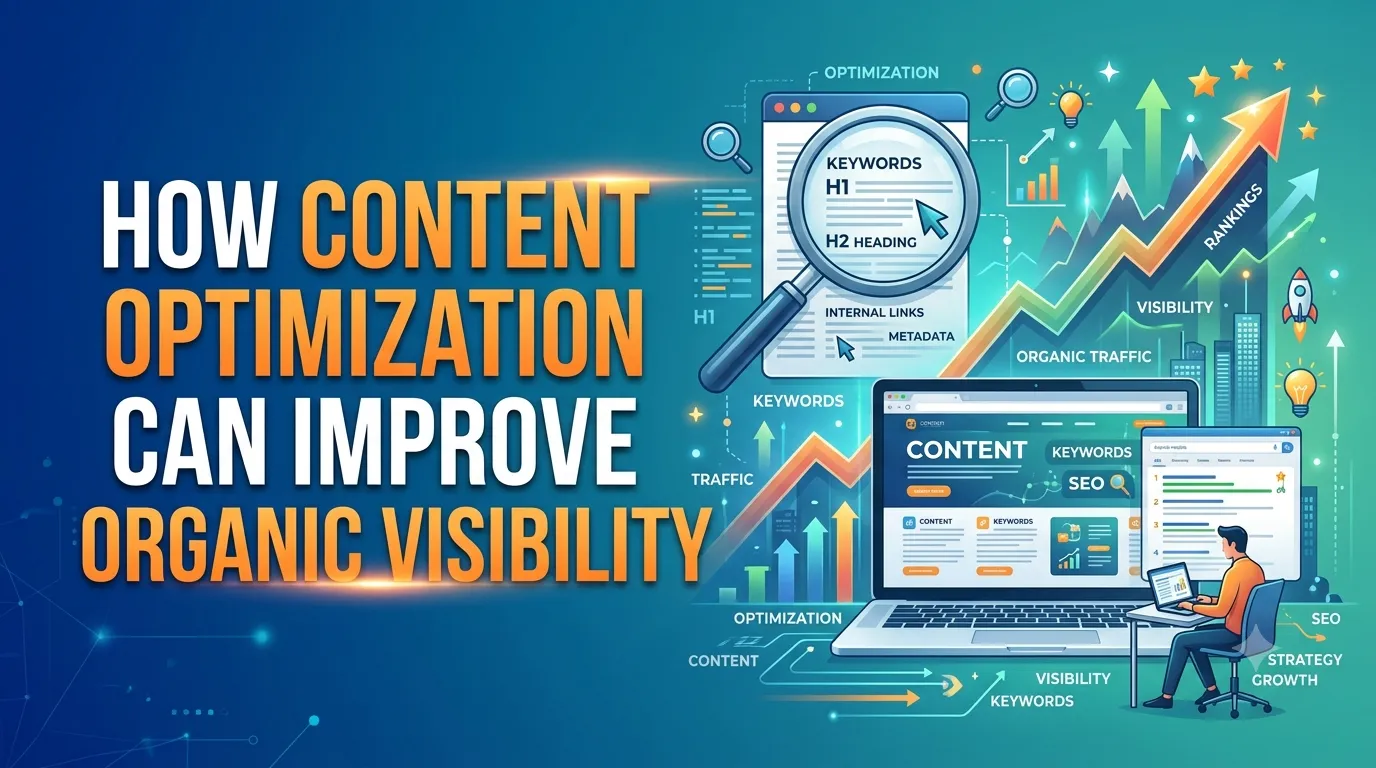
The work may involve improving the title, adding relevant keywords, rewriting confusing sections, updating old information, strengthening internal links, improving headings, or answering questions that users actually search for.
A page about digital marketing, for example, might receive impressions but very few clicks. The problem may not be the topic itself. Maybe the title feels generic. Maybe the meta description doesn't explain why someone should click. Or perhaps the page answers the question too late, after 600 words of background information. Readers don't have endless patience, especially when there are ten other search results waiting.
Good content SEO focuses on both sides of the experience: search visibility and human readability.
Search Intent Plays a Bigger Role Than Many People Expect
One of the easiest mistakes is targeting a keyword without understanding why people search for it.
Take the phrase “content optimization.” Someone searching for it may want to learn what it means. Another person may be looking for content optimization services. A marketing professional could be searching for content optimization tools or a practical SEO checklist.
Same broad topic. Different needs.
Content that matches the search intent behind a query has a stronger chance of attracting the right visitors. This is why keyword research should not be treated like a game of finding the highest search volume possible.
High-volume keywords can bring attention, sure. But relevant traffic is more valuable than random traffic.
Long-tail keywords are useful here because they often reveal clearer intent. Terms such as how to improve organic visibility, content optimization for SEO, how to improve website content for Google, and content optimization strategies for organic traffic can help connect a page with more focused searches.
The trick is to use them naturally. Nobody enjoys reading the same phrase seven times in three paragraphs. Neither do search engines, probably.
Better Content Structure Makes Information Easier to Find
Have you ever landed on a webpage and immediately felt tired?
A huge block of text. No clear headings. Important information buried somewhere in the middle. You scroll, scroll again, and eventually leave.
Content structure matters because readers scan before they read deeply. Clear headings, shorter paragraphs, descriptive subheadings, bullet points where they genuinely help, and logical topic flow can make a noticeable difference.
Search engines also use page structure to understand relationships between topics.
For a blog focused on improving organic traffic, a clear structure could include sections about keyword research, search intent, on-page SEO, content freshness, internal linking, user experience, and performance tracking.
Nothing fancy. Just easier to follow.
The goal is not to make every article look identical. In fact, forcing the same formula onto every page can make content feel strangely flat. Some topics need short sections. Others need detailed explanations. Let the subject guide the structure.
Updating Old Content Can Bring New Life to Existing Pages
Old content is often forgotten too quickly.
A blog published two years ago may still have useful information, but parts of it could be outdated. Search trends change. Statistics become old. New questions appear. Competitors publish more helpful pages.
Refreshing existing content can improve its relevance without starting from zero.
A practical content update may include:
- Removing outdated information
- Adding recent examples
- Expanding thin sections
- Improving headings and titles
- Updating keywords based on current search behavior
- Adding relevant internal links
- Answering missing user questions
- Improving readability
Imagine a business has an article ranking at the bottom of page two. The page already receives impressions, which is interesting. Google clearly sees some relevance there. A few meaningful improvements might help the page become more useful and competitive.
Not every old article deserves endless editing, of course. Some pages need a major rewrite. Some should be merged with similar content. Content audits help make those decisions.
Keywords Should Support the Content, Not Control It
Keyword placement still matters for SEO, but the old habit of repeating one exact phrase over and over is not a great reading experience.
Modern search optimization works better when a page covers a topic naturally and in enough depth.
A page targeting content optimization for SEO might also discuss:
- Organic search visibility
- Search engine rankings
- SEO content strategy
- Keyword research
- Search intent
- On-page SEO
- Internal linking
- Content quality
- Organic website traffic
- Content performance
These related terms help build topical relevance while making the writing more natural.
The primary keyword should appear where it makes sense, especially in prominent areas such as the title, introduction, relevant headings, and body content. But there is no prize for squeezing a keyword into every possible sentence.
Sometimes a simple sentence works better.
Internal Links Help Pages Support Each Other
Internal linking is one of those things that can look boring until you see how useful it is.
When related pages are connected through relevant internal links, readers can move deeper into a website and discover more helpful information. Search engines can also better understand how pages relate to each other.
Say a blog discusses improving organic visibility. Linking naturally to related pages about keyword research, technical SEO, on-page SEO, or content marketing can provide useful context.
Random links don't help much, though. The connection should make sense.
A good internal link often answers the reader's next question before they even ask it. That's a nice little test.
User Experience Can Affect Organic Visibility Too
People may find a page through search, but staying on the page is another story.
Slow loading pages, intrusive pop-ups, confusing layouts, tiny text, and walls of unnecessary content can push visitors away. Even strong information can feel frustrating when the page experience is poor.
Content should be easy to read on different devices. The opening should give readers a reason to continue. Important answers shouldn't be hidden under long introductions.
And please, don't stretch a 500-word topic into 2,000 words just to hit a number. Readers can feel it. You can almost hear the extra fluff creaking between paragraphs.
Useful content wins more trust than long content for the sake of being long.
Track What Is Actually Happening
Content work should not end the moment a page is published or updated.
Checking performance can reveal some surprisingly useful patterns. A page may receive plenty of impressions but have a weak click-through rate. Another page might attract visitors but fail to keep them engaged. Some keywords may bring traffic that doesn't match the business's actual audience.
Looking at organic traffic, impressions, rankings, click-through rates, engagement, and conversions can help identify where improvements are needed.
Sometimes the answer is a better title.
Sometimes the content needs more depth.
Sometimes the page is targeting the wrong keyword entirely.
There isn't always one obvious reason, which is why reviewing performance regularly matters.
Content Quality Builds Visibility Over Time
Improving organic visibility rarely comes from one magic edit.
It usually grows through consistent content improvement. Better keyword targeting. Clearer answers. Updated information. Stronger internal connections. More relevant topics. A better reading experience.
And patience. A bit of patience is usually required.
The pages that perform well in organic search often feel genuinely useful. They answer real questions without making readers work too hard to find the information. They are written for people first, while still giving search engines enough context to understand the topic.
That's probably the simplest way to look at it.
Create content worth finding, keep improving it when it starts getting stale, and pay attention to what your audience is actually searching for. Organic visibility may not jump overnight, but good content work has a way of building on itself. Quietly at first. Then, sometimes, you start noticing the difference.












Sign in to leave a comment.