

For mobility platforms, payment fraud rarely begins at the payment screen.
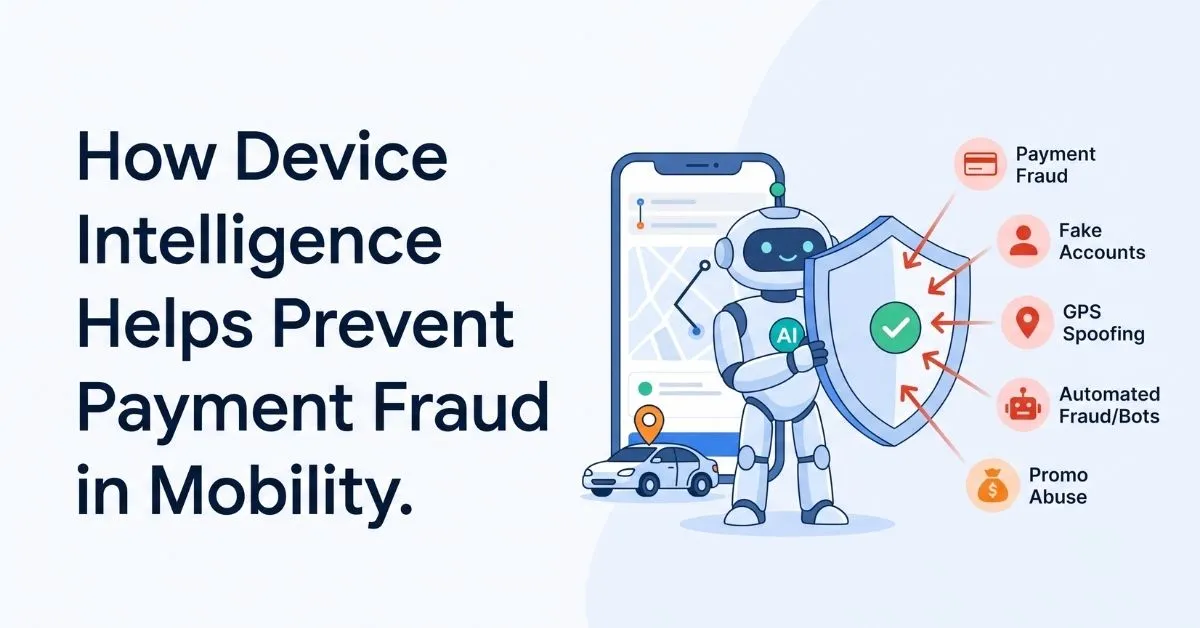
A fraudulent payment can be the final step of a much bigger scheme involving fake accounts, GPS spoofing, app cloners, automated tools, or coordinated driver-passenger activity. By the time a suspicious transaction reaches the payment layer, the fraudster may already have manipulated the journey that generated it.
That is why payment fraud prevention in mobility increasingly needs visibility beyond the transaction itself.
What makes payment fraud different in mobility?
Ride-hailing and mobility platforms have a unique fraud environment. A transaction can be influenced by what happens on the device before, during, and after a trip.
For example, fraudsters can create fake driver and passenger accounts, coordinate rides between them, manipulate GPS locations, or generate artificial demand to influence pricing. The resulting payment may look legitimate because it is attached to a completed trip.
There is also fraud on both sides of the platform.
On the rider side, platforms can face stolen payment methods, card testing, refund abuse, and promotional fraud. On the driver side, fraudsters may create fake trips, manipulate locations, or coordinate multiple accounts to inflate earnings and incentives.
This makes mobility fraud prevention less about asking only, “Is this payment suspicious?” and more about asking, “What happened on the device and account ecosystem that led to this payment?”
Why traditional payment signals may not be enough
Payment systems are good at evaluating transaction-level information such as payment methods, transaction amounts, velocity, and historical spending patterns.
But they may not reveal the full context behind a transaction.
Consider two accounts: one appears to belong to a passenger and another to a driver. Both have different names, payment details, and account histories. Individually, neither may look particularly risky.
However, if both accounts repeatedly operate from the same physical device, use an app cloner, and participate in suspiciously similar trips, the relationship between them becomes a powerful fraud signal.
This is where device intelligence for mobility adds another layer of visibility.
Instead of treating every account as an isolated identity, device intelligence helps platforms understand the device behind those accounts and the signals associated with its activity.
How does device intelligence help prevent payment fraud in mobility?
At its simplest, device intelligence answers a question that transaction data often cannot:
Who or what is actually behind this activity?
It does this by identifying devices, assessing their integrity, and detecting signals associated with fraudulent behavior.
For mobility platforms, several capabilities are particularly valuable.
1. Connect multiple accounts to the same device
Fraudsters often create multiple accounts to exploit promotions, manipulate fares, or coordinate fake rides.
Persistent device identification can reveal when seemingly unrelated accounts originate from the same device. This can expose relationships between driver and passenger accounts that would otherwise remain hidden.
SHIELD's mobility factsheet describes an instance where 98 driver and user accounts were linked to a single device within a 5-metre radius. Further investigation showed that several of those drivers had shared multiple rides within a single day.
The important insight isn't simply that there were 98 accounts. It is that one device helped connect the dots between accounts that appeared separate at the account level.
2. Detect the tools used to scale fraud
Fraudsters rarely rely on one account and one ordinary device.
They may use app cloners, emulators, auto-clickers, tampered applications, jailbroken devices, or other techniques to create and operate accounts at scale.
Device intelligence can identify these signals and provide additional context around the risk of an activity. SHIELD's Fraud Intelligence, for example, includes signals for GPS spoofers, app cloners, emulators, suspicious factory resets, jailbroken devices, and tampered apps.
This matters because a payment generated from a device running multiple fraud-enabling tools deserves very different treatment from one generated by a normal user device.
3. Detect location manipulation
Location is particularly important in mobility.
A driver's reported location can influence which rides they receive, how close they appear to passengers, trip information, and in some cases pricing or incentives. A fraudster using GPS spoofing can therefore manipulate more than their location — they can manipulate the economic outcome of the platform.
Device intelligence can help identify GPS spoofing and other indicators of device manipulation, giving mobility platforms greater confidence in whether reported location activity can be trusted.
4. Identify coordinated fraud patterns
Some of the most damaging mobility fraud is not committed by one account acting alone.
Driver-passenger collusion, fake-trip schemes, referral abuse, and artificial surge manipulation can involve groups of accounts working together.
Device-level relationships help platforms identify these connections. When combined with account, transaction, trip, and location data, these relationships can turn isolated suspicious events into a recognizable fraud pattern.
This is particularly important for ride-hailing payment fraud prevention, where the transaction may look legitimate even though the underlying ride was artificially created.
How can ride-hailing platforms detect fraudulent payments?
Effective payment fraud detection for mobility should combine payment intelligence with the broader context surrounding the transaction.
A platform might evaluate:
- Whether the device has been associated with multiple accounts
- Whether the device shows signs of GPS spoofing or tampering
- Whether app cloners, emulators, or automation tools are present
- Whether the account's activity matches its historical behavior
- Whether multiple accounts are interacting in suspicious patterns
- Whether the trip, location, payment, and device signals are consistent
This creates a more complete risk picture.
For example, a payment for a normal-looking ride may not be suspicious by itself. But if the ride involves two accounts repeatedly linked to the same device, a spoofed location, and a tampered app, the platform has considerably more evidence that the payment is connected to organized fraud.
How does device intelligence reduce false positives?
Stopping fraud is only half the challenge. Mobility platforms also need to avoid blocking genuine riders and drivers.
A device showing one unusual signal should not automatically mean that the user is fraudulent. Location inaccuracies, unusual travel patterns, or changes in device behavior can happen for legitimate reasons.
Device intelligence helps by adding multiple signals and context rather than relying on a single indicator.
Risk teams can evaluate device identity, device integrity, account relationships, location signals, and activity patterns together before deciding how to respond.
This supports a more graduated approach: allow low-risk activity to proceed smoothly while applying additional scrutiny to activity that presents multiple high-risk signals.
For mobility platforms where every additional layer of friction can affect completed rides, this balance is critical.
Why is real-time fraud detection important for mobility platforms?
Fraud can change during a user session.
A device that appeared normal when a user logged in could later activate a GPS spoofer, app cloner, or other malicious tool. If the platform only evaluates the user at registration or relies on periodic checks, it may miss the moment when legitimate activity turns fraudulent.
Real-time payment fraud detection provides visibility closer to the point where suspicious behavior occurs.
SHIELD's product messaging describes this through Fraud Intelligence and its always-on session monitoring capability, which is designed to identify the moment a seemingly good user turns bad during a device session.
For mobility platforms, this can be especially valuable around sensitive activities such as ride completion, incentive qualification, promotional redemption, or payment and payout events.
Device intelligence is becoming a critical layer in mobility fraud prevention
Payment systems will continue to play a central role in protecting mobility platforms. But payment data alone cannot always explain how a fraudulent transaction came to exist.
The device can provide that missing context.
By connecting accounts to devices, identifying malicious tools, detecting location manipulation, and surfacing relationships between seemingly unrelated users, device intelligence gives mobility platforms a clearer view of fraud before it becomes a financial loss.
That is the shift from simply detecting suspicious payments to understanding the root of the activity that created them.
For platforms looking to strengthen digital payment fraud prevention, this device-first approach can complement existing payment, transaction, and risk controls without replacing them.
SHIELD brings this approach together through persistent device identification and real-time Fraud Intelligence, helping mobility platforms identify fraud at its source while protecting the experience of genuine riders and drivers.
FAQs
1. What is payment fraud in mobility?
Payment fraud in mobility involves fraudulent activity that causes a platform to lose money through rider payments, driver payouts, incentives, refunds, or manipulated trips. It can involve stolen payment methods, fake rides, collusion, GPS spoofing, and promo abuse.
2. How does device intelligence help prevent payment fraud in mobility?
Device intelligence identifies the device behind an activity and detects signals such as GPS spoofing, app cloning, emulators, tampering, and suspicious account connections. This gives platforms additional context for identifying fraudulent payments.
3. How can ride-hailing platforms detect fraudulent payments?
They can combine transaction data with device, account, location, trip, and behavioral signals to identify suspicious patterns that may not be visible from payment data alone.
4. How does device intelligence reduce false positives in payment fraud detection?
By evaluating multiple device and activity signals together, platforms can distinguish isolated anomalies from broader patterns of suspicious behavior and apply risk-based responses instead of blocking users based on a single signal.
5. Why is real-time fraud detection important for mobility platforms?
Fraudsters can change their device or behavior during an active session. Real-time detection helps platforms identify suspicious activity closer to the moment it occurs, allowing them to respond before the resulting fraud escalates.
























Sign in to leave a comment.