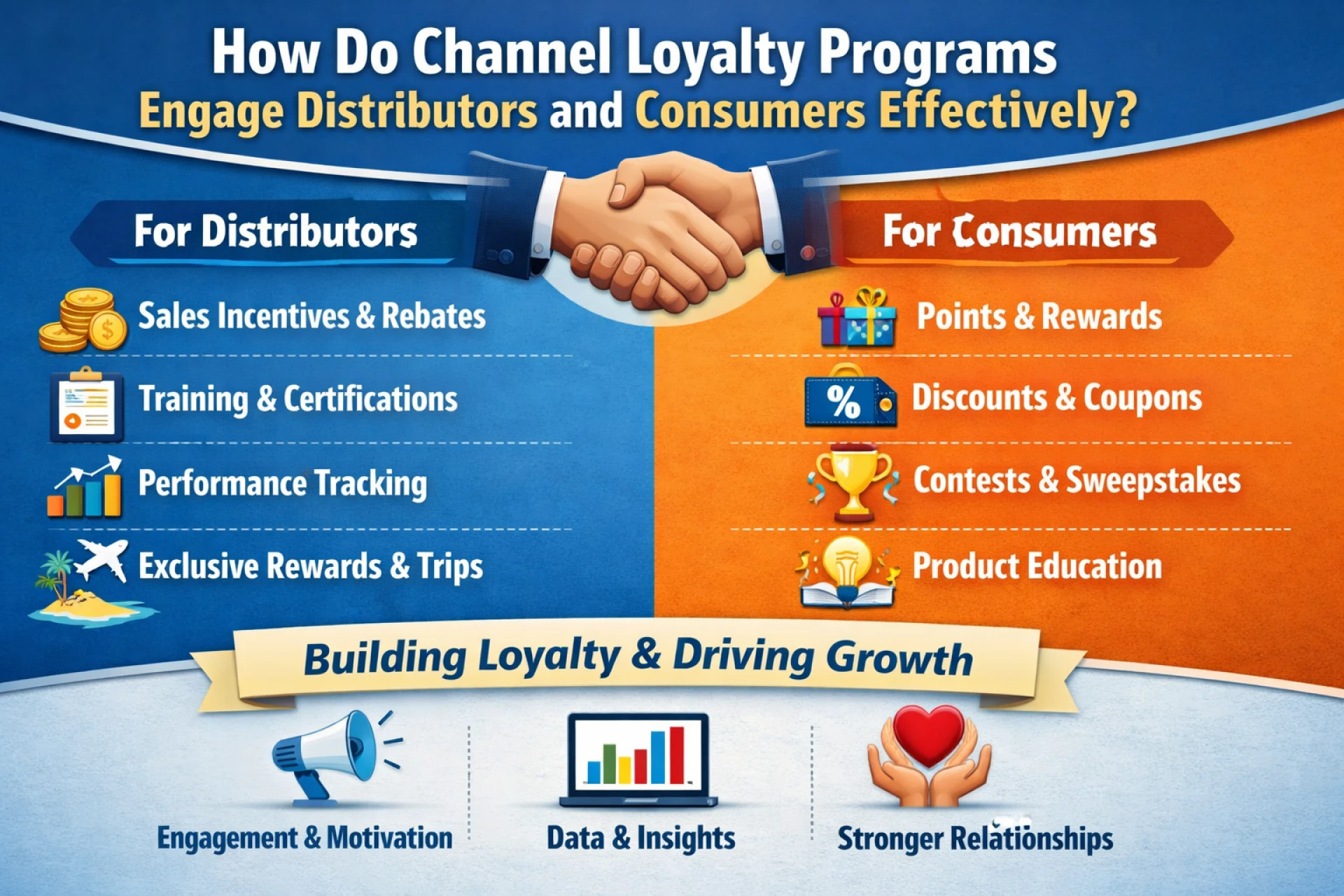

Selling a great product is not enough anymore. Today, brands need strong relationships — with the people who sell their products and the people who buy them. That is exactly where channel loyalty programs come in.
A well-built channel loyalty program works on two levels. It keeps distributors motivated to push your brand over competitors. And it keeps consumers coming back for more. When both sides are engaged, your entire sales chain becomes stronger, faster, and more profitable.
In this blog, we break down how channel loyalty programs work, why they matter, and how a distributor loyalty program can change the way your business grows.
What Are Channel Loyalty Programs?
Channel loyalty programs are reward-based systems built for the people in your sales chain — dealers, retailers, wholesalers, and distributors. They work differently from a regular customer rewards card. Instead of just giving points for purchases, they reward business behavior: hitting sales targets, pushing specific SKUs, attending training sessions, or recruiting new buyers.
Think of it this way. If you make a paint brand and you want hardware shops to recommend YOUR paint — not a competitor's — you need to give them a reason. A channel loyalty program does exactly that.
Why Do Businesses Need a Distributor Loyalty Program?
Your distributors are not employees. They stock and sell dozens of brands. Without a reason to prioritize yours, they will push whatever earns them the best margin or the simplest sale.
A strong distributor loyalty program fixes this by:
Giving distributors skin in the game. When distributors earn points, cashback, or rewards for selling your brand, they actively choose your products over others. It becomes personal — their earnings depend on your success.
Building long-term relationships. A distributor loyalty program is not just a one-time campaign. It creates a habit. Distributors who earn rewards consistently start to see your brand as a partner, not just a supplier.
Providing real-time performance data. Modern channel loyalty programs track distributor performance in real time. You can see who is selling, what they are selling, and where the gaps are — all in one place.
Reducing channel conflict. When rewards are tiered and transparent, distributors feel treated fairly. This reduces complaints, drop-offs, and under-performance.
How Do Channel Loyalty Programs Engage Consumers?
On the consumer side, channel loyalty programs work as a trust builder. When your distributors are rewarded for recommending your product AND your consumers get rewarded for buying it, the entire experience feels coordinated and genuine.
Here is how channel loyalty programs connect with consumers:
Points and rewards for purchases. Consumers collect points every time they buy a product. These points can be redeemed for discounts, gifts, or exclusive offers. This simple mechanic builds purchase habits over time.
Personalized offers. Good channel loyalty programs use purchase data to send the right offer to the right customer at the right time. A consumer who buys a product every month might get a loyalty discount in week three — just before they would normally reorder.
Gamification. Badges, levels, and milestone rewards keep consumers engaged beyond just buying. They feel like part of a club, not just a transaction.
Feedback loops. When consumers share reviews or referrals through a channel loyalty program, they become active promoters. This turns loyal buyers into an unpaid sales force.
How Does a Distributor Loyalty Program Connect with Consumer Engagement?
Here is the part most businesses miss. A distributor loyalty program and a consumer loyalty program should not run in isolation. The best channel loyalty programs connect both.
When a distributor earns rewards for promoting a product and a consumer earns rewards for buying that product, you create a reinforced loop. The distributor has more reason to recommend your brand. The consumer has more reason to ask for it by name. Both actions support each other.
For example, a home appliance brand might run a distributor loyalty program where dealers earn bonus points for every first-time buyer they onboard. At the same time, that new buyer gets a welcome reward on their first purchase. The distributor wins. The consumer wins. The brand wins.
Key Features That Make Channel Loyalty Programs Work
Not all channel loyalty programs are equal. The ones that actually drive results share a few common features:
Easy enrollment and access. If your distributor has to fill out 10 forms to join, they will not bother. The best channel loyalty programs have simple sign-up, a mobile-friendly dashboard, and instant reward visibility.
Tiered rewards. A flat reward structure does not motivate growth. Tiered systems — like Silver, Gold, and Platinum — push distributors to sell more because the next level always offers better benefits.
Real-time tracking. Both distributors and consumers want to know their points balance instantly. Real-time tracking reduces confusion and keeps engagement high.
Flexible redemption. Cash, vouchers, travel, merchandise — the best channel loyalty programs give participants options. Flexibility increases the perceived value of rewards.
Training and enablement rewards. A smart distributor loyalty program rewards distributors not just for sales, but for completing product training. Better-trained distributors sell more confidently and more accurately.
Mistakes to Avoid in Channel Loyalty Programs
Even well-funded channel loyalty programs can fail. Here is what to watch out for:
One-size-fits-all rewards do not work. A small retailer and a national distributor have very different motivations. Your distributor loyalty program should segment participants and offer relevant rewards to each group.
Complicated terms kill participation. If distributors have to read a 10-page document to understand how they earn rewards, they will disengage. Keep the rules simple and clear.
Ignoring feedback leads to drop-off. The best channel loyalty programs regularly survey participants and update reward structures based on what is actually motivating people.
Final Thoughts
The most effective businesses today are not just building great products — they are building great ecosystems. Channel loyalty programs are at the heart of this approach. They align distributors, retailers, and consumers around a shared goal: your brand's growth.
A thoughtfully designed distributor loyalty program ensures your sales partners are always motivated, well-informed, and loyal. And when that loyalty is paired with strong consumer engagement, you build a sales chain that practically runs itself.
If you are ready to build channel loyalty programs that actually move the needle — for your distributors and your consumers — now is the time to act.


























Sign in to leave a comment.