How Do Coding Agents Work? From Writing Code to Autonomous Development

Introduction
Coding agents are AI-powered systems that can understand software development tasks, analyze codebases, write and modify code, run tests, and debug problems with limited human intervention. Unlike traditional AI coding assistants that primarily suggest code, coding agents can execute multiple development steps using tools, contextual information, and feedback from their environment.
Understanding how coding agents work helps developers and engineering teams use them effectively. These agents can support everything from small code changes to complex software development workflows, while human developers remain responsible for reviewing and validating the results.
What Are Coding Agents?
Coding agents are AI systems designed to perform software development tasks by understanding instructions, making decisions, and taking actions within a development environment.
A coding agent can receive a task such as fixing a bug, implementing a feature, or improving an existing function. It then analyzes the available code, determines the steps required, and uses tools to carry out the work.
Depending on its capabilities and permissions, a coding agent may:
- Analyze source code and understand project structure.
- Identify files relevant to a development task.
- Generate, modify, or refactor code.
- Execute commands and run tests.
- Investigate errors and suggest fixes.
- Review changes and explain its implementation.
The key difference between a coding agent and a basic AI coding assistant is its ability to perform a sequence of actions toward a defined goal rather than simply responding to individual prompts.
Related Blog: https://savyre.com/ai-coding-agents-what-are-they-and-how-do-they-work
How Do Coding Agents Work?
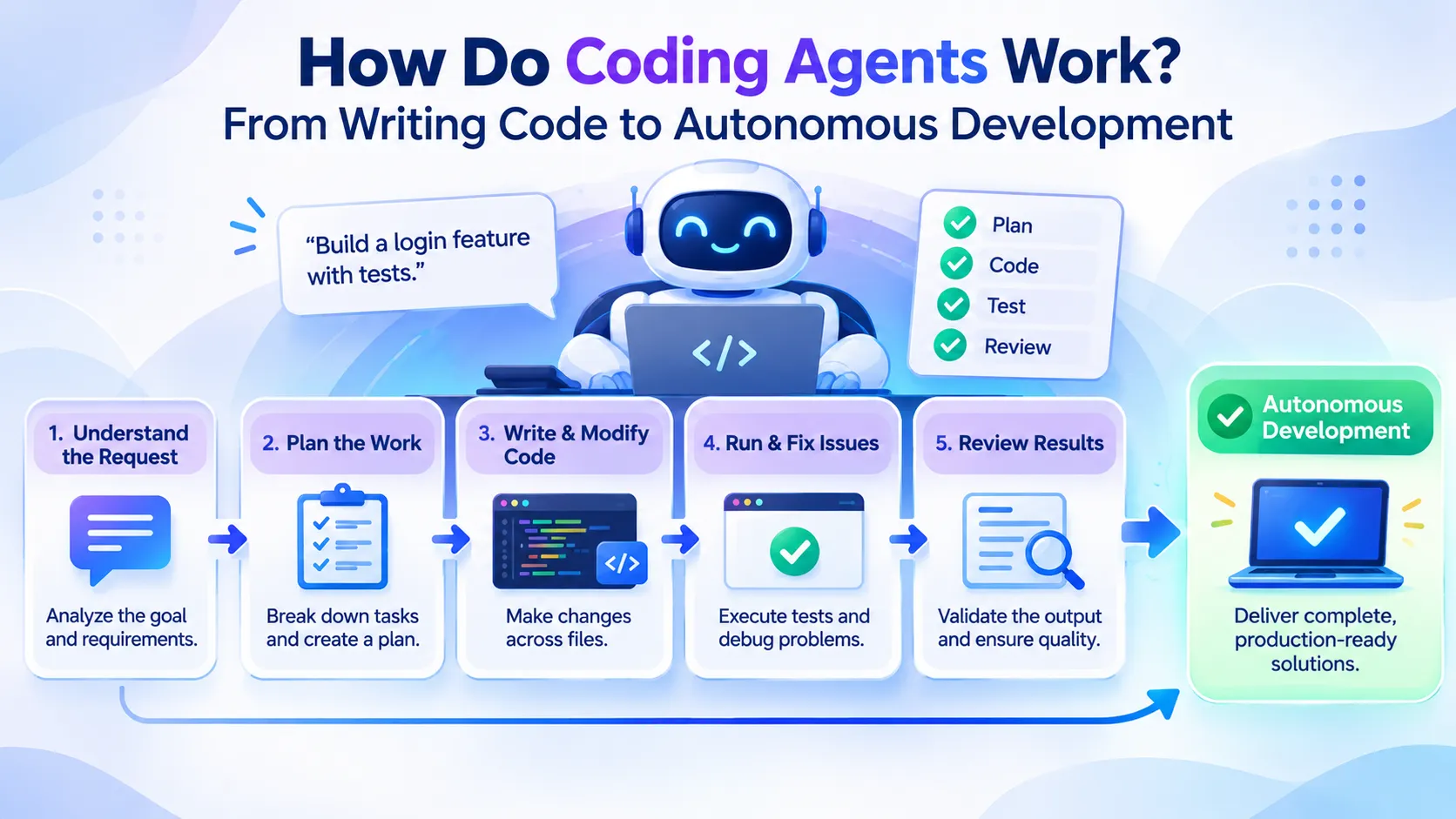
Coding agents work through a continuous cycle of understanding a task, planning an approach, taking action, evaluating the results, and refining their implementation.
Although different tools use different architectures, most coding agents follow a similar process.
1. Understanding the Development Task
The process begins when a developer provides an instruction, such as adding a feature, fixing a bug, or improving application performance.
The agent interprets the request and identifies the expected outcome. It may use the existing codebase, documentation, and previous interactions to understand the requirements.
For example, a developer might ask an agent to add user authentication to an application. The agent needs to understand the existing authentication system, relevant dependencies, and expected behavior before making changes.
Clear requirements help the agent produce more relevant and reliable results.
2. Analyzing the Codebase and Context
Before writing code, a coding agent needs information about the project.
It may inspect files, search for functions, read configuration files, examine dependencies, and identify relationships between different components.
This process helps the agent understand how the requested change fits into the existing application.
For example, when fixing a bug in an API endpoint, the agent may inspect the route definition, related services, database models, and existing tests.
The quality of this analysis depends on the context available to the agent. Incomplete or outdated information can lead to incorrect assumptions and unnecessary changes.
3. Planning the Implementation
After understanding the task, the agent determines how to complete it.
For a complex feature, the plan may include several smaller steps:
- Identify the files that need modification.
- Determine the required code changes.
- Update relevant dependencies or configurations.
- Create or modify tests.
- Verify the implementation.
Breaking a task into smaller steps helps the agent manage complex development work and makes its actions easier to review.
However, a plan is not a guarantee of correctness. Developers should review important decisions, especially when changes affect security, architecture, or critical business logic.
4. Writing and Modifying Code
Once the agent has a plan, it generates or modifies code using the available development tools.
Depending on the environment, it may edit files directly, apply patches, create new components, or execute commands through a terminal.
For example, an agent working on a payment feature may update the payment service, add validation logic, and modify related tests.
The agent uses the task requirements and codebase context to guide its implementation.
Unlike a traditional code suggestion tool, an agent may carry out multiple changes across files as part of one development task.
5. Running Tests and Evaluating Results
Coding agents can use feedback from their development environment to evaluate their work.
They may execute unit tests, integration tests, build commands, linters, or other validation tools.
If a test fails, the agent can examine the error, identify a possible cause, and attempt a correction.
For example, if a newly added function causes a test failure, the agent may inspect the failing assertion, modify the implementation, and rerun the test.
This feedback loop is an important part of how coding agents work. It allows them to improve an implementation based on actual execution results rather than relying only on generated code.
Still, passing tests does not prove that software is secure, correct, or ready for production. Human review and broader validation remain important.
6. Reviewing and Delivering the Changes
After completing the implementation and validation steps, the agent can summarize its changes and provide the results for review.
A developer can inspect the modified files, review the generated code, verify the tests, and decide whether to accept or revise the changes.
Some agents can also prepare pull requests or assist with code review, depending on their integrations and permissions.
This final stage keeps developers involved in important decisions while allowing the agent to handle repetitive development tasks.
What Makes Coding Agents Different from Traditional AI Coding Assistants?
Traditional AI coding assistants primarily help developers by generating code suggestions, completing functions, or answering programming questions.
Coding agents can go further by coordinating multiple actions to complete a task.
| Capability | AI Coding Assistant | Coding Agent |
|---|---|---|
| Generate code | Yes | Yes |
| Understand code context | Yes, depending on the tool | Yes, depending on available context |
| Plan multi-step tasks | Limited or tool-dependent | A core capability |
| Execute development tools | Varies | Often supported |
| Run tests and respond to errors | Tool-dependent | Often part of the workflow |
| Complete tasks across multiple files | Tool-dependent | Commonly supported |
The distinction is not absolute. Modern coding assistants increasingly include agentic capabilities, and the level of autonomy varies across tools.
What Is Autonomous Software Development?
Autonomous software development refers to using AI systems to complete software development tasks with reduced human intervention.
A coding agent may independently analyze a task, create an implementation plan, modify code, execute tests, and refine its work.
For example, an engineering team could assign an agent a well-defined task to add input validation to an existing API. The agent may inspect the code, implement the validation, update tests, and prepare the changes for review.
However, autonomous development does not necessarily mean fully independent software engineering.
Human developers still need to define requirements, establish permissions, review important changes, and verify that the resulting software meets quality and security standards.
The practical goal is to automate appropriate development activities while maintaining human oversight.
Benefits of Coding Agents for Software Development
Coding agents can help engineering teams improve their development workflows in several ways.
Reduced repetitive work: Agents can assist with routine coding, test creation, documentation updates, and straightforward bug fixes.
Faster feedback: By running tests and examining errors, agents can help developers identify implementation problems earlier.
Support for complex tasks: Agents can coordinate changes across multiple files and follow structured development steps.
Improved workflow consistency: Teams can define reusable processes for planning, implementation, testing, and review.
More time for engineering decisions: Developers can spend more time on architecture, requirements, code quality, and product decisions instead of repetitive implementation work.
These benefits depend on task complexity, codebase quality, tool capabilities, and the level of human review.
How Savyre Supports Structured AI-Assisted Software Development
Savyre's AI Coding Workflow helps developers bring structure to AI-assisted software development through a 15-stage framework.
The workflow supports activities from requirements and codebase discovery through design, implementation, testing, code review, and impact analysis.
Developers can use it with VS Code and Cursor, working with AI tools such as Claude and Copilot.
Rather than relying entirely on ad hoc prompts, teams can follow a structured process with traceable engineering artifacts and exportable workflow reports.
This approach helps developers organize AI-assisted coding activities while maintaining visibility into the development process.
Savyre also offers AI Coding Evaluator, which helps engineering leaders evaluate AI-assisted development through measurable evidence, coding guardrails, and rubric-based reports.
These capabilities support a broader approach to AI-assisted engineering in which development speed is balanced with quality, accountability, and review.
Conclusion
Coding agents are changing how developers approach software development by combining code generation with planning, tool use, testing, and iterative problem-solving.
Understanding how coding agents work helps teams identify which tasks can be automated and where human judgment remains essential.
With structured workflows, clear requirements, and effective review practices, coding agents can support more organized AI-assisted software development. Savyre helps teams apply this approach through structured AI Coding Workflow processes and tools for evaluating AI-assisted development.
Frequently Asked Questions
How do coding agents work?
Coding agents work by interpreting a development task, analyzing the codebase, planning an implementation, writing or modifying code, and evaluating the results using tools such as tests and terminal commands. They can repeat this process until the task is completed or requires human intervention.
What is the difference between a coding agent and an AI coding assistant?
An AI coding assistant primarily helps with code suggestions, explanations, and completions. A coding agent can coordinate multiple development actions, such as analyzing files, modifying code, running tests, and responding to errors.
Can coding agents develop software autonomously?
Coding agents can complete certain software development tasks with limited human intervention. However, complex projects still require developers to define requirements, review implementations, manage permissions, and validate software quality.
Are coding agents suitable for enterprise software development?
Coding agents can support enterprise development when teams establish appropriate access controls, testing requirements, security reviews, and human oversight. Their suitability depends on the task, the development environment, and the organization's governance requirements.
How can developers improve coding agent results?
Developers can improve results by providing clear requirements, relevant codebase context, specific acceptance criteria, and appropriate testing instructions. Reviewing generated changes and validating the implementation also helps reduce errors.







Sign in to leave a comment.