

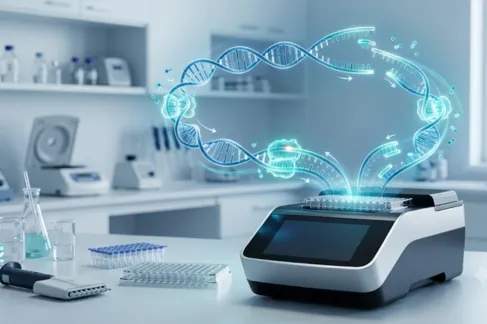
Polymerase chain reaction (PCR) is a widely used molecular biology technique for making millions of copies of a specific DNA sequence. PCR amplification kits simplify this process by providing the essential components needed to perform DNA amplification in a convenient, ready-to-use format.
These kits are used in research, genetic testing, diagnostics, biotechnology, and many other applications. But how exactly does a PCR amplification kit work? The answer becomes easier to understand when the PCR process is broken down into individual steps.
What Is a PCR Amplification Kit?
A PCR amplification kit is a collection of reagents required to amplify a target DNA sequence. Depending on the kit, it may contain a DNA polymerase, reaction buffer, deoxynucleotide triphosphates (dNTPs), magnesium ions, primers, and other components.
Some kits provide a complete master mix, while others require researchers to add certain components separately. The exact contents depend on the type of PCR and the intended application.
The main purpose of the kit is to provide the chemical environment required for a DNA polymerase to copy the target sequence repeatedly.
What Components Are Needed for PCR?
Before looking at the amplification process, it helps to understand the role of each major component.
Template DNA
Template DNA contains the sequence that researchers want to amplify. It can come from biological samples, purified genomic DNA, plasmids, or other sources.
Only the region between the two primers is amplified during a standard PCR reaction.
Primers
Primers are short, single-stranded DNA sequences designed to bind to specific regions on the template DNA. A PCR reaction generally uses two primers: a forward primer and a reverse primer.
They define the boundaries of the DNA fragment that will be amplified.
DNA Polymerase
DNA polymerase is the enzyme responsible for synthesizing new DNA strands. Thermostable DNA polymerases, such as Taq polymerase, are commonly used because PCR involves repeated exposure to high temperatures.
dNTPs
Deoxynucleotide triphosphates, or dNTPs, are the building blocks used to make new DNA strands. The four dNTPs are dATP, dCTP, dGTP, and dTTP.
Reaction Buffer and Magnesium
The reaction buffer provides an appropriate chemical environment for polymerase activity. Magnesium ions are also important because DNA polymerase requires magnesium as a cofactor for DNA synthesis.
Step 1: Preparing the PCR Reaction
The first step is to combine the required PCR components.
A typical reaction contains template DNA, forward and reverse primers, DNA polymerase, dNTPs, buffer, magnesium ions, and water. In many commercial kits, several of these components are already combined into a PCR master mix.
The reaction mixture is then transferred into a PCR tube or plate.
The amount and concentration of each component can vary depending on the kit, target sequence, and experimental purpose. Following the manufacturer's recommended conditions is important for consistent results.
Step 2: Denaturation Separates the DNA Strands
Once the PCR reaction is prepared, it is placed in a thermal cycler. This instrument repeatedly changes the temperature according to a programmed PCR cycle.
The first major stage is called denaturation.
During denaturation, the reaction is heated to a high temperature. This causes the hydrogen bonds between the two strands of double-stranded DNA to break, separating the DNA into two single strands.
These separated strands serve as templates for the next stage.
Step 3: Annealing Allows Primers to Bind
After denaturation, the temperature is lowered during the annealing stage.
At this temperature, the primers can bind, or anneal, to their complementary sequences on the single-stranded DNA templates.
Primer binding is an important part of PCR specificity. The primers are designed to recognize the target region, helping the reaction selectively amplify the desired DNA sequence.
The appropriate annealing temperature depends on factors such as primer sequence and composition.
Step 4: Extension Creates New DNA
The next stage is extension, also called elongation.
During this step, the DNA polymerase binds to the primer-template complex and adds complementary nucleotides to the growing DNA strand.
For example, if the template contains an adenine (A), the polymerase incorporates thymine (T) into the new strand. Similarly, cytosine (C) pairs with guanine (G).
The polymerase continues synthesizing the new strand until the DNA region is copied.
Step 5: Repeating the PCR Cycle
The denaturation, annealing, and extension steps are repeated multiple times.
Each cycle creates additional copies of the target DNA. As the number of cycles increases, the amount of amplified DNA can increase dramatically.
Ideally, the target DNA approximately doubles during each cycle. This exponential amplification is what makes PCR highly sensitive and useful for detecting or analyzing small amounts of DNA.
In practice, amplification eventually becomes less efficient because reaction components are consumed and other limiting factors develop.
Step 6: Final Extension and Product Analysis
After the required amplification cycles are complete, many PCR protocols include a final extension step. This gives the DNA polymerase additional time to complete partially synthesized strands.
The resulting PCR product, often called the amplicon, can then be analyzed using an appropriate downstream technique.
For example, researchers may use gel electrophoresis to examine the size of the amplified DNA fragment. Other applications may use sequencing, cloning, or downstream molecular assays.
How PCR Kits Improve the Process
PCR amplification kits can make PCR workflows easier and more consistent because important reagents are supplied together and often optimized for a particular application.
Ready-to-use master mixes can also reduce pipetting steps and minimize the possibility of preparation errors. Some specialized kits are designed for high-fidelity amplification, rapid PCR, multiplex PCR, or other specific applications.
However, kit performance still depends on factors such as template quality, primer design, reaction conditions, and proper handling.
Common Applications of PCR Amplification Kits
PCR amplification kits are used across many areas of molecular biology.
Common applications include:
- Amplifying DNA for sequencing
- Genotyping and genetic research
- Cloning and recombinant DNA work
- Detection of specific DNA sequences
- Mutation analysis
- Microbial research
- Molecular diagnostics
- Forensic DNA analysis
- Research involving gene expression when combined with reverse transcription
Different applications may require different types of PCR kits. For example, RT-PCR kits are used when RNA must first be converted into complementary DNA (cDNA), while high-fidelity PCR kits are useful when accurate DNA copying is particularly important.
What Happens After PCR Amplification?
PCR amplification produces a large number of copies of the selected DNA region, but amplification is often only one part of a larger workflow.
The amplified DNA may need to be purified before downstream applications. Researchers can then analyze the product using techniques such as sequencing, restriction analysis, electrophoresis, cloning, or other molecular assays.
The choice of downstream method depends on what information the experiment is intended to obtain.
Conclusion
PCR amplification kits work by providing the essential reagents needed to repeatedly copy a selected DNA sequence. The process begins with template DNA and primers and proceeds through three fundamental stages: denaturation, annealing, and extension.
During denaturation, DNA strands separate. During annealing, primers bind to their target sequences. During extension, DNA polymerase adds nucleotides to create new DNA strands. Repeating these stages generates many copies of the target sequence.
By combining optimized reagents in a convenient format, PCR amplification kits help researchers perform reliable DNA amplification for a wide range of molecular biology applications.


























Sign in to leave a comment.