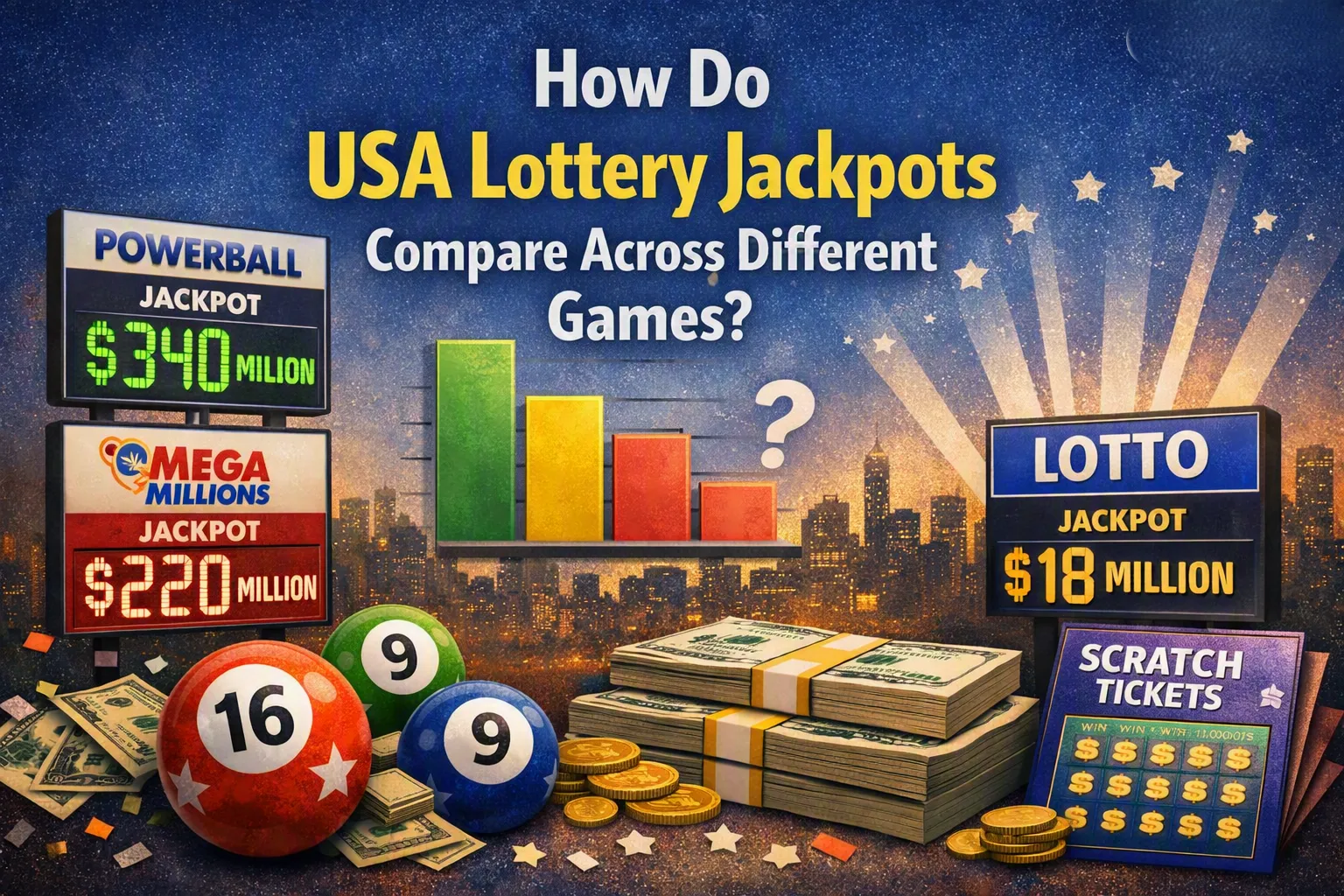

A huge lottery jackpot is appealing because one winning combination can create a life-changing prize. But jackpot sizes vary because each game uses different number pools, prize structures, ticket prices, and rollover rules. When comparing the jackpot usa lottery landscape, the headline number is only one part of the story. Powerball and Mega Millions dominate the biggest-jackpot conversation, while state-specific games can offer smaller prizes with different odds.
The Heavyweights: Powerball vs. Mega Millions
Powerball and Mega Millions are the two major multi-jurisdiction lottery games. Their jackpots can reach hundreds of millions or billions when nobody wins the top prize.
Powerball currently starts at $20 million after a jackpot win, while Mega Millions starts at $50 million. Both jackpots can grow when there is no jackpot winner. Ticket sales and the amount needed to fund the advertised annuity also influence how quickly the headline prize rises.
The top-prize odds are extremely difficult:
- Powerball: about 1 in 292.2 million.
- Mega Millions: about 1 in 290.5 million.
Despite different starting jackpots, the odds are remarkably close. Neither game should be viewed as a realistic way to build wealth through regular play.
Mega Millions also changed its structure in 2025. Its ticket price became $5, while non-jackpot prizes increased and a built-in multiplier was added to every play. So, ticket cost and lower-tier prizes matter too.
The State-Specific Options: Smaller Games
State-specific lottery games can offer a different balance between jackpot size and winning odds. California SuperLotto Plus, for example, has a much smaller top prize than the largest Powerball or Mega Millions jackpots, but its jackpot odds are about 1 in 1.59 million.
That difference is substantial. A smaller jackpot does not automatically mean a less interesting game. Players focused on jackpot odds may prefer a game with a smaller number pool.
Some state games also include bonus drawings, second-chance promotions, or stronger lower-tier prizes. These features can provide additional chances to win, depending on the rules. Always check the current official rules because prize structures and promotional features can change.
The trade-off is straightforward: massive national jackpots usually come with extremely difficult jackpot odds, while smaller games may offer better odds but a lower maximum prize.
The "Annuity" Factor: Understanding the Real Payout
An advertised jackpot is not always the amount a winner receives immediately.
For major US lottery games, the advertised jackpot is generally the estimated annuity value. A jackpot winner can typically choose scheduled payments or a one-time cash option. The cash value is lower because it represents the money needed today to fund future annuity payments.
Imagine a hypothetical $100 million advertised jackpot. The cash option might be around $60 million, although the actual amount depends on the game, interest rates, and final sales figures. Taxes would then affect the amount ultimately kept. This example is illustrative, not a fixed payout formula.
So, comparing games only by advertised jackpots can give an incomplete picture.
Which Game Offers the Best "Value"?
There is no single game that offers the best value for everyone. It depends on what you mean by value.
If the goal is the biggest possible dream, Powerball and Mega Millions are the obvious heavyweights. Their enormous jackpots can far exceed most smaller games.
If the goal is better jackpot odds, state-specific games may be more appealing. The prize is smaller, but the chance of hitting the top tier can be dramatically better.
Before choosing a game, compare:
- Ticket price and number of plays.
- Jackpot size and growth.
- Jackpot odds.
- Overall odds of winning any prize.
- Lower-tier prize amounts.
- Cash and annuity options.
- Bonus or second-chance features.
This makes the jackpot usa lottery market a spectrum rather than a race for the largest number.
Conclusion
Comparing US lottery jackpots requires more than looking at the biggest advertised figure. Powerball and Mega Millions offer extraordinary jackpot potential, but their top-prize odds remain roughly one in hundreds of millions. Smaller state games can provide lower jackpots and, in some cases, much better odds. The cash-versus-annuity choice also changes how an advertised prize should be interpreted.
The sensible approach is to understand the rules, compare odds and payouts, set a firm entertainment budget, and treat every ticket as a chance rather than an investment. Jackpots change from drawing to drawing, so the jackpot usa lottery landscape continues to evolve. Staying informed helps you enjoy the excitement without losing sight of the mathematics.

























Sign in to leave a comment.