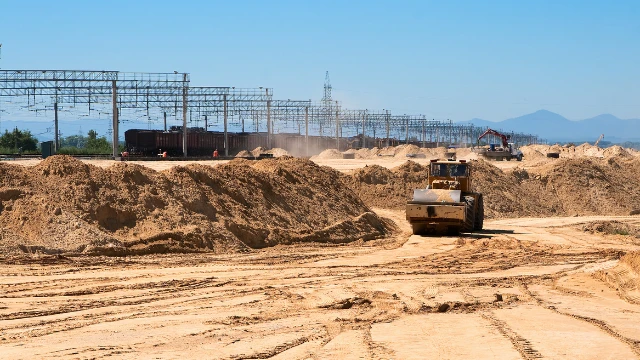

Are you working on a construction project that requires excavation or fill? The reason may be anything. But, knowing how to find the amount of material needed for grading is crucial in any construction project.
They are crucial for roadways, bridges, and building foundations, ensuring the success and efficiency of these projects.
I will discuss all the information and the steps for calculating earthwork volume. So, let\'s roll up our sleeves and dive into the world of earthworks!
Methods for Measuring and Calculating Earthwork Volume
Accurately measuring earthwork volume is essential in construction projects. It shows the amount of soil, rock, or other materials that need to be moved. Leverage Earthwork Takeoff Services to streamline the calculation process. Here are standard methods used for measuring and calculating earthwork volume:
Cross-Sectional Method:
The cross-sectional method divides the area into equally spaced sections. They are perpendicular to the alignment. It calculates the volume of each section using the trapezoidal formula: [ text{Volume of Section} = frac{{text{Area of Lower Base} + text{Area of Upper Base} + sqrt{text{Area of Lower Base} times text{Area of Upper Base}}}}{2} times text{Interval Length} ]
Summing the volumes of all sections provides the total earthwork volume.
Average End Area Method:
The average end area method involves taking cross-sections at regular intervals along the length of the excavation or embankment. Then, you calculate the average areas of the end sections to find the volume.
The formula for the volume by the average end area method is: [ text{Volume} = frac{{text{Area of Start Section} + text{Area of End Section}}}{2} times text{Distance between Sections} ]
Grid Method:
The grid method divides the site into a grid of squares or rectangles, with each grid cell representing a specific volume of earthwork. By determining the depth of excavation or fill for each grid cell, the total volume can be calculated by summing the volumes of all cells.
3D Modeling and Software:
Advanced 3D modeling software like AutoCAD Civil 3D, Trimble Business Center, or Bentley MicroStation can make digital terrain models (DTMs) and analyse earthwork volumes. These tools enable precise calculations and visualisation of earthwork quantities.
Laser Scanning and Drone Technology:
Employ laser scanning and drone technology to capture detailed topographic data of the project site. LiDAR scans and aerial surveys provide high-resolution elevation information for accurate earthwork volume calculations and terrain modelling.
Mass Haul Diagrams:
Make mass haul diagrams. They optimise earthmoving by balancing cut and fill. Mass haul diagrams show on-site material movement, reducing transportation costs and time during earthwork activities.
Geospatial Technologies:
They use GPS, GIS, and total stations to collect precise field data, track earthwork progress, and check volume calculations. Geospatial tools enhance accuracy and efficiency in earthwork volume measurement.
Construction professionals can efficiently measure earthwork volume by applying methods and technology. This enables effective project planning, resource allocation, and earthmoving.
Factors Affecting Accuracy in Earthwork Volume Calculations
Several factors can influence the accuracy of earthwork volume calculations. Here are vital factors to consider:
Survey Accuracy:
The precision of survey data affects earthwork volume accuracy. This includes topographic surveys, elevation measurements, and site contours. High-quality survey data leads to more reliable volume estimations.
Measurement Errors:
During field surveys or data collection, mistakes in measuring distances, elevations, or areas can add errors to earthwork volume calculations. Minimising measurement errors through calibration, validation, and quality control processes is essential.
Data Quality and Consistency:
Insufficient data, such as missing elevation points, wrong units, or old survey information, can affect earthwork volume calculations. Ensuring data quality and consistency improves the reliability of volume estimates.
Assumption Accuracy:
Assumptions made during volume calculations can affect the accuracy of earthwork estimates. These assumptions include uniform soil densities, slope stability, and compaction factors. Validating assumptions with site-specific data enhances accuracy.
Interpolation and Extrapolation:
Estimating volumes by connecting surveyed points creates uncertainties. Extrapolating beyond measured boundaries adds more. Careful consideration of interpolation methods and extrapolation techniques is necessary to minimise errors.
Calculation Methods:
The calculation method chosen affects the accuracy of earthwork volume calculations. Options include cross-sectional analysis, average end area method, 3D modelling, and software-based approaches. Selecting the most suitable method for the project requirements is critical.
Complexity of Site Conditions:
The site has complex conditions, including irregular terrain, soil types, rock formations, and tight work areas. These conditions make accurate volume calculations difficult. Adapting calculation methods to account for site complexities improves accuracy.
Changes in Design or Scope:
Design modifications, scope changes, or unforeseen site conditions during construction can impact earthwork volume calculations. Regularly updating volume estimates to reflect design revisions ensures alignment with project dynamics.
By using best practices in data collection, math, and quality control and considering these factors, construction professionals can improve earthwork volume calculations. This will lead to better project outcomes.
Best Practices for Efficient Earthwork Volume Estimation
By using best practices, construction pros can speed up estimates. They can also boost overall project efficiency. Here are essential best practices for efficient earthwork volume estimation:
- Utilise advanced surveying equipment and techniques to ensure precise measurements for volume calculations.
- Digital tools like 3D modelling software, GPS, drones, and laser scanning are used to make digital terrain models (DTMs) and find volumes.
- Create standard measurement methods and calculation procedures. Use them for consistent earthwork volume estimates across projects.
- Implement regular progress monitoring of earthwork activities to track excavation and fill operations.
- Collective expertise enhances the accuracy of volume calculations.
- Diversifying calculation approaches minimises errors and improves estimation precision.
- Adapting calculations to address site constraints enhances the accuracy of estimations.
- Analysing mass haul diagrams, material quantities, and transportation logistics can optimise cut-fill balances. Balancing earthmoving operations reduces unnecessary movements, minimises costs, and improves overall project efficiency.
Construction professionals can optimise earthwork activities by using best practices. These practices ensure efficient, accurate, and productive management, leading to success.
To read more articles visit Writeupcafe
Conclusion
Calculating earthwork volume is a crucial step in many construction and engineering projects. It lets builders estimate material amounts accurately, which allows them to plan well and save time and money. We can improve accuracy significantly by using proper techniques and tools, like GPS systems and automated software. The key takeaway is that adequate calculations are vital for success in construction. They must be considered. Technology advances, so we can only expect this process to become better and more precise.






Sign in to leave a comment.