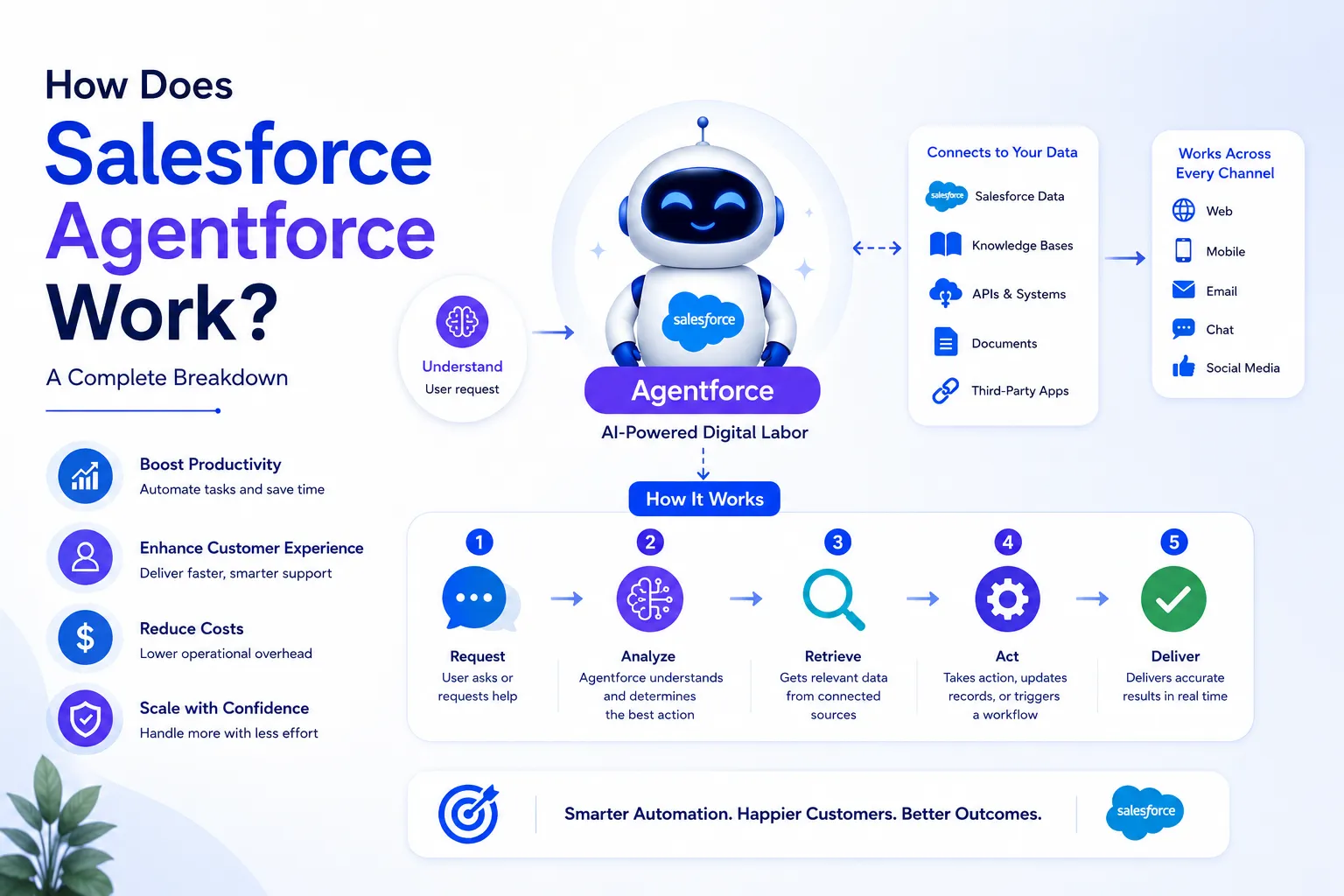

A practical guide from someone who has spent considerable time building, testing, and deploying Agentforce in real business environments.
When Agentforce was first announced, I will be honest, I was sceptical. Having worked with Salesforce automation tools for years, I had seen plenty of AI features launched with big promises that turned out to be more limited than the marketing suggested. So when I first got my hands on Agentforce, I approached it carefully, testing it against real business scenarios rather than demo environments.
What I found genuinely surprised me. Agentforce is not just another chatbot layer on top of Salesforce. It represents a fundamentally different way of thinking about automation, one where the system does not just respond to instructions but actually reasons through problems, decides what actions to take, and executes them across connected systems without a human in the loop at every step.
Here is a complete breakdown of how it actually works, based on what I have seen building and deploying it across multiple business environments.
What Agentforce Actually Is
Before getting into the mechanics, it helps to understand what makes Agentforce different from previous Salesforce automation tools. Flows automate predefined processes. Einstein Bots respond to scripted conversation paths. Agentforce does something different. It uses a large language model connected to your Salesforce data and a set of defined actions to reason through an interaction and decide what to do next based on the context of that specific situation.
The clearest way I have found to explain this to clients is with a simple comparison. A flow is like a decision tree. It follows a path based on predetermined conditions. Agentforce is more like a knowledgeable team member who reads the situation, draws on what they know, and figures out the best response on their own. If you want to understand where Agentforce sits relative to other Salesforce AI tools, our comparison of agentforce vs Salesforce Prompt Builder covers this in practical detail and is a good starting point before diving into a full Agentforce deployment.
The Four Core Components of How Agentforce Works
Topics
Topics are the foundation of how an Agentforce agent understands what it should and should not handle. Each topic defines a category of interaction, what the agent is responsible for, what it is not, and the natural language instructions that guide its behaviour within that area.
When I build topics, I spend a significant amount of time on the instruction writing. Vague instructions produce unpredictable behaviour. Specific, well structured instructions produce agents that behave consistently. The quality of topic definition is probably the single biggest factor in how well an Agentforce deployment performs in production.
Actions
Actions are what the agent actually does when it decides to take a step. An action might retrieve a record from Salesforce, update a field, trigger a flow, send an email, or make a callout to an external system. Each action is connected to a flow, an apex class, or an external service, and the agent calls them based on what the situation requires.
This is where integration experience becomes critical. Businesses working with a salesforce consulting company that understands both the Agentforce layer and the underlying integration architecture get significantly better results than those treating the agent configuration and the action layer as separate concerns.
The Reasoning Engine
Between receiving an input and deciding what action to take, Agentforce uses a reasoning engine powered by a large language model. This is where the "intelligent" part of the system lives. The reasoning engine reads the context of the interaction, considers the available actions, checks the instructions in the relevant topic, and decides on a response or action.
What I found in practice is that the reasoning engine performs best when the actions available to it are clearly defined and the topic instructions are specific about when to use each one. When actions are vaguely described, the agent makes suboptimal decisions about when to trigger them. This is one of the areas where salesforce development consulting experience makes a real difference, because knowing how to structure action descriptions to produce reliable agent behaviour is something that comes from seeing many deployments, not from reading documentation.
The Data Layer
Agentforce does not operate in isolation. It draws on the data in your Salesforce org and, if configured correctly, on unified data from Salesforce Data Cloud. The quality and completeness of that data directly determines the quality of the agent's responses and decisions.
This is the part of Agentforce deployments that I find most businesses underestimate. They focus on the agent configuration and then discover that the agent cannot do what they need it to because the underlying data is incomplete, inconsistently structured, or siloed in systems that have not been connected to Salesforce.
What Actually Happens During an Agentforce Interaction
Walking through a real interaction helps make the mechanics concrete. A customer contacts your service portal with a query about their order status. The interaction enters Agentforce. The reasoning engine reads the message, identifies the relevant topic based on the content, and checks the instructions for that topic.
It then looks at the available actions and decides to retrieve the order record from Salesforce using the relevant action. It reads the record, formulates a response based on the order status, and replies to the customer with accurate, personalised information. If the order has a complication, the agent might trigger a different action to create a case and assign it to the relevant team, all without a human touching the interaction.
The whole process happens in seconds. And unlike a scripted bot, if the customer then asks a follow up question that falls into a different topic, the agent handles the transition naturally rather than getting stuck in a fixed conversation path.
Where Agentforce Needs Careful Design
Escalation logic
One of the most important design decisions in any Agentforce deployment is defining when the agent should stop trying to handle an interaction and pass it to a human. Getting this wrong in either direction creates problems. Escalating too quickly defeats the purpose of the agent. Escalating too late frustrates customers who needed human help several steps earlier.
I spend a lot of time on escalation design in every deployment. Clear escalation thresholds, well defined handoff points, and proper context passing so the human agent inherits the full conversation history are all critical.
Action efficiency
Every action an Agentforce agent takes consumes flex credits. Inefficient action chains, where the agent triggers multiple actions where one well designed action would do, add up quickly in production. Businesses using software integration services to build their action layer as part of a broader integration architecture tend to avoid this problem because the actions are designed with efficiency in mind from the start.
Testing with real world data
I cannot overstate the importance of testing Agentforce with real, messy, production-like data rather than clean demo records. In my experience, agents that perform well in testing with perfect data frequently encounter edge cases in production that produce unexpected behaviour. Build your test scenarios around the most unusual interactions you can imagine, not the most common ones.
What Makes the Difference Between a Good and a Great Deployment
After working on multiple Agentforce deployments across different industries and business sizes, the consistent differentiator between deployments that perform well and those that underdeliver is not the configuration of the agent itself. It is the quality of the foundation underneath it. Clean, well structured Salesforce data. Efficient, well designed actions. Properly integrated external systems.
Businesses that invest in getting the custom software integration layer right before they deploy Agentforce consistently get better results than those who try to shortcut the foundation and then fix problems after go live. The agent is only as capable as the systems it is connected to.
Final Thought
Agentforce is the most genuinely capable automation tool I have worked with in my Salesforce career. It does things that were not possible before and it does them in a way that feels surprisingly natural in production. But like any powerful tool, it rewards careful design, solid foundations, and a willingness to invest time in getting the details right before going live.
The businesses getting the best results from it are the ones treating it as a strategic capability rather than a feature to switch on.
























Sign in to leave a comment.