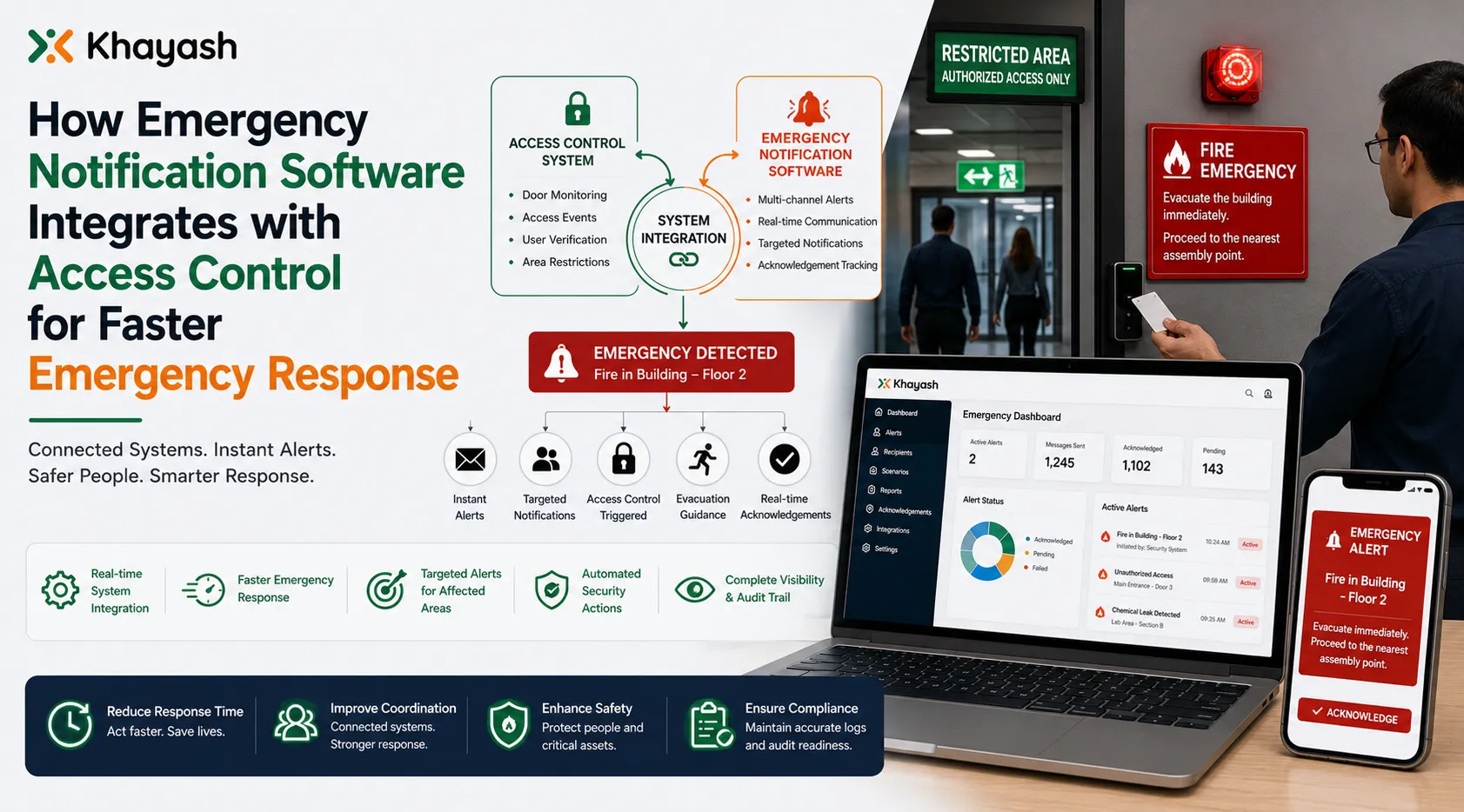

Every second matters during an emergency. Whether it is a fire, unauthorized access attempt, chemical leak, medical emergency, or security incident, organizations need to respond immediately to protect employees, visitors, and critical assets. While many workplaces have access control systems and emergency communication tools, these systems often operate independently, creating delays that can affect emergency response.
Modern Emergency Notification Software bridges this gap by integrating with access control systems to deliver real-time alerts, support evacuation procedures, and improve coordination during critical situations. Instead of relying on manual communication and isolated security systems, organizations can automate emergency workflows and ensure that the right information reaches the right people at the right time.
As businesses continue to prioritize workplace safety, integrating emergency notification with access control has become an important step toward creating a safer and more resilient workplace.
Why Standalone Emergency Systems Are No Longer Enough
Many organizations invest in access control systems to regulate entry into offices, production areas, server rooms, and other restricted spaces. At the same time, they may use separate tools to communicate during emergencies.
While each system serves its purpose, disconnected platforms often create challenges during critical incidents.
Some common issues include:
- Delayed emergency communication
- Manual coordination between security teams
- Difficulty identifying affected employees
- Inconsistent evacuation procedures
- Limited visibility into ongoing incidents
- Slower emergency response times
Integrating these systems helps organizations respond more efficiently while improving overall workplace safety.
The Role of Emergency Notification Software
Emergency Notification Software is designed to deliver critical information instantly during workplace emergencies.
Instead of relying on a single communication channel, organizations can notify employees, contractors, visitors, and emergency response teams simultaneously through SMS, email, mobile push notifications, voice calls, and desktop alerts.
This multi-channel approach improves message delivery and ensures that important instructions reach people regardless of where they are located.
By automating emergency communication, organizations reduce manual effort and improve response speed during high-pressure situations.
How Access Control Integration Improves Emergency Response
Access control systems manage who can enter specific areas within a workplace. When integrated with Emergency Notification Software, these systems become an active part of an organization's emergency response strategy.
For example, when an emergency is detected, authorized personnel can initiate predefined response workflows that immediately notify employees while supporting coordinated security actions based on organizational procedures.
Integration allows safety teams to respond more quickly by reducing manual communication and ensuring emergency information is shared without unnecessary delays.
Rather than operating independently, access control and emergency communication work together to create a more coordinated response.
Delivering Targeted Emergency Alerts
Not every incident affects an entire workplace.
A localized equipment failure, restricted-area security event, or building-specific emergency may require communication with only a particular group of employees.
Emergency Notification Software supports targeted notifications, allowing organizations to send alerts to specific buildings, departments, teams, or locations.
This focused communication helps employees receive relevant instructions while minimizing confusion for unaffected areas.
Targeted alerts also enable emergency teams to manage incidents more effectively without disrupting the entire organization.
Supporting Safe Evacuation Procedures
During emergencies, employees need clear instructions to leave affected areas safely.
Emergency Notification Software helps organizations distribute evacuation guidance instantly through multiple communication channels.
Combined with workplace maps and predefined evacuation plans, employees can receive timely information about assembly points, evacuation routes, and safety instructions.
Providing consistent guidance reduces uncertainty, supports orderly evacuations, and helps emergency coordinators account for personnel more efficiently.
Real-Time Acknowledgements Improve Coordination
Knowing that an emergency message has been sent is not enough. Organizations also need to understand whether employees have received and acknowledged important instructions.
Modern emergency notification platforms provide real-time acknowledgement tracking, enabling emergency coordinators to monitor communication as events unfold.
If responses are delayed, additional notifications can be triggered automatically through alternative channels.
This visibility helps emergency teams identify communication gaps and respond more effectively during critical situations.
Managing Emergencies Across Multiple Locations
Many organizations operate multiple offices, manufacturing facilities, warehouses, campuses, or branch locations. Coordinating emergency communication across these sites can be challenging when each location relies on different systems or manual processes.
A centralized Emergency Notification Software platform enables organizations to manage incidents across all locations from a single dashboard. Whether an emergency affects one building or multiple facilities, authorized teams can send alerts, monitor responses, and coordinate actions consistently.
This centralized approach ensures that every location follows the same emergency communication procedures while giving leadership complete visibility into ongoing situations.
Automating Emergency Response Workflows
During an emergency, manual decision-making can consume valuable time. Predefined response workflows help organizations act faster and more consistently.
Modern emergency notification platforms allow safety teams to create workflows for common scenarios such as:
- Fire emergencies
- Unauthorized access incidents
- Chemical spills
- Medical emergencies
- Power failures
- Severe weather events
- Building evacuations
Once an incident is identified, authorized personnel can activate the appropriate workflow to automatically notify employees with predefined instructions.
Automation reduces communication delays, minimizes human error, and ensures that everyone receives accurate information quickly.
Using Activity Dashboards for Better Incident Visibility
Effective emergency management requires real-time awareness.
Emergency Notification Software provides centralized dashboards that display:
- Active emergency alerts
- Alert delivery status
- Employee acknowledgements
- Ongoing incidents
- Communication history
- Response progress
These dashboards help safety teams monitor emergencies as they develop and make informed decisions based on live information.
Access to accurate operational data enables organizations to improve coordination and reduce confusion during high-pressure situations.
Improving Emergency Preparedness Through Reporting
Every emergency response creates valuable operational data.
Reporting and analytics allow organizations to evaluate how effectively emergency notifications were delivered and how employees responded.
Safety managers can review:
- Alert delivery performance
- Response times
- Acknowledgement rates
- Incident timelines
- Communication effectiveness
These insights help organizations identify opportunities to improve emergency planning, employee training, and response procedures.
Continuous improvement strengthens workplace safety and helps organizations prepare for future emergencies.
Choosing the Right Emergency Notification Software
Selecting the right emergency communication solution is essential for building a proactive workplace safety strategy.
When evaluating Emergency Notification Software, organizations should consider features such as:
- Multi-channel emergency alerts
- Access control integration
- Geo-targeted notifications
- Automated emergency workflows
- Real-time acknowledgement tracking
- Workplace maps and evacuation guidance
- Centralized dashboards
- Reporting and analytics
- Multi-location management
- Scalability for future business growth
A solution with these capabilities enables organizations to respond faster while improving employee safety and operational resilience.
The Future of Connected Workplace Safety
As workplaces become more connected, emergency management is evolving beyond standalone systems.
Organizations are increasingly integrating emergency notification platforms with access control, building management, surveillance, and other workplace technologies to create a unified safety ecosystem.
This connected approach enables faster communication, better coordination, and more informed decision-making during emergencies.
Businesses that invest in integrated safety solutions today are better prepared to protect people, maintain operational continuity, and respond confidently to unexpected incidents.
Conclusion
Fast and coordinated communication is one of the most important factors in managing workplace emergencies successfully. While access control systems help secure facilities, combining them with Emergency Notification Software creates a more comprehensive emergency response strategy.
By integrating emergency communication with workplace access management, organizations can automate alerts, coordinate evacuations, improve visibility into incidents, and reduce response times during critical situations.
A connected safety approach not only protects employees and visitors but also helps organizations maintain business continuity and strengthen overall workplace resilience.
If your organization is looking to modernize emergency communication and build a more connected safety infrastructure, get in touch with the team at Khayash. Our Emergency Notification Software helps businesses integrate emergency communication with workplace systems, deliver real-time alerts, and respond faster to emergencies across single or multiple locations.
Frequently Asked Questions
1. What is Emergency Notification Software?
Emergency Notification Software is a digital platform that enables organizations to send real-time emergency alerts through channels such as SMS, email, push notifications, and voice calls, helping employees respond quickly during critical situations.
2. How does Emergency Notification Software integrate with access control systems?
It complements access control by enabling organizations to automate emergency communication, coordinate security procedures, and improve response workflows during incidents, creating a more connected workplace safety strategy.
3. Why is access control integration important during emergencies?
Integrating emergency communication with access control helps organizations reduce manual coordination, improve response times, support evacuation procedures, and strengthen overall workplace safety.
4. Can Emergency Notification Software support multiple business locations?
Yes. Modern platforms allow organizations to manage emergency alerts, monitor responses, and coordinate incidents across multiple offices or facilities through a centralized dashboard.
5. What features should businesses look for in Emergency Notification Software?
Key features include multi-channel alerts, access control integration, geo-targeted notifications, automated workflows, acknowledgement tracking, centralized dashboards, reporting, evacuation guidance, and multi-location management.
























Sign in to leave a comment.