
Here’s a number that should stop every CTO mid-scroll: technical debt now absorbs between 21% and 40% of total enterprise IT spending, according to Deloitte’s 2026 Global Technology Leadership Study. Gartner puts a finer point on it — 80% of that debt is architectural, not cosmetic. It doesn’t come from sloppy code. It comes from a framework decision made in month one, before anyone on the founding team knew what “scale” would actually demand.
Most product leaders treat the tech stack as an engineering preference. It’s not. It’s a bet on your company’s future org chart, your infrastructure bill, and how fast you can ship the feature that lands your Series B. Get it wrong, and you don’t find out for eighteen months — right when the cost of fixing it is highest.
The problem with framework decisions is that they are rarely looked at again after they are made. A junior engineering lead will choose something they know well so they can meet a launch deadline. The product then becomes popular, and eighteen months later the same choice is a part of the infrastructure that nobody wants to change. By the time a Chief Technology Officer steps in to ask questions about how well the framework will work as it grows, the framework has already had a big impact on the team, the budget for hiring new people, and the plan for what the company will do in the future. Framework decisions like these are very important. They can affect the company for a long time. The framework is a part of the company's technology, and it is hard to make changes to it once it is in place.
Framework Selection Is a Scalability Bet, Not a Preference
Every framework encodes assumptions about how your product will grow. A stack built for content-heavy marketing sites behaves differently under load than one built for real-time, data-intensive applications. Pick the wrong fit, and you’re not just slower — you’re rebuilding core systems while competitors ship.
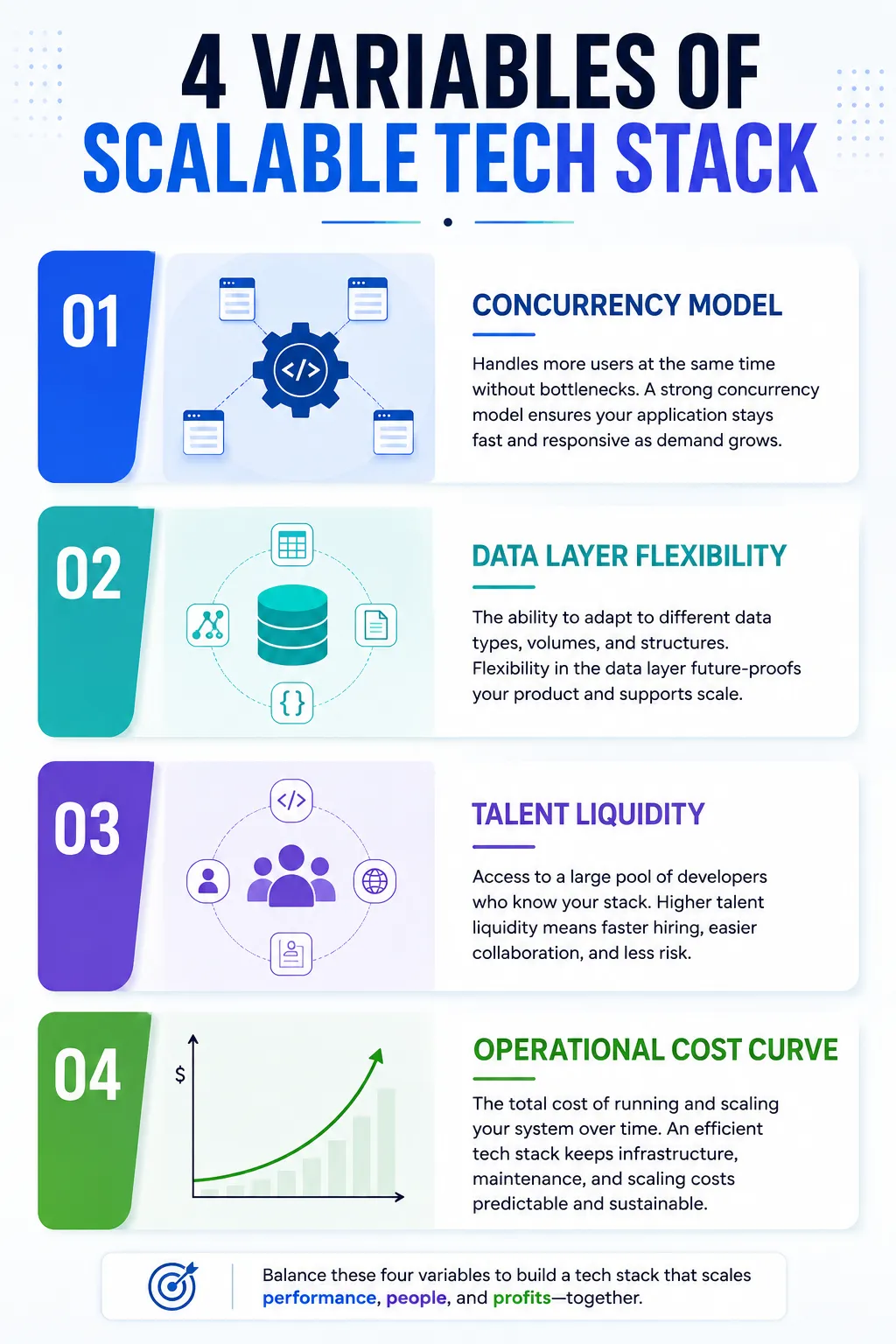
Four variables decide whether a stack scales with you or against you:
• Concurrency model — how the runtime handles thousands of simultaneous connections without falling over
• Data layer flexibility — whether your schema can evolve as fast as your product does
• Talent liquidity — how many engineers you can actually hire who already know the stack
• Operational cost curve — whether infrastructure spend grows linearly with users or spikes unpredictably
CTOs who get this right early aren’t smarter. They’re just asking “what does this look like at 50x current load” before signing off on the architecture doc — and increasingly, that means deciding early whether to build a JavaScript-native team in-house or hire MEAN stack developers who already have the concurrency and data-layer tradeoffs figured out.
Where Scalability Actually Breaks
Scalability failures rarely show up as a single dramatic outage. They show up as a slow bleed — release velocity drops, infrastructure costs creep up faster than revenue, and engineers spend more time working around the codebase than building on it.
Database Bottlenecks
When you have a system that's very strict and rigid it is the first thing that will have problems when a lot of people start using it.
A system that uses tables to organize information might work well when you have 10,000 users.
When you have 10 million users it can become very hard to add new things to the system because you have to make a lot of changes to the tables every time.
On the other hand teams that use systems that are flexible and store information in documents have a lot less trouble with this.
This is because the system can adapt to changes of falling apart which means that database schemas like this are very good for big systems, with a lot of database schemas and a lot of users and a lot of traffic.
Hiring and Team Velocity
A framework nobody wants to hire for becomes an anchor. If your backend runs on a niche or declining stack, every open requisition takes longer to fill, and every new hire takes longer to ramp. JavaScript-based stacks avoid this trap almost by design — over 45% of professional backend developers now actively use Node.js in production, which means the hiring pool isn’t the bottleneck it is for more obscure runtimes.
The Refactor Tax
Pegasystems surveyed more than 500 IT decision-makers and found the average enterprise loses over $370 million a year to failed or delayed legacy modernization. That’s not a rounding error in a budget review — it’s a strategic tax paid for architecture decisions nobody revisited early enough.
Where MEAN Earns Its Place — And Where It Doesn’t
The MEAN stack, which is made up of MongoDB, Express.js, Angular and Node.js is a solution to a big problem. This problem is making sure that a website or application can handle a lot of users and work well. The MEAN stack is good at this because it uses one language for the application, a database that can change as the data model changes and a system that can handle a lot of work at the same time. This is why more than 50 percent of big companies use Node.js to build and maintain their application programming interfaces or APIs. In fact since 2023 the use of Node.js inside companies has grown by more than 25 percent.
For technology officers who have to make decisions about what to build it makes sense to hire MEAN stack developers when they need to add real-time features to their product. They should also hire MEAN stack developers if they think their data model will be changing a lot over the two years. Another good reason to hire MEAN stack developers is if they want one team of engineers to be able to work on both the frontend and backend of the application without having to switch languages. MEAN stack is a choice for these types of projects because it uses MongoDB, Express.js, Angular and Node.js which all work well together.
It’s a weaker fit for static, content-heavy sites or workloads that lean almost entirely on complex relational joins — there, a different combination earns its keep instead.
In practice, that means MEAN tends to earn its place on:
• Real-time dashboards and collaboration tools where data changes constantly, and users expect updates without a page refresh
• Enterprise SaaS platforms with data models that will keep evolving through multiple product pivots
• API-first products serving multiple frontends — web, mobile, and partner integrations — off one backend
• MVPs that need to move from prototype to production-scale without a language or framework switch along the way
This is also where the build-versus-hire calculus matters. Standing up an in-house team with deep MongoDB, Express, Angular, and Node.js expertise takes months you may not have before a funding milestone or a competitor’s launch. That’s why many CTOs choose to hire MEAN Stack Developers through a vetted staffing partner instead — it puts a production-ready team in place in days rather than quarters, without the sunk cost of a hiring cycle that might still land on the wrong skill mix.
A Familiar Scaling Story
Picture a mid-market SaaS company two years post-launch. Its MVP ran on a monolithic PHP stack, chosen because it was fast to ship. By month eighteen, every new feature required touching the same tangled controller files, releases slowed from weekly to monthly, and the infrastructure bill nearly tripled without a matching jump in users.
The fix wasn’t a full rebuild. The team split the monolith, moved the API layer to Node.js and Express, and swapped the rigid relational schema for MongoDB collections that matched how the product’s data actually behaved. Release velocity came back within a quarter. Average API response times dropped by roughly a third, and the infrastructure bill flattened out even as user counts kept climbing. More importantly, the team could finally answer “can we handle 10x traffic” with evidence instead of hope.
That’s the real argument for framework selection as a board-level decision, not an engineering footnote. The stack isn’t just what your product runs on — it’s what your growth plan depends on.
The framework you choose today either compounds in your favor or against you — there’s no neutral setting. CTOs who treat stack selection as a scalability decision, not a shipping-speed shortcut, spend less time firefighting architecture two years out. The MEAN stack won’t fit every product, but for teams building real-time, API-driven applications that need to move fast without rewriting the foundation later, it remains one of the more dependable bets on the table. The question isn’t whether your stack will get tested by growth. It’s whether you chose it with that test in mind.

























Sign in to leave a comment.