

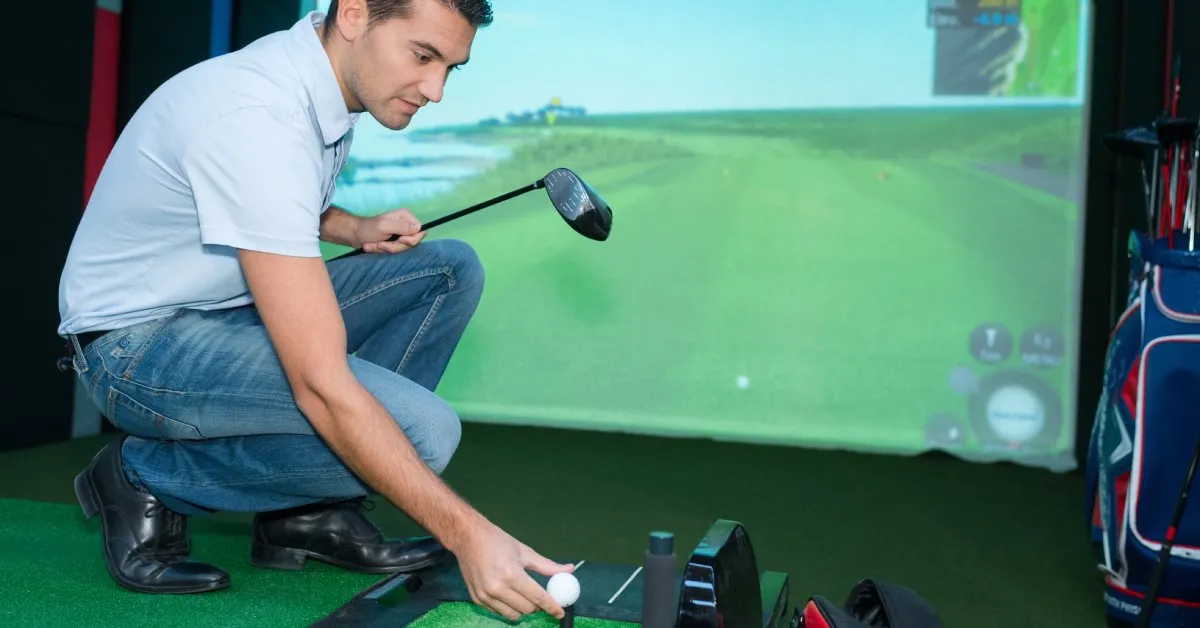
You swing at a real ball, it vanishes into a screen a few feet away, and a second later you're watching it trace a curved flight path across a fairway that doesn't exist in the room you're standing in. It looks like a magic trick. It's actually radar, cameras, and a physics engine doing a lot of very fast math.
If you've ever wondered how a simulator "knows" your shot sliced 15 yards right before the ball even lands on screen, here's what's actually happening.
Three Things Every Simulator Needs
Strip away the branding and every simulator setup, cheap or expensive, comes down to the same three pieces.
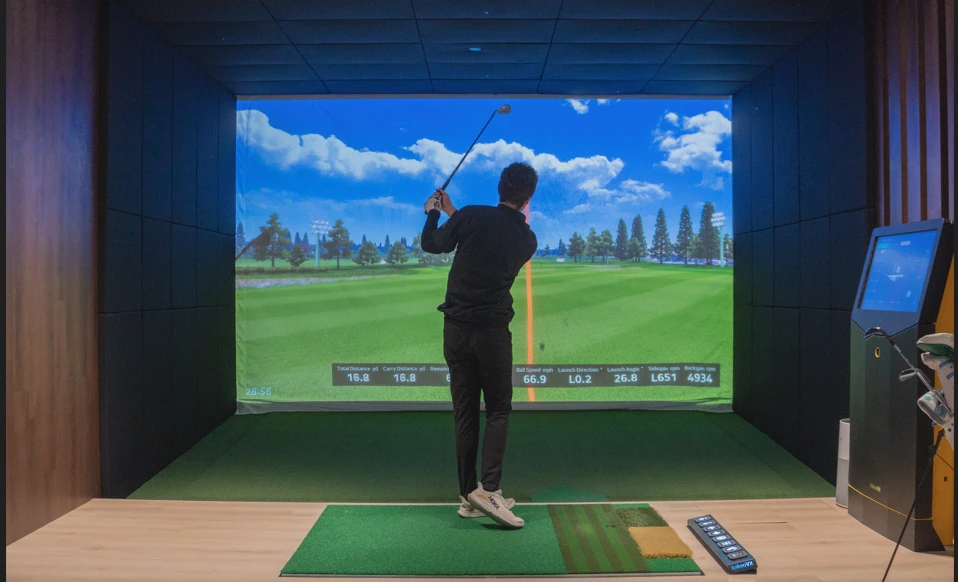
- The launch monitor does the real work. This is the sensor that catches everything at the moment of impact: ball speed, launch angle, spin rate, club path. Whatever the screen shows you next, it started here.
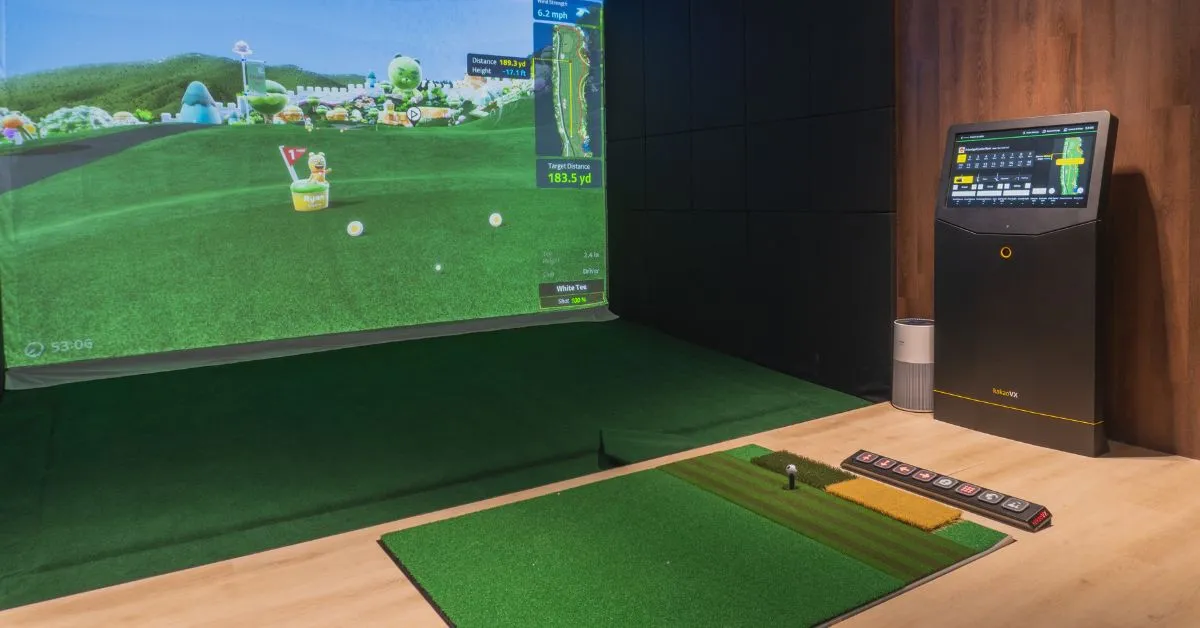
- The projector and screen handle the visuals. A short-throw projector throws the course image onto an impact screen built to take a repeated beating from a golf ball moving well over 100 mph without kicking it back at you or tearing.
- The software connects the two. It takes the numbers off the launch monitor and turns them into a shot on a rendered course, accounting for terrain, wind, and green speed so the ball behaves the way it would outside.
Radar or Camera: Two Different Ways to "See" a Shot
Here's where simulators actually diverge from each other, and it's worth understanding if you're comparing systems.
- Doppler radar works the same way a weather radar or a speed gun does. The unit fires radio waves at the ball and, on better systems, the clubhead too, then reads how the frequency shifts as they move. That shift tells the system how fast the ball is going, how much it's spinning, and where it's headed. No dots or markings on the ball required. Radar units usually sit behind the golfer, which means they track the ball's entire flight rather than just the split second of contact. That's also why they travel well. The same unit that's tracking your swing indoors can move to a driving range or an outdoor lesson without any recalibration.
- Camera-based systems take a completely different route. Instead of radio waves, they use several high-speed cameras, sometimes shooting thousands of frames a second, mounted near or above the hitting area. Software then picks apart those frames to measure launch angle, spin, and even how much the ball compressed at contact. Some camera rigs mount overhead specifically so a facility doesn't have to physically move the unit when a lefty steps up after a righty.
Neither one is flatly better. Radar tends to win on portability and tracking the ball's full path. Cameras often win on precision right at impact. That's exactly why more setups now blend both technologies into a single unit instead of picking a side. If you're weighing the two head-to-head, Golf VX has broken down how its simulators compare to a pure launch-monitor system like TrackMan, which is a useful read if you're trying to figure out which approach actually matters for what you want to work on.
The Ground Under Your Feet Matters Too
Launch monitors get most of the attention, but the hitting surface is doing quiet, important work of its own. Basic setups use a flat mat and a fixed tee, which is fine for range-style practice but doesn't do much to replicate an actual lie. Higher-end systems use a moving swing plate that tilts and adjusts to mimic uphill, downhill, and sidehill lies the way you'd actually encounter them on a course, along with an auto-tee that resets the ball height between shots so you're not bending down every swing.
This sounds like a small detail until you've played a simulator round on a course with real elevation change. A flat mat on every hole means your body never has to adjust, which quietly trains habits that don't hold up outdoors. A plate that shifts under your feet on a downhill lie forces the same weight and posture adjustments a real fairway would, which is part of why some setups feel noticeably more like actual golf than others.
What Happens Between Impact and the Ball Landing On Screen
Once the launch monitor grabs its numbers, the heavier lifting starts. The software runs everything through a physics model that factors in air resistance, gravity, altitude, humidity, even temperature, because all of those genuinely change how far a ball travels and how it curves. That's the difference between a simulator that shows a generic arc and one that renders a shot shaped by conditions close to what you'd actually face outside.
Good systems don't stop at the landing spot, either. They model what happens after: firm fairways add roll, soft greens and thick rough kill it fast. That detail is what separates a simulator that feels like a golf-themed video game from one that actually tells you something true about your game.
The course rendering itself is a separate piece of software from the physics engine, and it matters more than people give it credit for. Most modern systems license or build digital replicas of real courses, mapping elevation, hazards, and green contours from actual survey data instead of guessing at a generic layout. That's why a shot landing in a real bunker on a course you've actually played can feel oddly familiar, even standing in a converted garage. The graphics get noticed first, but they only work because the physics feeding them is accurate. A gorgeous render with sloppy ball-flight math falls apart the first time you flush a drive and watch it do something physically impossible on screen.
Why the Technology Choice Actually Matters to You
This isn't just spec-sheet trivia. It changes what kind of feedback you walk away with. If you mostly care about carry distance, ball speed, and shot shape off the tee, a radar setup will cover you. If you're trying to fix a swing flaw or diagnose exactly what your clubface is doing at contact, camera precision at impact is usually the more useful data.
Golf VX's Quantum simulator leans into this by pairing a 9-axis swing plate with high-speed camera tracking, aiming for both realistic ball flight and swing data you can actually use, not just a screen that looks impressive. Whether you're grooving consistency off the tee or dialing in your 100-yard wedge number, the point of all this sensor and software work is data you trust enough to act on.
It's also worth knowing that no simulator, radar or camera, claims to be a laser-perfect replica of outdoor ball flight, and any brand that tells you otherwise is overselling. Indoor factors like the distance from mat to screen get compensated for mathematically rather than measured directly, which is part of why numbers can shift slightly between well-calibrated units. What actually matters for improving your game isn't chasing a perfect number. It's consistency: the same swing producing the same reported numbers, session after session, so a change in the data reflects a real change in your swing rather than sensor noise.
The Experience Still Has to Hold Up
None of the sensor precision matters much if sitting in the bay isn't actually enjoyable, whether that bay is a commercial lounge or a simulator someone built into their own garage. That part gets skipped over a lot when people talk about simulator tech, but the rendering quality, the course library, and the general feel of the space count for just as much as what the launch monitor spec sheet says.
That's the piece Play Golf VX locations focus on: accurate tracking paired with a lounge environment where you can book a bay by the hour, work through a full practice session, or just get a round in with friends when the weather outside makes that impossible. It answers a question a lot of golfers actually have: how do you get real practice reps in during a Tuesday in January?
Bottom Line
Golf simulators went from arcade novelty to a legitimate training tool almost entirely because launch monitor technology got good. Whether a system leans on Doppler radar, high-speed cameras, or both at once, the goal is the same: capture the swing precisely enough that the software can render an honest, physics-based version of that shot on a screen.
Next time you're in a simulator bay, you're not just hitting a ball at a projection. You're triggering a burst of radar pulses or camera frames, a physics calculation, and a rendering pipeline, all in well under a second, just to tell you what that swing was actually worth.
Originally published on medium.com.





















Sign in to leave a comment.