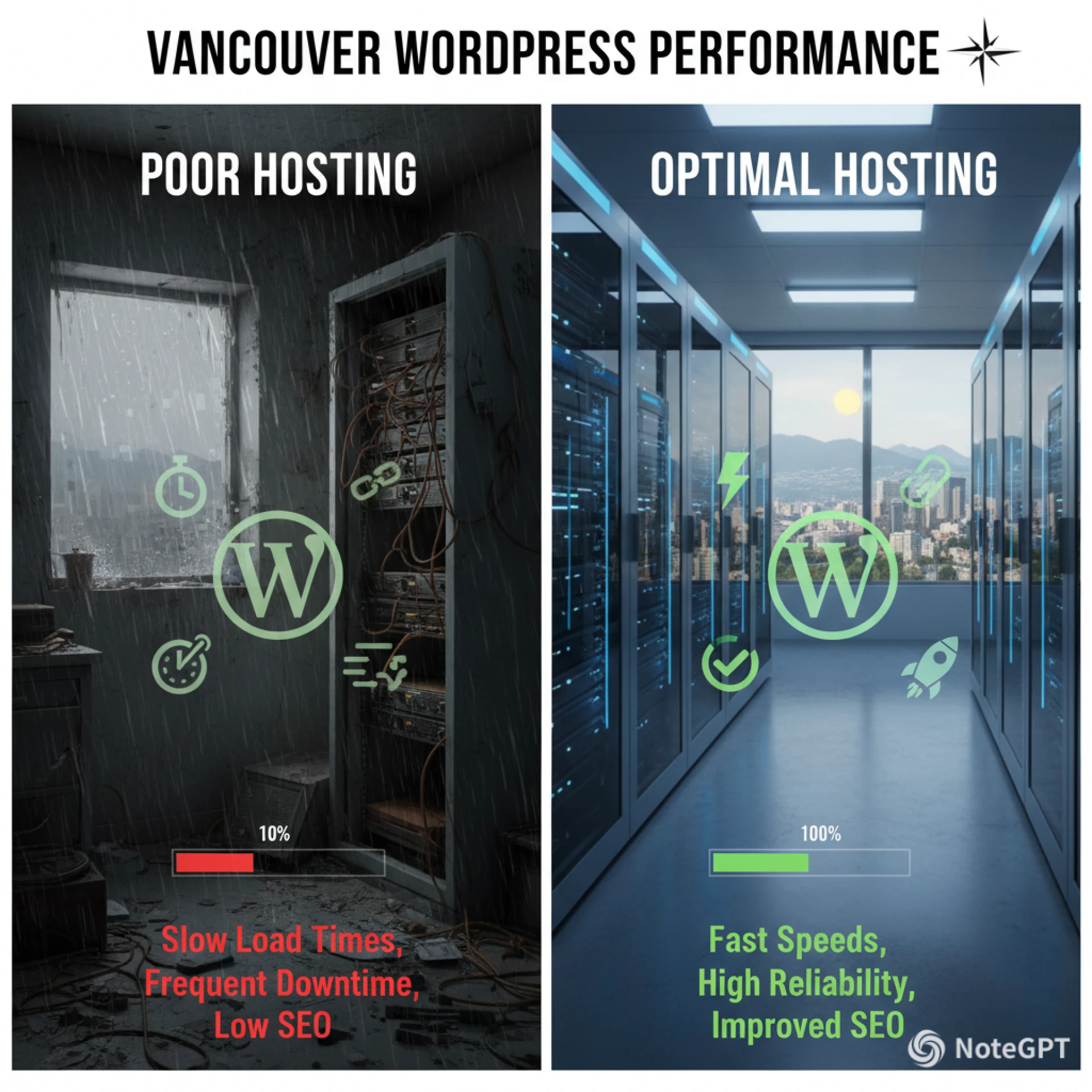

In Vancouver’s bustling business scene, having a fast and reliable website is no longer optional – it’s essential. Canadian consumers expect quick load times and smooth browsing, especially when visiting local business sites. While many factors influence a WordPress site’s speed, one critical element often flies under the radar: the hosting environment. This behind-the-scenes factor – encompassing where your site’s data lives and how the servers are set up – can make or break your WordPress performance. For Vancouver business owners, understanding this can be a game-changer in delivering a superior user experience and staying compliant with Canadian regulations. In this article, we’ll explore how your hosting environment affects WordPress performance, with a special focus on the Vancouver context, and offer insights on making informed hosting decisions for long-term success.
The Hidden Influence of Your Hosting Environment
Think of your website’s hosting environment as the foundation of a building – it supports everything else and determines how sturdy (or fast) your site can be. The term hosting environment refers to the physical and virtual setup that powers your WordPress site. This includes the server’s hardware (CPU, memory, storage), the software stack (operating system, web server, database, PHP version), and the data center location where the server resides. All these components work together to influence your site’s load times, stability, and ability to handle traffic surges. In short, even a well-designed WordPress site with optimized images and plugins can struggle if it’s running on a subpar hosting foundation.
For instance, a site hosted on an aged server with limited resources or outdated software might suffer slow response times and frequent timeouts. On the other hand, a site on a modern, performance-optimized server (with ample CPU cores, fast SSD/NVMe storage, and tuned software configurations) can deliver snappy page loads even under heavy traffic. The difference lies in the environment: one is like a slow gravel road, and the other is a high-speed highway for your data. The WordPress developers’ handbook itself emphasizes that hosting is a key factor – along with configuration and content – in site performance, underscoring that upgrading hardware and optimizing server software are fundamental steps to speed up WordPress. In essence, investing in a robust hosting environment is investing in your website’s user experience.
Location, Location, Location: Why Server Location Matters in Vancouver
When it comes to website speed, geography plays a surprisingly big role. The physical distance between your web server and your site visitors affects how quickly data travels – a concept known as network latency. For Vancouver-based businesses or those targeting Canadian audiences, hosting your WordPress site on servers located in Vancouver (or nearby in Canada) can significantly reduce latency. Less distance for data to travel means faster delivery of your site’s content to users. It’s a simple principle: shorter distance, quicker data transfer.
Imagine your main customer base is in Vancouver, but your website is hosted on a server in Texas or Europe. Every time a local user clicks a link, their request must traverse thousands of kilometers, possibly hopping across multiple networks, before reaching the server – and then the data has to make the long journey back. Those extra milliseconds (or even full seconds) in each round trip can add up to a sluggish experience. On the flip side, if that same site is hosted in Vancouver or within Canada, the data has a much shorter trip. According to experts, a server in Montréal or Toronto can deliver content “noticeably quicker” to Canadian users than one in a far-flung location. The result? Pages feel more instant and visitors stay happier.

A modern Canadian data center. Hosting closer to your Vancouver audience reduces data travel distance, resulting in faster page load times for local visitors.
Not only do human visitors appreciate this speed, but search engines do as well. Google’s algorithms favor websites that load faster, which can indirectly boost your search rankings and conversions. In other words, local hosting isn’t just about pleasing impatient customers – it can also improve your visibility online. A WordPress site that loads quickly for Vancouver users is more likely to keep them engaged and less likely to be abandoned, which sends positive signals to search engines.
Vancouver’s unique position on the Pacific Rim also offers strategic advantages. Hosting in Vancouver means fast connections to the Asia-Pacific region, thanks to trans-Pacific fiber routes that land on the West Coast. If your business has suppliers or customers in markets like Japan, China, or Australia, a Vancouver-based server can provide lower latency to those regions compared to servers in Eastern Canada. Essentially, Vancouver acts as a gateway between North America and Asia-Pacific – a benefit you can leverage if you have a global audience. Additionally, Vancouver’s temperate climate provides natural cooling efficiencies for data centers, contributing to reliability and even environmental sustainability in the hosting infrastructure. While climate might not directly speed up your site, a reliably cooled server is less prone to overheating and downtime, indirectly supporting consistent performance.
Of course, modern content delivery networks (CDNs) can cache and serve some of your site’s static content (like images or scripts) from edge servers around the world, mitigating distance issues for global visitors. Many hosting providers bundle CDNs to extend your reach. However, the origin server’s location still matters for dynamic content (like your WordPress PHP processing and database queries). Having that origin in Canada ensures that the master copy of your data and all real-time processing occur on Canadian soil. From there, the CDN edge nodes can quickly deliver content globally. The key takeaway is that for your Vancouver and Canadian visitors – who might form the core of your customer base – a local server provides the fastest, smoothest experience. And as a bonus, keeping the origin in Canada brings us to another important aspect: data residency and legal compliance.
Infrastructure and Technology: Building a High-Performance Foundation
Speed isn’t just about location. The quality of the hardware and software in your hosting environment forms the bedrock of your site’s performance. Think of this as the engine under the hood of a car. Even on a perfectly paved Vancouver road, a car with a weak engine won’t win any races. Similarly, to make your WordPress site fly, you need a powerful engine in your server.
Hardware matters: Modern websites perform best on modern hardware. This means servers equipped with fast processors (CPUs), plenty of RAM, and high-speed storage drives. For example, solid-state drives (SSD) or the newer NVMe SSDs provide much quicker data access than old-school spinning hard drives, resulting in faster database queries and file loading. High-performance hosts often advertise these features – and for good reason. Upgrading from HDD to SSD alone can drastically cut down page load times during heavy database operations. In addition, having multiple CPU cores and generous memory ensures that your WordPress PHP scripts and MySQL database can execute without bottlenecks. If your site experiences traffic spikes (perhaps during a big sale or event), extra processing headroom prevents slowdowns. In summary, the more robust the hardware, the better your WordPress site can perform under load.
Software and stack optimizations: The software layer is just as crucial. A well-tuned server stack can serve WordPress pages with lightning efficiency. Many high-end hosting environments use optimized web servers and caching systems to accelerate WordPress. For instance, some hosts use LiteSpeed Web Server technology instead of the traditional Apache server, because LiteSpeed is known for its high performance, especially under heavy load. Pair that with server-level caching (where pages are pre-generated and stored ready to serve), and you have a recipe for extremely fast response times. In practice, this means that repeat visits or multiple users hitting your site simultaneously will still get near-instant loads, because the server can deliver cached content without processing the full WordPress PHP logic each time.
Beyond the web server choice, up-to-date software is key. Newer PHP versions and database engines (like MariaDB or the latest MySQL) often bring speed improvements. An optimized hosting environment will ensure you’re running these latest stable versions, giving you performance gains without you having to lift a finger. Some hosts further enhance performance with features like object caching (storing reusable database query results in memory), image optimization on the fly (automatically compressing or resizing images to lighten pages), and more. For example, a Vancouver-based managed host called WPCloud.ca emphasizes using LiteSpeed servers, NVMe storage, and integrated caching and image optimization – all geared towards squeezing the most performance out of WordPress. The takeaway is that a thoughtfully engineered software stack can dramatically speed up your site’s delivery. It’s not just raw server power; it’s also how intelligently that power is harnessed.
Network and infrastructure: A high-performance host will also have a resilient network infrastructure. This includes things like multiple high-bandwidth connections to the internet backbone, so data can reach users via the fastest routes. It also means low network contention (your traffic isn’t getting stuck in a digital traffic jam with others). Many Canadian hosting providers design their data centers with carrier-rich connectivity – essentially multiple network providers and routes – to ensure fast and reliable data flow. Additionally, infrastructure investments such as N+1 redundancy for power and cooling keep servers running smoothly, translating to better uptime. After all, performance isn’t just speed; a site that’s frequently down or unreachable is offering poor performance in terms of availability. Vancouver’s data centers, like those operated by seasoned hosts, combine speed with reliability by using such enterprise-grade infrastructure.
In summary, choosing a host with strong infrastructure and up-to-date technology means your WordPress site gets a solid foundation to perform at its best. It’s the difference between running WordPress on a clunky old laptop versus a tuned-up, high-end workstation. For Vancouver business owners who might not be server experts, the key is to look for clues in the host’s offerings: mentions of SSD or NVMe storage, modern processors, optimized WordPress stack (often including caching and CDN), and robust network connectivity. These technical details translate directly into real-world improvements in how fast and smoothly your site runs.
Managed WordPress Hosting vs. Traditional Hosting
As you evaluate hosting environments, you’ll encounter a choice: opt for a general-purpose web host (perhaps a basic shared hosting plan) or go for managed WordPress hosting. Understanding this difference is crucial, because it can have a major impact on your site’s performance and your peace of mind.
Traditional (Shared) Hosting: Many small businesses start with shared hosting – an affordable, no-frills option where your WordPress site lives on a server alongside dozens or even hundreds of others. Shared hosting can be perfectly fine for low-traffic or personal sites, but it has performance limitations. Since resources are shared, surges in one site’s traffic can affect others on the same server. Moreover, these environments are typically not tuned specifically for WordPress; they run generic configurations to accommodate all sorts of applications. While you might have some control and can install caching plugins or optimization plugins yourself, the server itself isn’t giving you any WordPress-specific boosts. In fact, you often “have to figure out the right setup for your site” on your own in a shared environment. If you’re tech-savvy and your site is modest in scope, this might be workable. But many Vancouver business owners find it challenging to squeeze performance out of a bargain host, especially as their traffic grows.
Managed WordPress Hosting: In contrast, managed WordPress hosting is like moving from a basic apartment to a serviced high-end condo – it’s more expensive, but a lot of the hard work is done for you, and the amenities are far superior. Managed WordPress hosts tailor the entire environment for WordPress. They often impose limits (like restricting certain plugins or offering a fixed stack) but in return, they deliver significantly enhanced performance and support. These hosts usually employ advanced caching at the server level, meaning many WordPress pages are delivered blazingly fast without the need for separate caching plugins. They integrate CDNs and often use enterprise-grade networks, so even traffic from across Canada or globally is handled efficiently. Think of a managed host as having a pit crew for your site’s speed – everything is configured for optimal WordPress performance from day one.
Crucially, managed WordPress providers also scale resources intelligently. Many run on cloud infrastructure which can handle traffic spikes better, or they isolate your site’s resources so that other customers’ websites can’t slow yours down. Some even offer auto-scaling or load balancing for when your marketing campaign or viral post brings in an influx of visitors. The result is that your site remains stable and fast under conditions that might crash a lesser host.
Another big plus is expert support and maintenance. Managed hosts often include automatic WordPress core updates, plugin updates, daily backups, and security monitoring as part of the package. These indirectly aid performance too – a site that is secure and up-to-date avoids the slowdowns that can come from hacking or outdated software. And if something does go awry, you have a team of WordPress specialists to call, rather than generic support that might not know WordPress deeply. As one comparison aptly put it, managed WordPress hosting is the “Formula 1 car of hosting environments, designed specifically for WordPress speed and performance”. The servers are fine-tuned for our favorite CMS, so you don’t have to tinker with as many performance plugins or worry that your server setup is suboptimal – it’s optimized out of the box.
For Vancouver businesses, there’s an added consideration: local managed hosting options. There are managed hosts that allow you to choose Canadian data centers (some even in Vancouver) for your WordPress site, combining the benefits of managed tuning with the advantages of local hosting. For example, major players like Kinsta or WP Engine let customers host in Canada (Toronto, Montréal, etc.), which means you get world-class performance architectures with data residency. Kinsta, known for its speed, runs entirely on Google Cloud’s infrastructure and offers a choice of Montréal or Toronto data centers – leveraging Google’s global network for excellent latency. This means if you select Toronto for a Vancouver audience, you still keep data in-country; though Vancouver to Toronto isn’t as close as Vancouver itself, it’s far closer than the U.S. or Europe, and their use of Cloudflare CDN helps bridge the gap for West Coast visitors. Meanwhile, Canadian-based managed hosts like WPCloud.ca and Web Hosting Canada (WHC) actually have servers in Vancouver. WPCloud, for instance, offers WordPress-optimized cloud servers across Montréal, Toronto, and Vancouver, letting you choose the region nearest you (so a Vancouver university could host in Vancouver for lowest latency). They use LiteSpeed servers and NVMe storage with caching, showing that local providers can deliver top-tier performance tech. WHC similarly has data centers in Montréal and Vancouver, using SSDs, LiteSpeed, and built-in caching to achieve solid WordPress performance.
In deciding between shared and managed hosting, consider your site’s needs and your own capacity. If your WordPress site is central to your business – generating leads, sales, or serving an important function – the hosting environment is not the place to skimp. The cost of a sluggish site (in lost visitors or conversions) often outweighs the savings on cheap hosting. Managed hosting in Vancouver or Canada may cost a bit more each month, but it buys you speed, reliability, security, and expert help, which is a bargain for many businesses. On the other hand, if you’re just starting out or testing an idea, a basic host might suffice until you grow. Just be aware that as you expand, migrating to a better environment sooner rather than later can spare you headaches and ensure consistent performance for your users.
Compliance and Data Residency: The PIPEDA Factor
Performance is paramount, but for Canadian business owners, there’s another side to hosting decisions: legal compliance and data privacy. Canada has strict privacy laws, and chief among them is PIPEDA (Personal Information Protection and Electronic Documents Act), which governs how businesses handle personal information. You might be wondering, “What does compliance have to do with performance?” Directly, not much – a law doesn’t make your site faster. However, where you host can impact your ability to comply with these laws, and that in turn influences which hosting options are on the table for you. The good news is, the choices that favor compliance often dovetail with those that favor performance for local users.
PIPEDA doesn’t explicitly mandate that data must stay in Canada, but it requires that you protect personal data according to Canadian standards. By hosting your WordPress site on Canadian soil, you make it much easier to meet those standards. Your data remains under Canadian jurisdiction and is safeguarded by Canadian laws without the tangle of foreign legislation. This is a big plus for user trust as well – visitors and customers feel more secure knowing their data is kept at home under local privacy protections. In British Columbia (home province of Vancouver), there’s even a stronger rule for public institutions: the Freedom of Information and Protection of Privacy Act (FIPPA) requires public bodies (like government offices, public universities, etc.) to store personal data in Canada, with very limited exceptions. So a Vancouver-based public sector site really has no choice but to use a Canadian hosting environment. Even if you’re a private business, this highlights how seriously data residency is taken here.
What about private-sector businesses in Vancouver? Aside from PIPEDA, some provinces have their own privacy laws (for instance, BC’s Personal Information Protection Act, and Quebec’s recent Law 25) that can apply to how you handle customer data. By keeping your site and data in Canada, you avoid many potential cross-border complications. If you host abroad, your data could inadvertently become subject to foreign laws – think of the USA PATRIOT Act or CLOUD Act, where U.S. authorities might request access to data held by U.S.-based companies. This scenario might sound unlikely for a small business, but it’s not impossible, and it’s a concern for any company handling sensitive or customer data. Canadian officials and businesses often worry that if their website is hosted in the U.S., their data could be accessed or even subpoenaed without their knowledge. By contrast, hosting in Canada sidesteps that risk. One Canadian hosting provider bluntly noted that when your site is abroad, “your data could be accessed, moved, or even seized without your knowledge,” whereas keeping it in Canada ensures it stays under Canadian rules.
Compliance-oriented hosting choices have another benefit: clarity and peace of mind. It simplifies your privacy policy and contracts when you can state outright that all user data stays in-country. Legal teams and savvy customers appreciate this clarity. Under PIPEDA and provincial laws, data stored in Canada stays within Canadian jurisdiction, meaning no surprise foreign access requests and fewer legal grey areas in terms of privacy. If you ever deal with clients in regulated industries or government, they may specifically ask about your hosting location as part of due diligence. Being able to say “our site is hosted in a Vancouver (or Canadian) data center” can streamline such conversations.
From the performance perspective, the nice thing is that compliance doesn’t require a sacrifice. In fact, as we’ve explored, hosting in Canada (for example, Vancouver, Montréal, or Toronto data centers) is a win-win: you’re both keeping data at home and serving Canadian users faster. Many Canadian hosting providers explicitly market their services as PIPEDA-compliant or “100% Canadian”, underscoring that all data is stored on Canadian servers and not subject to foreign jurisdiction. For example, Web Hosting Canada (WHC) operates data centers in Montréal and Vancouver and stores all data in those facilities, inherently aligning with PIPEDA’s requirements. They highlight that your data isn’t subject to foreign laws and even offer a badge for “Canada Hosted” for websites – a bit of a marketing touch, but it shows the value they know businesses place on Canadian hosting. Another local provider, WPCloud.ca, ensures all servers and even network traffic stay within Canada, giving especially cautious organizations full confidence that their WordPress data never leaves home.
To sum up, while your primary aim in choosing a great hosting environment might be to achieve top-notch performance, if you’re a Canadian business, you can often tick the compliance box at the same time by opting for Canadian data centers. It’s about being smart and strategic: you get the speed benefits of local hosting we discussed earlier (low latency for local visitors, etc.) and simultaneously ensure your customers’ data is handled in line with Canadian privacy expectations. In an era where consumers are increasingly aware of data privacy, this can even be a selling point. Performance may get people through the door, but trust keeps them around – and a PIPEDA-aligned hosting choice can quietly bolster that trust.
Before moving on, let’s encapsulate these dual benefits. Why should a Vancouver business consider a Canadian (local) hosting environment? Here are a few key reasons:
- Faster load times for local visitors: Keeping your server in Canada shortens the distance to your audience, resulting in quicker page loads and a better user experience. This can indirectly boost SEO rankings and conversion rates as well.
- Compliance with privacy laws: Your data stays under Canadian jurisdiction, supporting compliance with PIPEDA and provincial privacy laws without extra complexity. You avoid entanglement with foreign surveillance laws and reduce cross-border data risks.
- Customer trust: You can reassure your customers (or partners) that their personal information is stored safely in Canada. In a privacy-conscious market, this transparency can set you apart.
- Local support and currency: Working with Canadian hosting providers often means support during your business hours and dealing in Canadian dollars, avoiding exchange rate hassles. These practical perks make managing your hosting smoother and more predictable for a Vancouver business.
- Data sovereignty and security: By hosting in Canada, you eliminate scenarios where another country’s government might access your data without consent. Your security measures and breach responses only need to answer to one jurisdiction, which simplifies governance.
All these factors combined illustrate that the hosting environment is not just an IT decision – it’s a business decision that touches performance, legal compliance, and user perception.
Future-Proofing Your Website’s Performance (Conclusion)
Web technology and user expectations are constantly evolving. What’s considered a fast loading time today might feel sluggish in a few years as everything else speeds up. That’s why future-proofing your WordPress performance is critical. The hosting environment you choose now should not only meet your current needs but also position you for what’s next.
Looking ahead, trends like increased mobile usage, richer web content (think 4K videos or interactive media), and new web standards (such as HTTP/3 or emerging protocols) mean websites will handle more data and more simultaneous users. A strong hosting environment gives you the capacity and scalability to adapt to these trends. Many Vancouver businesses are already thinking about how to serve customers who expect instant gratification online. If your site is slow, competitors are just a click away. Investing in high-quality hosting – perhaps a managed WordPress plan on a Canadian cloud infrastructure – is akin to laying a highway that can accommodate faster traffic and more cars in the future. It ensures that as your site’s functionality grows or traffic ramps up, performance remains rock solid.
Another aspect of future-proofing is staying ahead of regulatory changes. Privacy laws are tightening worldwide. Canada itself is continually reviewing and strengthening its privacy framework (for example, discussions around updating PIPEDA have been ongoing). By already hosting in a way that respects data residency and strong security, you’re a step ahead of any new requirements that might emerge. You won’t be scrambling to relocate your data or overhaul your hosting setup to catch up with a new law – you’ll be largely compliant by design. This proactive stance not only avoids potential legal headaches but also signals to your customers that you take their privacy seriously, which will only become more important over time.
In conclusion, the hosting environment is the unsung hero of WordPress performance. For business owners in Vancouver and across Canada, it’s a pillar that supports speed, reliability, compliance, and user trust all at once. By choosing a hosting environment optimized for WordPress – ideally one that’s local or with Canadian data centers for that extra edge – you set your website up for success now and in the long run. Think of it as choosing a long-term business partner: you want a host that will grow with you, keep your site safe and fast, and respect the values and regulations that matter in your region.
To keep your competitive edge, don’t treat hosting as an afterthought. Evaluate your options carefully, ask providers about what technologies they use for performance, where your data will reside, and how they will support your growth. The right environment will free you to focus on what you do best – running your business and delivering value to customers – while it takes care of delivering your website quickly and consistently. By prioritizing your hosting environment today, you’re not only enhancing your WordPress site’s performance for all your Vancouver visitors tomorrow, but you’re also building an online foundation that can stand the test of time. Here’s to faster loads, happier users, and a future-ready web presence!











Sign in to leave a comment.