
Creating a digital product that stands out and gains traction in today's overcrowded market takes time & effort. How do you get a consumer's attention surrounded by great daily offers? Which is the better way to develop a new product?
The iterative design process is one of the most effective approaches. The Software Development Life Cycle (SDLC) includes a variety of development and testing methods, tools, techniques & other aspects. An iterative process model is a segment of the software development process. Read on to find out what an iterative design approach is, what stages it consists of, and why you should use it in product development.
What is the Iterative Design Process?
It's a series of steps that you go through repeatedly, refining and improving your product for each new cycle. The iteration's goal is to move closer to the ideal solution with each repetition. The fundamental principle of the iterative design approach is to break down a large project's workflow into smaller phases and streamline the design process.
Why do you think Iteration is Important for Design?
Clients rarely show up at a design agency with a detailed project framework; instead, they need a clearer idea of what they require. In such cases, the designer's main challenge is to get into the clients' heads and make stuff exactly how they want it to look, even if the clients themselves lack understanding.
“Iterative design is the only method to ensure a precise fit for your design.”
You have the option to stop this process at any time and start over with new information as you work to create a product that better fits consumer needs. Deep collaboration between those involved in design thinking is essential. For instance, a team may contact stakeholders to discuss the problem, make the required changes, and begin the design process if they find that the project's initial specifications are incorrect.
Different Stages of the Iterative Design Approach
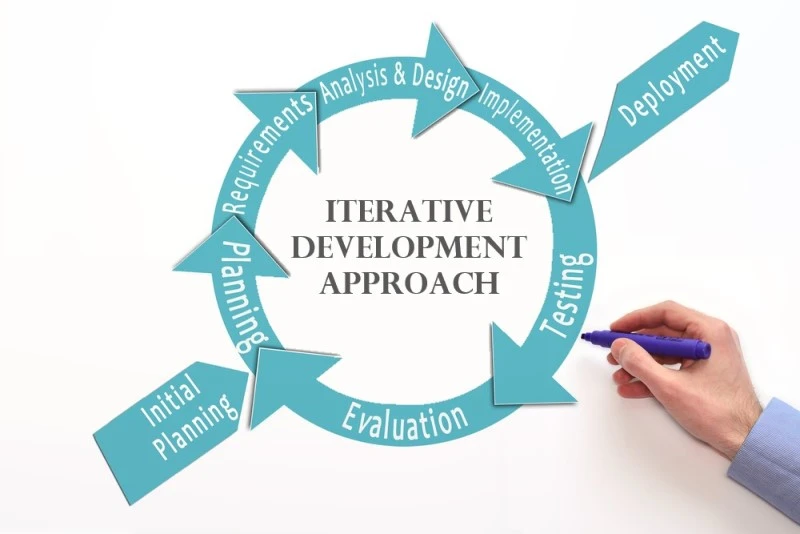
A continuous process of planning, analysis, implementation, and evaluation is a part of the iterative process. Every cycle results in a development unit that serves as the foundation for the next cycle of iterative improvement. The requirements for the product and your available resources will determine how quickly you move through the iterative design process; there is no predefined pace for development.
There are five stages in the iterative design approach:
1. First stage: Planning
The iterative design pattern should be speedy but effective; therefore, some planning is necessary to keep iterations focused on a specific user need. Choosing which issue to address during an iteration is the main focus of the planning stage. Sometimes it involves listening to stakeholder perspectives, but it usually entails directly obtaining user feedback from previous iterations.
Determine which factors have a negative impact on the user experience (UX) through research.Consider how you can improve them and make a user-friendly website.The development process must then be documented by an expert and given to web developers.2. Second stage: Analysis and Design
When the planning stage is complete, it is time to identify the project's business logic. Business logic allows the database and end users to communicate. Then, based on the plan, finalize the business needs, database models, and technical specifications. Finally, create a working structure, schematic, or algorithm that meets your requirements.
3. Third stage: Implementation
Begin the development process based on the requirements and feedback from users. The development team handles the preferences and details of the tasks with the client before the beginning of each iteration. Typically, all code changes are first uploaded to the staging site. Then, develop the required functionality and design to meet the specifications.
4. Fourth stage: Testing
When the project team has completed coding, testing is required to find and fix all errors & issues. Determine and locate what needs to be fixed or is not performed as expected. Testing the product is not sufficient. QA engineers should pay special attention to and test user documentation. Stakeholders, users, and product testers share their perspectives.
5. Fifth stage: Evaluation
The final step in the iterative design process is evaluation. In collaboration with the development team, the client evaluates the working model to ensure that all requirements are met.
Repeat the entire process if anything is missing.
Benefits of Iterative Design
In addition to being cost-effective, the iterative design approach has other straightforward benefits, such as:
It allows for the rapid resolution of misconceptions and the formation of clarity within the project team early in the development lifecycle.It gathers user feedback to ensure that system requirements fulfill user needs.Showing a design's evolution rather than "dropping" a finished product on a client might improve communication.The development team gains some confidence that their efforts are invested in increasing value for users.Smaller iterations make testing easier because you can identify flaws earlier in the process, and each iteration involves users & customers.The team can quickly incorporate any lessons learned from previous tests into each iteration and subsequently enhance the development process.Due to this, stakeholders can see the progress more clearly between iterations.Why Should you use an Iterative Design Process?
Speed up your workflow: Instead of reworking a whole plan as changes occur, the iterative process builds your product step by step and quickly repeats & revises it. As a result, the development team's workload is distributed throughout the project's development lifecycle.Remain flexible: The iterative development strategy assumes that you must have all the solutions and that your product's environment & needs of customers may change as the project is being developed. Considering this changing environment enables you to plan for changes as you build your product and offer deliverables suited to your business.Gather feedback effectively: You can quickly incorporate changes and continuously get feedback due to the iterative design process. With each iteration, actual user testing enables you to see errors or inconsistencies in the requirements, designs, codes, and other implementations. Additionally, it aids in avoiding misunderstandings and figuring out what works through trial & error.Avoiding complicated solution: To meet project specifications and provide value early in iterative processes, you can develop a minimum viable product (MVP).Increase stakeholder involvement: With each new iteration, an iterative design approach allows stakeholders to see how the project is proceeding and ensure that their requirements are met.Risk management: Since you begin with the most challenging parts of a project, each iteration aids you in identifying and resolving risks. So every iterative process enables the team to easily integrate lessons learned from previous runs while constantly improving the development process to minimize risk.Conclusion
The iterative design approach is an effective methodology that you must use if you want your web project to succeed because it allows you to test and improve product quality continuously. Innoraft's web designers adore the iterative design process and will happily share their knowledge to help you make a user-friendly website. It is a cost-effective method that puts user experience at the core of the design process.


Sign in to leave a comment.