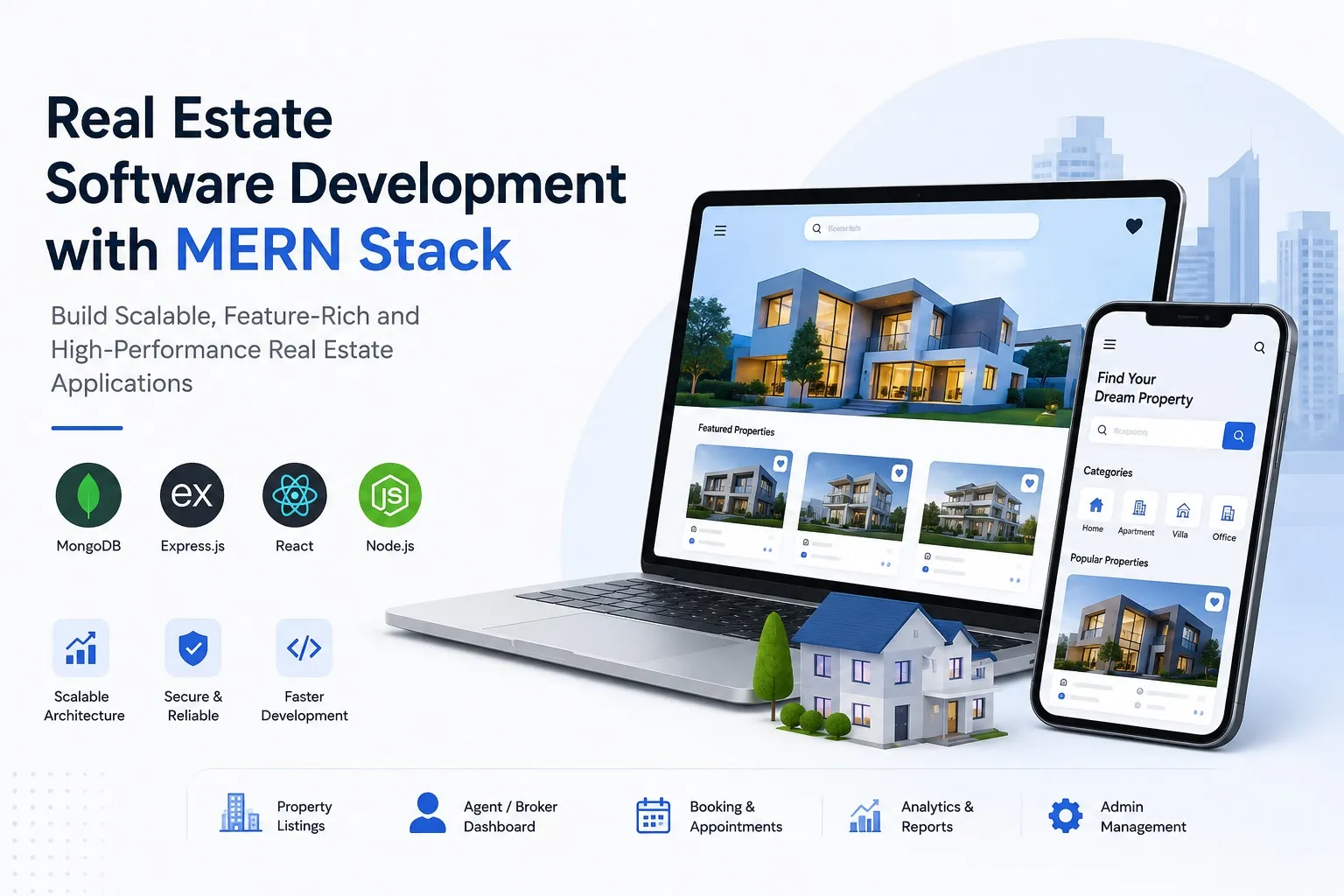

Real estate was one of the last industries to take software seriously. For years, the default was a clunky backend database, a listing page that looked like it was built in 2009, and a CRM held together with exported CSVs. Agents made it work because there wasn't a better option.
Then Zillow happened. Then Redfin. Then buyers started expecting sub-second property search results, real-time availability updates, and filter logic that actually worked the first time. The old approach didn't just slow things down, it broke under the weight of what users had been trained to expect.
That's the real reason MERN stack keeps coming up in real estate software conversations. Not because it's new, but because the architecture underneath most property platforms wasn't built for what the market demands now.
What Modern Real Estate Software Actually Has to Handle
The instinct is to describe real estate software as "just a listing platform with some search filters." That undersells how technically demanding a production-grade property platform actually is.
Think about what happens when a brokerage goes live on a custom platform. Hundreds of agents logging in simultaneously. Property listings updating from MLS feeds every few minutes. Buyers filtering by zip code, price range, school district, and square footage at the same time, expecting results in under a second. Then add tenant portals for property managers, investment dashboards for REITs, lease workflows for commercial landlords, and maintenance request tracking for residential portfolios.
A production-ready real estate platform has to support:
- Property search and filter engines with complex multi-condition queries running on large datasets without lag
- MLS and IDX integration pulling external listing data on a near-real-time feed schedule
- Tenant and lease management with document workflows, payment triggers, and compliance tracking
- CRM and lead nurturing tools for agents managing hundreds of active buyer inquiries
- Investment analytics dashboards for portfolio managers tracking asset performance across multiple properties
- Real-time notifications for offer submissions, maintenance requests, lease renewals, and payment confirmations
- Role-based access separating what agents, brokers, tenants, landlords, and investors can see and do
That's a lot of moving parts. Each one puts different pressure on a tech stack, and they all have to work at the same time on the same infrastructure.
Read More: guide to choosing a custom software development company
Why MERN Handles Real Estate's Technical Demands
Most real estate platforms that feel slow have the same problem: they're running complex queries on relational databases that weren't designed for property data's structure, serving them through a backend that wasn't built for concurrent load, and rendering results through a frontend that does full page reloads.
MERN stack addresses all three.
MongoDB stores property listings as flexible documents, not fixed rows. A residential listing has different fields than a commercial one. A short-term rental has different attributes than a long-term lease. With document-based storage, each property type gets the schema it actually needs without forcing everything into one rigid table structure. Geospatial queries, which are central to every property search ("show me homes within 2 miles of this point"), are something MongoDB handles natively and fast.
Node.js + Express on the backend runs non-blocking I/O. Translated: when 300 users run property searches simultaneously, the backend doesn't queue them up sequentially. It handles concurrent requests without the performance degradation you'd see in a traditional synchronous backend. This matters especially during peak hours on a marketplace platform when traffic spikes hit all at once.
React makes the frontend behave the way users on Zillow or Redfin expect. Map views update as you pan. Filters apply without reloading the page. Favorites sync instantly. That kind of responsiveness isn't a design choice. It's a technical requirement for any property platform that wants users to stay on the page long enough to book a showing.
Teams that hire MERN stack developers for real estate builds get one more practical advantage: the same JavaScript runs across frontend and backend. Shared validation logic, shared data models, no mismatch between what the API sends and what the UI expects. On a complex real estate platform with 15-plus data types, that consistency saves weeks during development and cuts down on integration bugs significantly.
Where MERN Makes the Biggest Difference in Real Estate Builds
Not every part of a real estate platform benefits equally from MERN. The areas where it earns the most are the ones where real-time data and complex querying matter most.
Property search and filter engines. This is where most custom real estate builds get into trouble. A property search that feels instant at 500 listings starts lagging at 50,000. MongoDB's aggregation pipeline combined with indexed geospatial queries keeps filter results fast at scale. React's state management handles what users see without a full reload each time they adjust a filter.
MLS/IDX integration feeds. MLS data comes in on a schedule, sometimes every few minutes for active market listings. Node.js handles these inbound data feeds as background jobs without blocking the main API. Property data stays current without slowing down user-facing requests.
Tenant portals and lease workflows. Property management companies need portals where tenants can pay rent, submit maintenance requests, sign lease renewals, and access documents. All of these actions trigger downstream events: payment confirmation, work order creation, audit trail entries. Node.js's event-driven architecture handles these workflow chains cleanly, without the chain of synchronous calls that cause delays in simpler backends.
Investment analytics dashboards. Real estate investment platforms need dashboards showing occupancy rates, rental yield, maintenance costs, and property value trends across a portfolio. These are read-heavy, aggregation-heavy queries. MongoDB's aggregation framework handles them well, and React keeps the charts and data tables updating without locking up the interface.
Hidden Brains' real estate software development services cover all of these categories: CRM systems for brokerage firms, MLS and IDX integration platforms, lease and tenant management systems, property marketplace portals, and investment tracking dashboards. Since 2003 enterprise software development experience and builds for clients across residential, commercial, and investment segments, the technical gaps between a property platform that works in a demo and one that works in production are something the team has navigated many times over.
What a MERN Real Estate Build Looks Like in Practice
A mid-size property marketplace built to connect buyers and renters with affordable housing listings came to the team with a specific problem: their existing platform couldn't handle geographic search at any reasonable scale, and the tenant application workflow was entirely manual. Agents were processing paperwork by email.
The build included:
- MongoDB with geospatial indexing so property search by neighborhood, school district, or radius returned results under 300 milliseconds on a catalog of 40,000-plus listings
- Node.js background jobs syncing updated listing data from MLS feeds every 10 minutes without impacting frontend performance
- React map interface where listings updated as users panned across neighborhoods without a page reload
- Tenant application workflow with digital document submission, status tracking, and automated notifications at each review stage
- Role-based dashboards giving landlords, agents, and administrators different views of the same underlying data
Time from build start to first live listings: 14 weeks. Manual application processing: eliminated. The platform now handles the gap between available affordable housing inventory and prospective tenants without the bottlenecks that plagued the earlier version.
The Part That Usually Gets Underscoped
Real estate software projects that go over budget and over timeline almost always have the same culprit: the search and filter layer was scoped as "basic," and it wasn't.
Property search sounds simple until you're dealing with compound filters that combine price range, bedroom count, pet policy, HOA status, school district, proximity to transit, and availability date, all applied simultaneously on a live dataset that's updating every few minutes. That's not a simple query. It needs proper indexing strategy from day one, a backend that can handle the query load, and a frontend that doesn't flash blank results while each filter applies.
Scoping that correctly at the start of a build saves more time than any other architectural decision. Teams that treat it as an afterthought end up rebuilding the search layer six months in, which is the most expensive version of learning that lesson.
FAQ: MERN Stack and Real Estate Software
Q. Is MERN stack actually a good fit for real estate platforms, or is it just trendy?
It fits real estate specifically because property data is document-heavy and geospatially complex. MongoDB handles both natively. The concurrent user patterns on property marketplaces also favor Node.js's non-blocking model. It's not trendy; it solves the actual problems real estate platforms run into at scale.
Q. Can a MERN-based platform handle MLS data feeds reliably?
Yes, and it's one of the cleaner use cases for Node.js. MLS feeds push listing updates on a schedule — sometimes every few minutes for active markets. Node.js runs background workers that process those feeds asynchronously, so incoming data updates don't interfere with user-facing search requests. The two pipelines stay independent.
Q. How does MERN handle the property search and geolocation features?
MongoDB has built-in geospatial indexing that supports radius queries, polygon searches, and proximity sorting natively. Paired with the right compound indexes on price, bedrooms, and availability, filter queries on large catalogs stay fast. Most of the performance problems we see in real estate search come from missing indexes, not from the wrong stack choice.
Q. What real estate software types work best with MERN stack?
Property marketplace portals, tenant and lease management systems, brokerage CRMs with MLS integration, investment portfolio dashboards, and rental platforms with complex application workflows are all strong fits. Basically anything with a heavy search layer, real-time data needs, and multiple user roles interacting with the same data.
Q. How long does a custom MERN real estate platform take to build?
A focused marketplace or property management platform with core features typically takes 3 to 6 months. Scope creep on the search layer and third-party integrations (MLS feeds, payment gateways, digital signature tools) are where timelines stretch. Teams that lock down the data model and integration list in week two build faster than those who define those things mid-sprint.
Q. What's the main thing real estate software projects get wrong technically?
Underscoping the search and filter layer. It gets written as "basic search" in the spec and turns into the most complex piece of the system in practice. Geographic queries, compound filters, and real-time listing updates hit the database harder than almost anything else in a property platform. If the indexing strategy isn't right from the start, performance becomes a rebuild conversation later.

























Sign in to leave a comment.