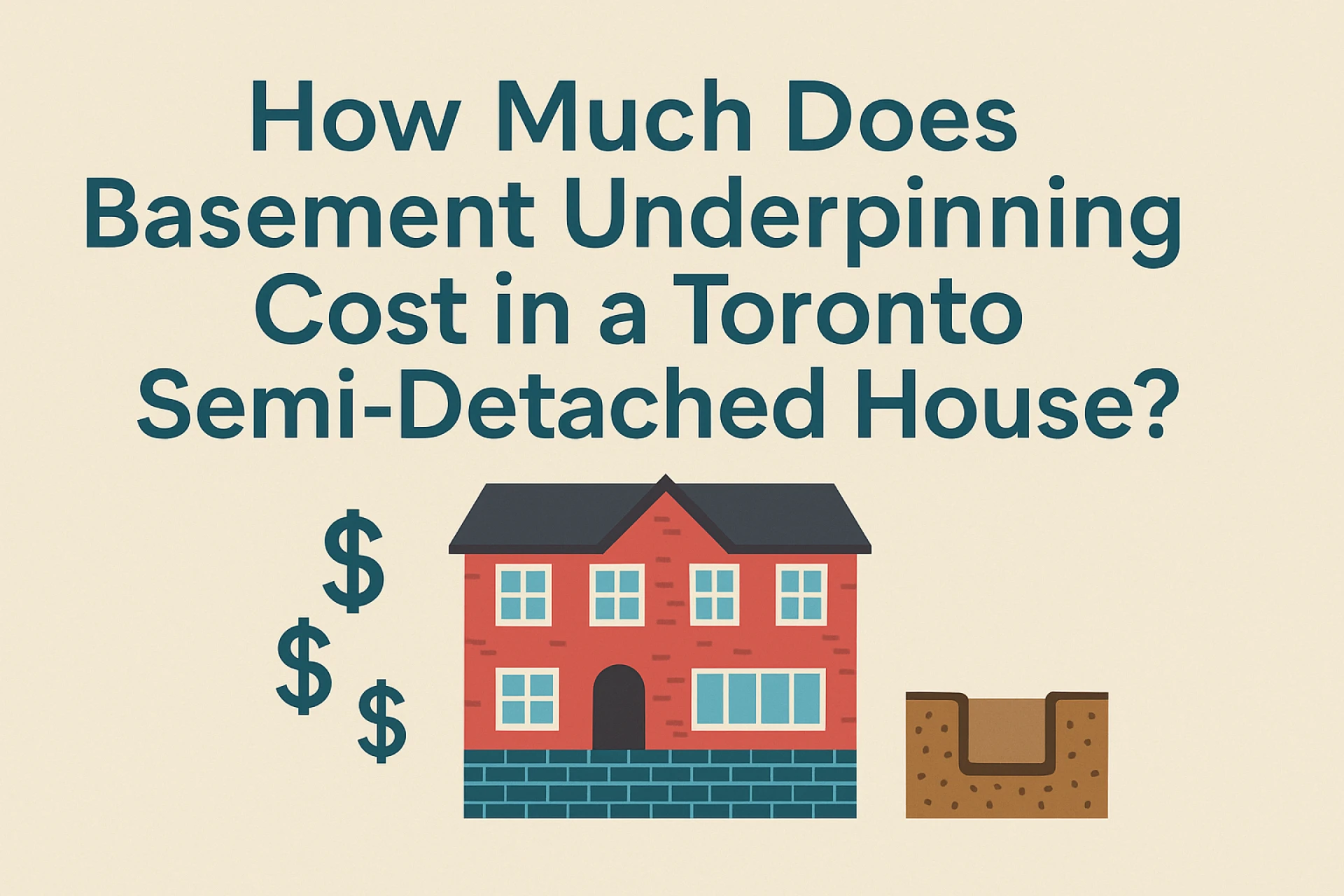

If you own a semi-detached home in Toronto, the basement probably wasn’t built for modern life. Low ceilings. Creaky floors. Cracks that make you wonder if the house is telling you something. And with home prices climbing every year, many owners want to upgrade the space instead of upgrading to a new house.
That’s where basement underpinning comes in.
But what most homeowners really want to know is simple: what’s this going to cost?
Let’s break it down without the sugar-coating.
Average Cost of Basement Underpinning in Toronto (2025 Estimates)
Basement underpinning in Toronto usually ranges between $400 and $550 per linear foot.
For a typical semi-detached footprint, most homeowners end up spending $55,000 to $85,000.
Why the range? Because no two Toronto basements behave the same. Some are straightforward. Others were built 80 years ago with foundations that look like geological history samples.
What’s Usually Included in the Base Price
Most underpinning quotes cover:
- Excavation
- New footings
- Concrete underpinning pins
- New basement slab
- Structural engineering
- City permits and inspections
If a contractor gives you a number without explaining these items, ask questions. A good quote is always transparent.
Why Semi-Detached Homes Cost More (or Less) Than Detached Homes
Semi-detached houses look simple from the street. Two homes. One wall. Easy, right?
Not always.
Shared Wall Responsibilities
Your party wall belongs to you and your neighbour. Underpinning that wall requires extra engineering, extra inspections, and sometimes extra approvals. Good contractors handle this smoothly, but it still adds time and coordination.
Access Challenges
Older Toronto semis often sit on narrow lots. Limited side access means:
- Smaller equipment
- More hand digging
- Longer timelines
That affects labour, and labour affects cost.
Key Factors That Influence Your Total Underpinning Cost
If you’ve ever renovated anything in Toronto, you already know the truth:
The devil lives in the details.
How Deep You Want to Go
Want 7 feet?
Want 8 feet?
Want the dream 9-foot ceiling height?
Every extra inch adds more excavation, more concrete, and more engineering.
Soil Conditions & Foundation Type
Toronto soil is a mixed bag, clay, sandy layers, old fill, or even rubble in century homes.
Harder soil and older foundations require more complex underpinning steps.
Waterproofing & Drainage Upgrades
If you’re already opening up the entire basement, most contractors recommend upgrading:
- Weeping tile
- Sump pump
- Waterproof membranes
It prevents future headaches and protects your investment.
Plumbing, HVAC, and Utility Changes
Want a new basement bathroom or laundry?
Need ductwork moved to create more headroom?
These adjustments change the final bill.
Permits & Engineering
Toronto building permits and structural engineering fees add $5,000–$10,000 on average.
Don’t skip them. This is structural work.
Popular Add-Ons Toronto Homeowners Request
Once the basement is open, most homeowners take the chance to upgrade other areas.
Common add-ons include:
- Basement walkout
- Heated floors
- Egress windows
- New insulation
- Waterproofing and drainage
- Full finishing work
Each adds cost but also adds long-term value.
How Long Does Underpinning Take for a Semi-Detached House?
Most semi-detached underpinning projects take 6–10 weeks.
Timelines depend on:
- Access
- Soil conditions
- Inspection schedules
- Additional upgrades (like adding a basement walkout)
Unlike cosmetic renovations, underpinning moves step by step. Every pin must cure before the next one starts. It’s precise work, not rushed work.
Cost Comparison: Semi vs Detached vs Row House
Here’s the quick cheat sheet:
- Detached home: Usually the easiest, lowest cost
- Semi-detached: Slightly higher due to shared wall and access limitations
- Row house: Most challenging due to zero lot lines on both sides
Semis sit right in the middle. Not the cheapest, not the most complex.
Signs Your Semi-Detached Home Needs Underpinning
Wondering if you’re doing this for the right reasons?
Here’s what homeowners often notice:
- Low ceiling height
- Uneven or sloping floors
- Basement moisture
- Visible cracks in foundation or walls
- Musty smell or cold drafts
- Limited space for rental or family use
If two or more of these sound familiar, underpinning might be worth exploring.
When Underpinning Becomes a Smart Investment
Underpinning is expensive, but in Toronto’s real estate market, it often pays off in real ways:
- You create livable square footage
- You can add a legal rental suite
- Your home value increases
- You fix long-term structural issues
- You gain ceiling height that changes how the entire house feels
For many semi-detached homeowners, underpinning becomes the upgrade that unlocks the home’s full potential.
Conclusion
According to True North Underpinning, Basement underpinning in a Toronto semi-detached home usually falls between $55k and $85k, depending on depth, access, soil, and add-ons. It’s a major investment, but it delivers major rewards, more height, more space, more safety, and more value.
And once the work is done, your basement stops being “the basement” and becomes a space you actually want to use.

























Sign in to leave a comment.