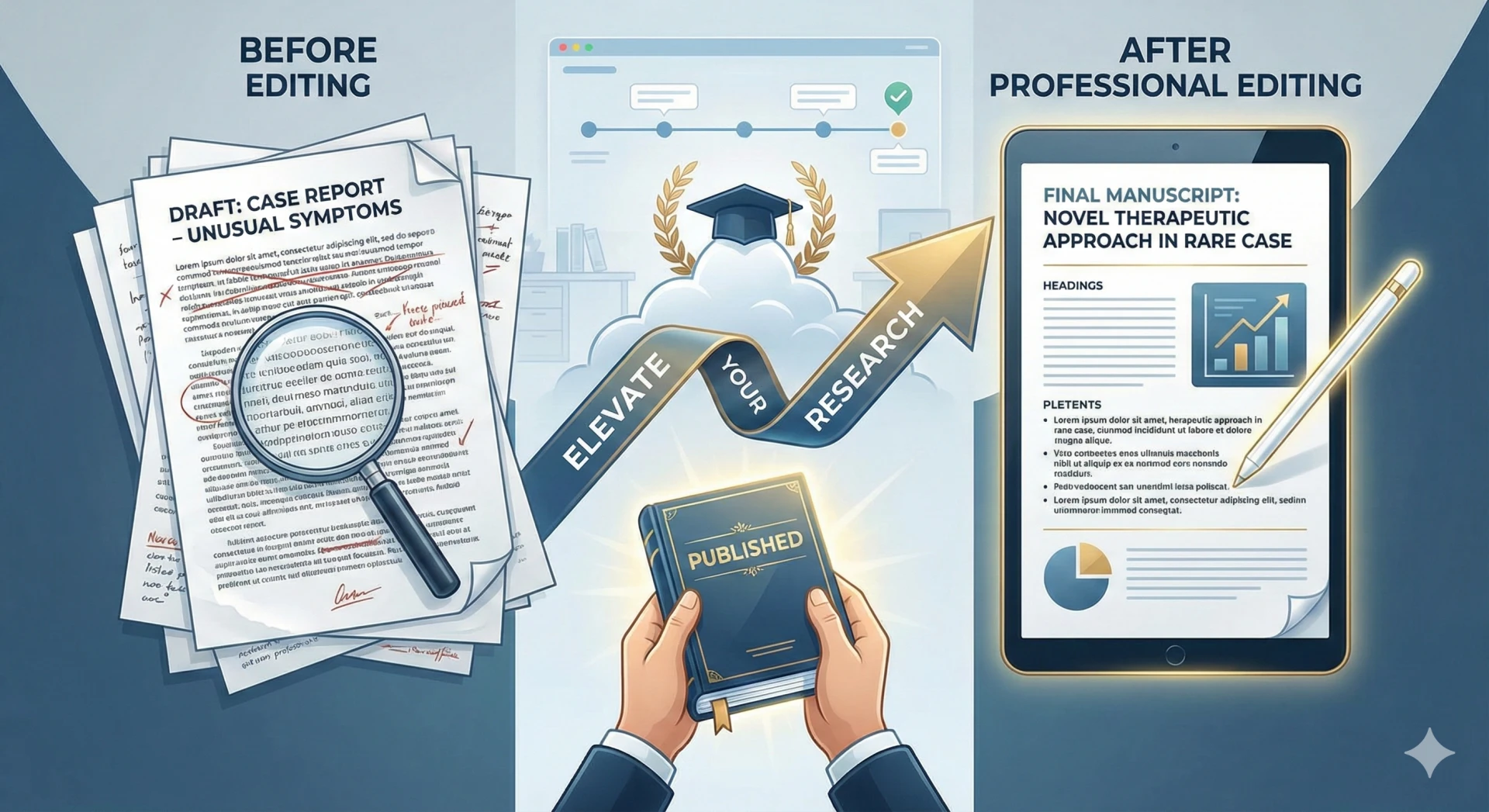
Imagine sitting at your desk late at night. You have spent months or perhaps even years diligently working on a groundbreaking study or documenting a unique clinical case that could change how physicians approach a specific disease. The data is solid, the findings are significant, and you are ready to share your work with the world. You submit your manuscript with high hopes, only to receive a rejection letter weeks later. The reviewers do not question your science, but they criticize the clarity of your writing.
This is a scenario that plays out far too often in the academic world. In the highly competitive landscape of scientific publishing, the quality of your writing is just as crucial as the quality of your research. If reviewers cannot understand your argument due to poor phrasing or structural issues, they cannot appreciate the value of your findings. This is where professional support becomes a necessity rather than a luxury. At Harvard Publication Hub, we believe that language barriers should never stop good science from being published.
The Umbrella of Excellence: Understanding English Editing Services
The first step in transforming a draft into a publishable paper is utilizing comprehensive English editing services. Many researchers assume this process is merely about running a spell check or fixing basic grammar mistakes. However, true academic editing goes much deeper than surface level corrections. It is a rigorous review process performed by language experts who understand the nuances of academic tone and flow.
The primary goal of these services is to make the text sound natural, fluent, and professional to a native English speaking audience. When a manuscript is riddled with awkward phrasing or limited vocabulary, it creates a mental load for the reader. Reviewers may become frustrated and focus on the errors rather than the scientific content. English editing services aim to eliminate ambiguity so that the reader can focus entirely on the science.
This service is essential for researchers whose first language is not English, often referred to as ESL authors. However, it is surprisingly beneficial for native speakers as well. Even seasoned researchers can overlook jargon, inconsistent tone, or overly complex sentence structures in their own writing because they are too close to the work. A fresh pair of professional eyes ensures that the narrative flows logically and the arguments are presented with maximum impact.
The Gold Standard: The Depth of Scientific Manuscript Editing Services
While general language polish is vital, scientific communication operates under a unique set of rigid rules and conventions. This is where scientific manuscript editing services distinguish themselves from standard proofreading. At Harvard Publication Hub, this level of editing is not performed by generalists. It is conducted by editors who hold advanced degrees such as PhDs or Masters in specific scientific fields including biology, medicine, and engineering. These professionals do not just correct the language; they truly understand the subject matter.
A scientific edit involves a deep dive into the technical accuracy of the text. The editor ensures that terminology is used correctly and consistently throughout the paper. They look at the structure and logic of the argument to verify that the manuscript follows the standard IMRaD format, which stands for Introduction, Methods, Results, and Discussion. If the flow of logic jumps around or if the conclusion does not fully align with the results presented, a scientific editor will identify these gaps.
Furthermore, these services prioritize compliance with journal guidelines. Every academic journal has specific requirements regarding formatting, reference styles like APA or Vancouver, figure and table legends, and abstract word counts. Failing to adhere to these can lead to an immediate desk rejection before a peer reviewer even sees the abstract. Scientific manuscript editing services also focus on clarity and conciseness. They work to eliminate wordiness and simplify complex ideas so that dense methodological descriptions are readable. Ethical standards are also a priority, as a good editor will flag potential issues and ensure that ethical guidelines are mentioned where necessary to protect the integrity of the work.
A Unique Challenge: The Critical Need for Case Report Editing Assistance
Among the various types of scientific manuscripts, the clinical case report stands out for its unique challenges and immense educational value. Writing a case report is different from writing a standard research article because it requires a compelling narrative. This is why specialized Case Report Editing assistance is a crucial service for medical professionals.
Case reports essentially tell a story about a patient. They require a narrative structure that balances specific clinical details with broader educational takeaways. The structure needs to hook the reader from the beginning and clearly state the lesson learned from the case. Researchers often face common pitfalls when drafting these reports. They may write an unfocused introduction that fails to provide a concise literature review, leaving the reader wondering why this specific case matters. Another common issue is a disjointed narrative where the case presentation reads like a raw patient chart rather than a coherent story.
The discussion section of a case report is often the most critical yet the most neglected part. It frequently lacks depth and fails to properly compare the case with existing literature or articulate its novel contribution to the field. Specialized Case Report Editing assistance provided by Harvard Publication Hub addresses these issues head on. An editor with a medical background can strengthen the narrative flow of the case presentation while ensuring that patient anonymity is rigorously maintained. They help frame the discussion to highlight the clinical relevance and novelty effectively, ensuring the report makes a strong case for publication.
The Synergy: How All Three Services Work Together for Your Success
It is important to understand that these services are not mutually exclusive. In fact, the best results come when they operate in synergy. A top tier service provider like Harvard Publication Hub ensures that these elements work together seamlessly.
When you submit a case report to us, it undergoes a multi layered process. It receives scientific manuscript editing performed by a medical editor, which inherently includes high quality English editing services. You can view it as a construction process. The foundation is perfect English, the walls are a robust scientific structure, and the final polish is the subject specific expertise required for the manuscript type. This integrated approach ensures that the manuscript is polished at every level. It removes every possible barrier to acceptance, maximizing the chances that your work will be welcomed by high impact journals.
Conclusion: An Investment in Your Academic Impact
In the end, seeking professional help is not an admission of weakness. It is a strategic investment in your career. Utilizing these services saves you time and reduces the frustration of repeated rejections. Most importantly, it ensures that your valuable research gets a fair hearing in the global scientific community. By partnering with experts who understand the intricacies of publishing, you pave the way for more citations and a stronger academic profile.



























Sign in to leave a comment.