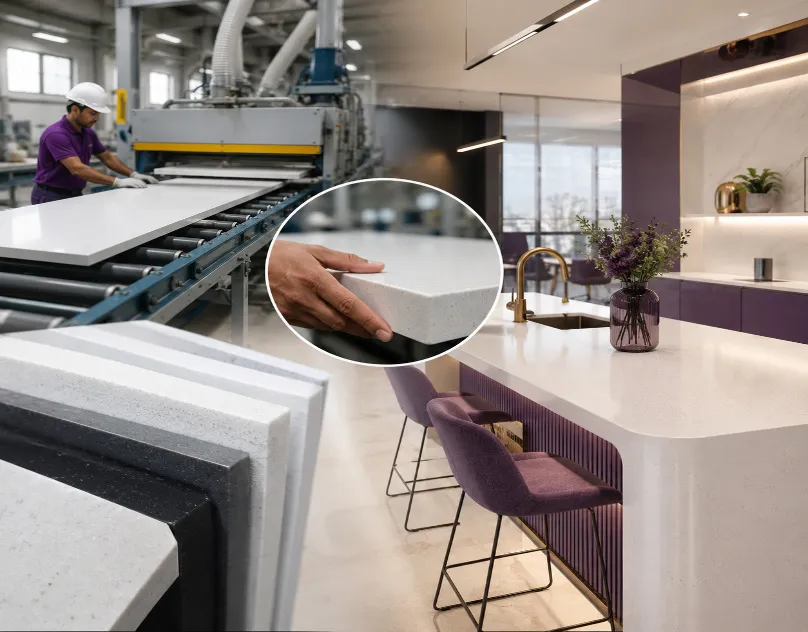

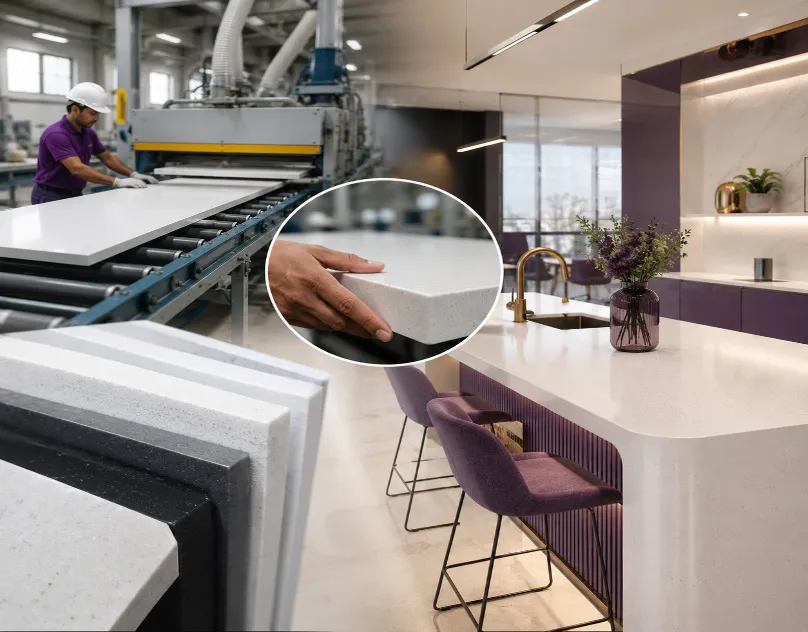
Manufacturing quality decides how well a countertop, vanity, or wall panel resists stains, holds an invisible joint, and survives years of daily use. Weak production shows up later as cracking, yellowing, or joints that pull apart.
According to DuPont, which introduced solid surface material in 1967 under the Corian brand, the production process still separates premium sheets from budget imitations nearly six decades later today. Most buyers skip the factory details.
For homeowners, architects, and contractors sourcing countertops in Ahmedabad, understanding what happens before a sheet reaches a fabricator matters more than any swatch card. Factory process matters most.
Key Takeaways
- Manufacturing quality depends on resin, curing, and quality control-not just branding.
- ISO 9001:2015 certification reflects consistent manufacturing standards.
- Strong joint-fitting ensures seamless, long-lasting installations.
- Checking raw materials and testing helps avoid costly replacements.
What Does Solid Surface Production Actually Involve Today?
Solid surface manufacture mixes resin, mineral filler, and pigment. Factories cast the mix into sheets, then cure, sand, and inspect each one before a fabricator sees it. The result resembles Corian style surfaces sold worldwide.
Raw Materials That Shape Solid Surface Sheet Quality Levels
The resin-to-filler ratio decides how a sheet resists impact, heat, and staining once installed. A factory that uses inconsistent filler grades produces sheets that chip or discolor faster, even when the color looks identical off the shelf.
Solid Surface Production Basics: The solid surface fabrication process blends acrylic resin, mineral filler, and pigment into cast sheets that get cured, sanded, and trimmed, producing a material fabricators can join without a visible line.
Casting, Curing, and Finishing Inside the Production Line
Sheets are poured into molds, cured under controlled heat, then run through sanding and polishing lines before quality checks. Fabricators need consistent thickness to join panels without a visible line between them.
Why Manufacturing Certifications Matter for Smart Buyers?
Certifications tell you whether a factory follows documented steps or runs on inconsistent, ad hoc processes across every shift. ISO 9001:2015 shows an ISO certified manufacturer repeats quality checks at every stage.
According to NSF International, solid surface tested under NSF/ANSI 51 meets food-zone contact safety standards used widely across healthcare, hospitality, and residential kitchen projects across India.
According to ISO, the 45001:2018 standard governs factory worker health and safety practices during solid surface production runs, an area many buyers overlook when comparing manufacturers on price alone.
Certification Signals: ISO 14001:2015 covers environmental management during production, while GREENGUARD testing focuses on chemical emissions that affect indoor air quality, a factor that matters most for bedrooms and healthcare interiors.
Manufacturing quality is not something inspected after installation. It has to be built into every batch, from resin ratio to curing time, long before a sheet ever ships out.
Does Local Manufacturing Really Change Fabrication Support?
Yes, sourcing from a local factory changes turnaround time, color-match availability, and how fast a fabricator gets replacement sheets mid-project. Christone operates as an acrylic solid surface producer based in Ahmedabad, Gujarat.
Producing in Ahmedabad instead of importing gives local fabricators faster color matching and shorter lead times on large commercial orders.
That responsiveness matters most on multi-phase 2026 commercial builds where delays cascade across trades quickly. Local factories also run smaller custom batches for specialty colors at reasonable cost.
What Does Poor Manufacturing Quality Cost You Later On?
Cutting corners during production creates problems that only surface after installation, when replacement costs run far past any upfront savings. The pattern shows up consistently across fabricator reports and warranty claims from 2025 onward.
- Uneven resin curing leads to premature yellowing within two to three years
- Low-grade filler causes surface chipping around sink cutouts and edges
- Inconsistent sheet thickness makes joints visibly uneven once installed
- Skipped quality checks let batch color variation slip into one installation
These issues trace back to one root cause: a solid surface manufacture process that skipped documented quality steps to cut costs somewhere along the line. Sheets built on a proper process rarely need seam repair within the first decade.
Conclusion
Manufacturing quality is the foundation every solid surface project rests on, from resin selection through final inspection. Buyers who check certification and raw material sourcing get panels that last.
At Christone, our solid surface manufacture process runs under ISO 9001:2015, ISO 14001:2015, and GREENGUARD certification in Ahmedabad, ensuring architects and homeowners get consistent quality on every single order placed.
Whether you need one kitchen or a full commercial build across Gujarat, reach out to Christone before finalizing a supplier so your project gets certified, consistent solid surface sheets from the start.
Frequently Asked Questions
What Makes Solid Surface Manufacturing Differ From Laminate?
Solid surface production casts resin and filler into solid sheets, while laminate bonds a thin layer onto particleboard. Solid surface stays uniform, so scratches can be sanded out.
Why Does ISO 9001:2015 Certification Matter for Buyers?
ISO 9001:2015 shows a factory documents and repeats quality control on every batch. Without it, sheet thickness and durability can vary between orders from the same supplier.
Can Damaged Solid Surface Sheets Be Repaired, Not Replaced?
Yes, properly manufactured solid surface sheets can be sanded and buffed to remove scratches or shallow burns, since the material stays solid through its full thickness.
Does Buying From an Ahmedabad Manufacturer Save Real Time?
Yes, local manufacturing shortens lead times for replacement panels and custom color runs, which matters most on commercial projects with tight installation schedules through 2026 and beyond.
What Certifications Should I Ask a Sheet Supplier About?
Ask about ISO 9001:2015 for quality management, ISO 14001:2015 for environmental controls, and GREENGUARD or NSF/ANSI 51 for emissions and food-contact safety, depending on your specific project type.





















Sign in to leave a comment.