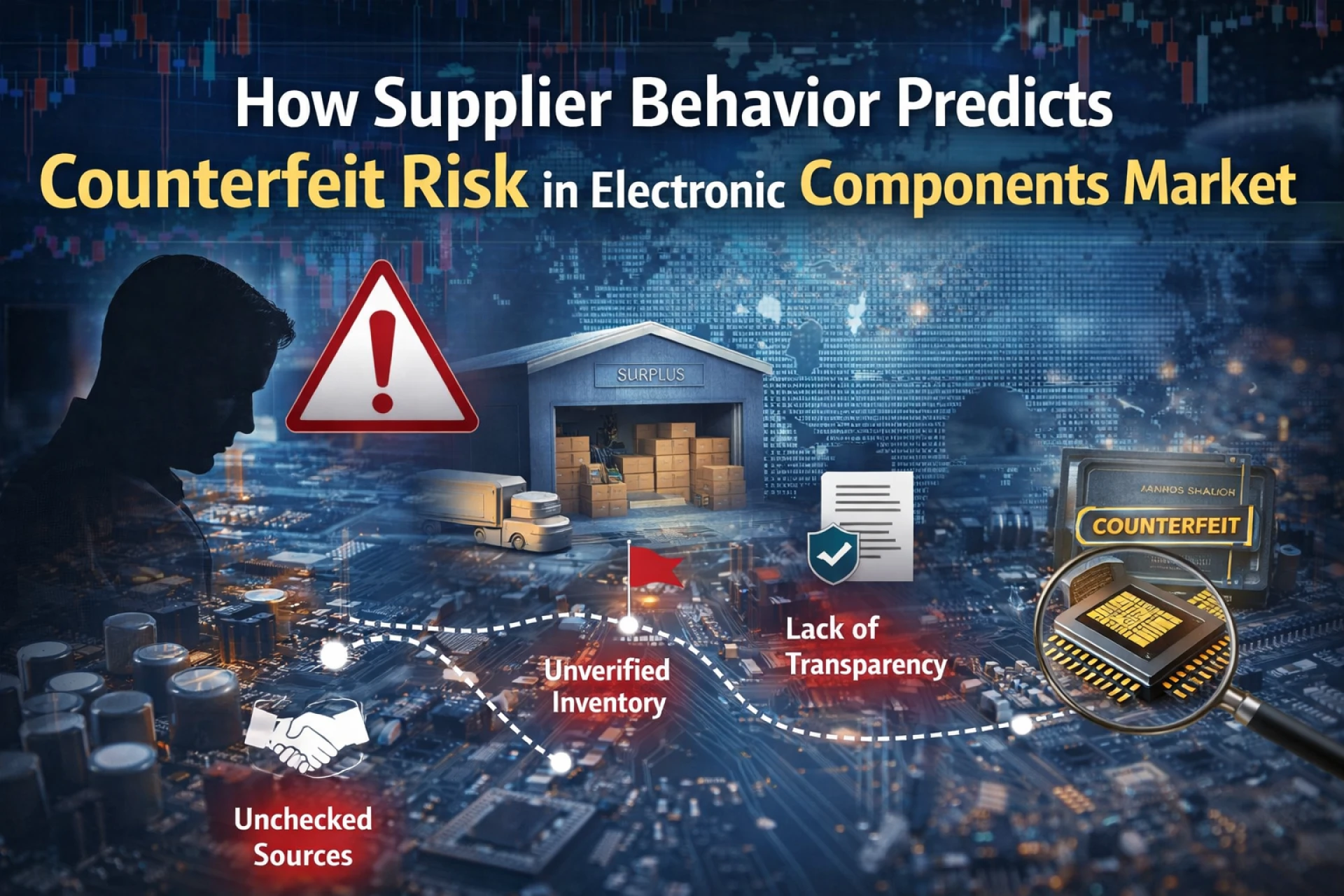

In the electronic components market, counterfeit risk is often treated as a product-level issue. The focus is typically on identifying fake parts through inspection, testing, and documentation checks after procurement. While these controls are necessary, they address risk too late in the process.
In reality, counterfeit exposure is not random. It is largely driven by supplier behavior.
Experienced buyers understand that the most effective way to reduce risk is not just to test components after purchase, but to identify high-risk sourcing patterns before an order is ever placed. This shift—from reactive verification to proactive supplier intelligence—is increasingly critical in the global market for obsolete and hard-to-find electronic components.
Counterfeit Risk Is Patterned, Not Random
Counterfeit components do not enter the supply chain uniformly. They tend to cluster around specific sourcing environments, inventory channels, and supplier behaviors.
In periods of shortage or when dealing with obsolete and end-of-life (EOL) components, supply becomes fragmented. Inventory moves through surplus markets, excess stock channels, and secondary distributors. Within this ecosystem, some suppliers consistently operate within controlled sourcing environments, while others are more exposed to refurbishment streams, mixed inventory, or unverified sources.
The difference is rarely visible in a single transaction. It becomes clear only over time, through patterns.
Here are some electronic components categories you can explore
Common Behavioral Red Flags in the Market
Supplier risk is often visible through repeated behaviors rather than isolated incidents. Some of the most common signals include:
Consistent availability of “new” stock for long-obsolete components
When a component has been discontinued for years, repeated claims of large volumes of newly manufactured inventory should be treated cautiously.
Inconsistent date codes across quotations
Frequent variation in date codes for the same part may indicate mixed lots, reworked inventory, or lack of controlled sourcing.
Sudden inventory spikes in constrained components
Unexpected availability in parts that are globally scarce can suggest sourcing from higher-risk channels.
Pricing that deviates significantly from market norms
Aggressive pricing is not always a competitive advantage. In some cases, it reflects compromised sourcing quality.
Reluctance to provide inspection or testing transparency
Suppliers who avoid discussion around quality controls, inspection processes, or testing history introduce additional uncertainty.
Unrealistically fast turnaround for rare components
Consistent ability to deliver hard-to-find parts with minimal lead time may indicate access to unverified inventory pools.
Individually, these signals may not confirm risk. Collectively, they form a pattern.
Why Static Supplier Qualification Falls Short
Many procurement processes rely on one-time supplier qualification—checking certifications, reviewing company profiles, or validating documentation at onboarding.
While necessary, this approach is insufficient in the secondary market.
Supplier behavior evolves. Inventory sources change. Market conditions shift. A supplier that was reliable for one category or time period may not exhibit the same standards consistently across all transactions.
Certifications and documentation provide a snapshot. Risk, however, is dynamic.
Effective sourcing requires continuous evaluation, not static approval.
The Role of Quotation-Level Intelligence
To manage this dynamic risk, procurement teams increasingly rely on quotation-level intelligence—analyzing supplier behavior across multiple interactions rather than evaluating quotes in isolation.
This includes:
- Tracking consistency of quoted inventory types over time
- Comparing pricing behavior across suppliers for the same part
- Monitoring responsiveness and transparency in communication
- Identifying recurring anomalies in date codes or availability patterns
Over time, this creates a behavioral profile for each supplier.
This approach does not depend on any single data point. Instead, it builds confidence—or raises concern—based on accumulated evidence.
In high-risk categories such as microcontrollers, power devices, and application-specific integrated circuits, this level of insight becomes a critical decision-making tool.
At Maketronics, this approach is applied through continuous monitoring of supplier quotations across part categories and regions. Rather than evaluating suppliers based on isolated transactions, sourcing decisions are supported by observed patterns in how suppliers quote, price, and represent inventory over time. This allows potential risk signals to be identified earlier in the procurement cycle, particularly in high-risk categories where documentation is limited and availability is fragmented.
Integrating Supplier Intelligence with Testing
Supplier behavior analysis does not replace inspection and testing. It determines where and how those controls should be applied.
Testing every component to the same level is neither practical nor necessary. Instead, risk-based testing aligns inspection depth with supplier profile, component criticality, and application sensitivity.
For example:
- A supplier with consistent historical behavior and stable sourcing patterns may require standard inspection protocols.
- A supplier showing irregular patterns or exposure to higher-risk channels may require advanced testing aligned with standards such as AS6081 or AS6171.
This layered approach ensures that resources are applied efficiently while maintaining control over quality and authenticity.
Moving from Reactive to Proactive Risk Management
Traditional counterfeit mitigation strategies focus on detecting failures after components have entered the procurement pipeline. While this remains important, it does not prevent exposure—it only contains it.
By contrast, supplier intelligence allows procurement teams to filter risk earlier in the process.
Instead of asking, “Is this component genuine?” after purchase, the more effective question becomes:
“Is this a supplier whose behavior indicates controlled sourcing?”
This shift reduces dependency on downstream testing and minimizes the probability of encountering high-risk inventory altogether.
Conclusion
In the global electronic components market, particularly within obsolete and hard-to-find categories, counterfeit risk is not simply a function of product authenticity. It is a function of sourcing behavior.
Traceability, documentation, and testing all play important roles in risk mitigation. However, without understanding how suppliers operate over time, these controls remain incomplete.
Organizations that incorporate supplier behavior analysis into their sourcing strategy gain a significant advantage. They move from reactive inspection to proactive risk management—reducing exposure before it enters the supply chain.
In an environment where availability is uncertain and documentation is often limited, supplier intelligence is no longer optional. It is foundational.










Sign in to leave a comment.