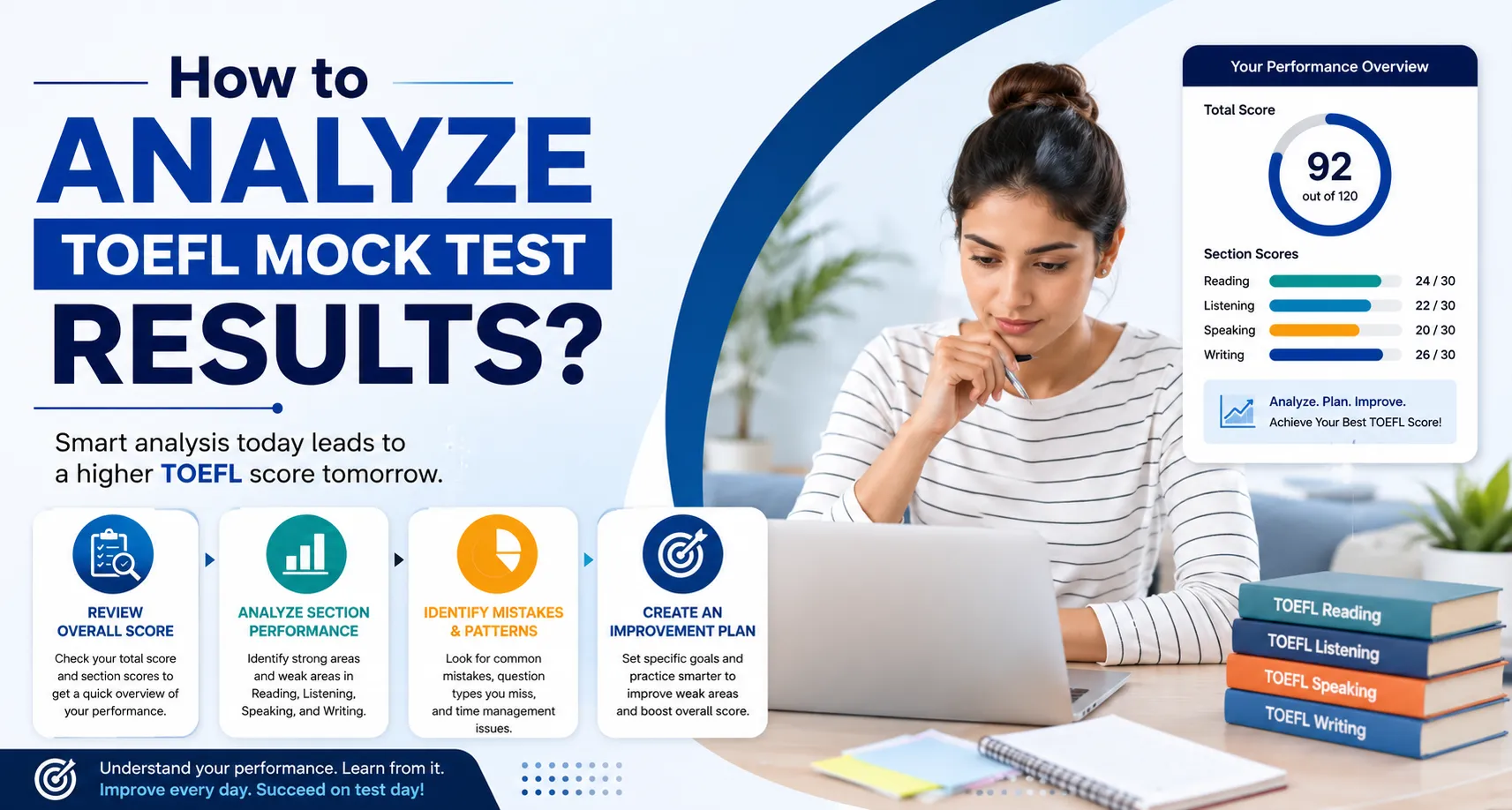

Mock tests provide valuable insight into exam readiness, but the score alone tells only part of the story. Effective preparation depends on identifying patterns, evaluating strengths, and correcting weaknesses before the official examination. Careful analysis transforms every practice session into a meaningful opportunity for improvement instead of simply measuring performance. By reviewing results systematically, candidates can strengthen essential language skills, improve time management, and develop greater confidence. Consistent evaluation also supports smarter preparation, helping every study session contribute toward stronger overall performance.
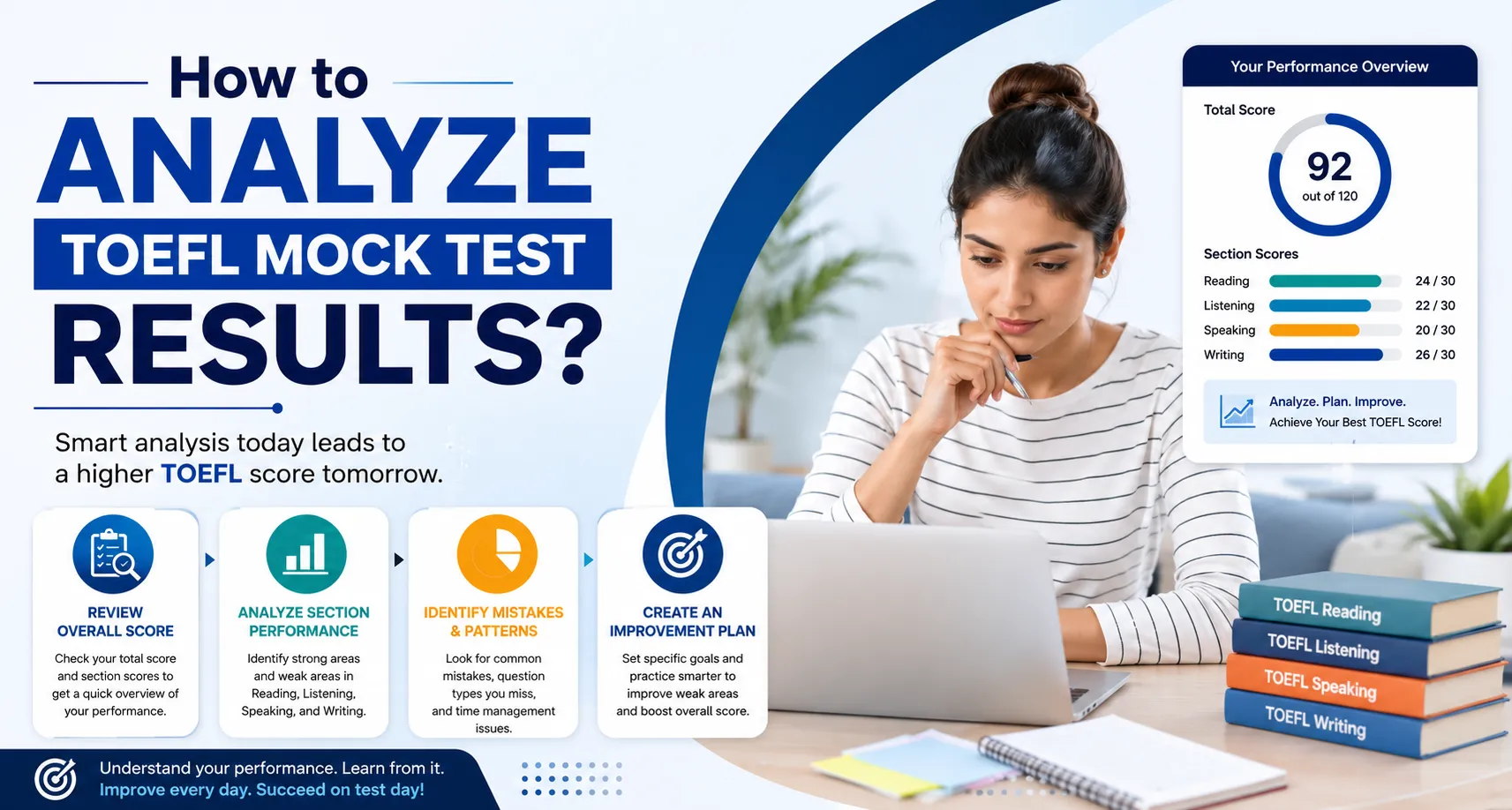
Why Mock Test Analysis Matters?
Completing a mock test marks only the beginning of effective preparation. The real value comes from reviewing every section carefully and identifying opportunities for improvement.
Many candidates focus exclusively on their final score. However, scores alone cannot explain why certain mistakes occurred or how future performance can improve.
A detailed review reveals habits, recurring errors, and skill gaps that ordinary study sessions may overlook.
Benefits of Careful Result Analysis
Analyzing mock test performance helps candidates:
- Measure actual progress
- Identify weak language skills
- Improve time management
- Reduce repeated mistakes
- Strengthen confidence
- Build realistic study goals
- Improve exam strategy
- Prepare more efficiently
Consequently, every completed mock test becomes an important part of long-term preparation.
Looking Beyond the Overall Score
A single score provides a summary but does not identify specific strengths or weaknesses.
Strong overall performance may still include weaknesses in individual sections. Likewise, a modest score may hide significant improvement in one language skill.
Candidates should evaluate each section independently before planning future study sessions.
Breaking Down Individual Section Scores
Review performance in:
- Reading
- Listening
- Speaking
- Writing
Each section reflects different language abilities and requires separate improvement strategies.
Moreover, comparing section scores highlights imbalances that deserve additional attention.
Avoiding Misleading Conclusions
Candidates sometimes become discouraged by one disappointing result.
Instead of treating one mock test as a final judgment, they should compare multiple assessments over time. Consistent trends provide much more reliable information than isolated scores.
Identifying Strengths Before Weaknesses
Many candidates immediately search for mistakes while ignoring areas that already perform well.
Recognizing strengths creates a balanced preparation strategy.
Strong skills require regular maintenance even while weaker sections receive additional attention.
Questions Worth Asking
Candidates should evaluate:
- Which section produced the highest score?
- Which tasks felt comfortable?
- Where did accuracy remain consistent?
- Which question types required minimal effort?
- Which skills improved since the previous test?
- Where did confidence remain highest?
These answers help maintain successful habits throughout preparation.
Building Upon Existing Strengths
Strong performance provides an excellent foundation for future improvement.
Candidates should continue practicing stronger skills regularly while dedicating extra study time to weaker areas. Consequently, overall performance remains balanced instead of becoming uneven.
Finding Patterns in Incorrect Answers
Every incorrect answer provides useful information.
Rather than feeling frustrated, candidates should identify why mistakes occurred and whether similar patterns appear repeatedly.
Repeated errors often reveal preparation habits that require adjustment.
Common Error Categories
Mistakes usually result from:
- Vocabulary limitations
- Grammar errors
- Poor concentration
- Misreading questions
- Weak listening accuracy
- Time pressure
- Careless responses
- Limited organization
Recognizing these categories makes future study sessions much more effective.
Separating Knowledge Errors From Careless Errors
Knowledge errors occur when candidates genuinely lack the required language skill.
Careless errors usually result from rushing, overlooking instructions, or losing concentration.
Distinguishing between these two categories helps candidates choose more appropriate improvement strategies.
Evaluating Reading Section Performance
Reading scores reveal much more than comprehension ability.
Candidates should evaluate both accuracy and efficiency throughout every passage.
A detailed review often exposes unnecessary rereading, weak vocabulary, or ineffective answer selection strategies.
Important Reading Indicators
Review factors such as:
- Accuracy rate
- Time spent per passage
- Difficult question types
- Vocabulary challenges
- Inference questions
- Detail recognition
- Main idea identification
- Completion consistency
These indicators reveal where improvement efforts should begin.
Improving Reading Performance
Candidates should focus on reducing unnecessary rereading while strengthening vocabulary and reading speed.
Moreover, practicing with timed passages helps improve efficiency without sacrificing accuracy.
Reviewing Listening Performance Carefully
Listening requires continuous concentration and quick information processing.
Candidates should evaluate not only incorrect answers but also moments when concentration declined during longer recordings.
Key Listening Evaluation Points
Review:
- Missed details
- Note-taking quality
- Concentration levels
- Speaker recognition
- Main idea accuracy
- Supporting information
- Response timing
- Consistency throughout recordings
Careful analysis often reveals patterns that ordinary listening practice cannot identify.
Strengthening Listening Skills
Candidates should identify whether mistakes result from vocabulary limitations, attention loss, unfamiliar accents, or incomplete note-taking.
Consequently, future listening practice becomes more focused and productive.
Analyzing Speaking Performance Objectively
Speaking requires candidates to combine pronunciation, fluency, grammar, vocabulary, and organization within limited time.
Objective evaluation helps identify specific improvements rather than relying on general impressions.
Areas Worth Reviewing
Candidates should examine:
- Pronunciation clarity
- Speaking fluency
- Response organization
- Grammar accuracy
- Vocabulary variety
- Speaking pace
- Hesitation frequency
- Completion within time limits
Each factor contributes to stronger communication during the examination.
Avoiding Common Speaking Mistakes
Many candidates speak too quickly because of nervousness.
Others pause excessively while searching for perfect vocabulary.
Balanced pacing, clear pronunciation, and organized responses usually produce stronger performance than attempting overly complex language.
Assessing Writing Performance in Detail
Writing evaluation should extend far beyond grammar correction.
Strong responses require logical organization, coherent ideas, appropriate vocabulary, and effective time management.
Candidates should examine every writing task carefully before beginning the next mock test.
Writing Elements That Require Attention
Review each response for:
- Organization
- Grammar accuracy
- Vocabulary selection
- Sentence variety
- Paragraph structure
- Task completion
- Clarity of ideas
- Time management
A balanced review identifies strengths while revealing opportunities for improvement.
Recognizing Repeated Writing Problems
Candidates often repeat similar grammar mistakes or organizational weaknesses across multiple practice sessions.
Tracking these recurring issues allows future study sessions to focus on corrections that create lasting improvement.
Measuring Time Management Across Every Section
Time management directly affects TOEFL performance because every section follows strict limits. Even candidates with strong language skills may lose valuable points if they fail to complete tasks efficiently.
Mock test analysis should always include a careful review of pacing.
Questions to Evaluate About Timing
Candidates should consider:
- Did every section finish on time?
- Which task required the most time?
- Where did unnecessary delays occur?
- Which questions caused hesitation?
- Did rushing reduce accuracy?
- Were review opportunities available?
- Did concentration decline near the end?
- Was pacing consistent throughout?
These questions reveal whether timing or language ability caused lower scores.
Improving Pacing Through Analysis
Candidates should compare completion times across several mock tests instead of relying on one attempt.
Moreover, gradual improvements in pacing often produce higher scores without requiring significant changes in language skills.
Comparing Multiple Mock Test Results
One practice test provides only a snapshot of current performance. However, several mock tests reveal long-term progress and recurring trends.
Candidates should review previous results regularly rather than evaluating each assessment independently.
Benefits of Long-Term Tracking
Comparing multiple results helps identify:
- Score improvements
- Stable performance areas
- Recurring weaknesses
- Better time management
- Increased accuracy
- Improved consistency
- Faster completion
- Stronger confidence
Consequently, candidates gain a realistic picture of their overall preparation.
Avoiding Overreaction to One Score
Individual results naturally fluctuate.
Instead of becoming discouraged by one lower score, candidates should focus on broader performance patterns. Long-term consistency provides a much better indication of exam readiness.
Creating an Improvement Plan Based on Results
Performance analysis becomes valuable only when candidates apply the information effectively.
Every mock test should lead to specific action rather than vague intentions.
Building Practical Study Goals
Effective goals may include:
- Improving reading speed
- Expanding academic vocabulary
- Strengthening grammar accuracy
- Practicing speaking fluency
- Organizing writing responses
- Improving listening focus
- Reducing careless mistakes
- Completing sections faster
Specific goals create measurable progress throughout preparation.
Prioritizing Weak Areas
Candidates should address the weakest skills first while maintaining regular practice in stronger sections.
This balanced strategy supports steady improvement without allowing existing strengths to decline.
Tracking Recurring Mistakes
Repeated mistakes often indicate habits rather than isolated errors.
Candidates should maintain a written record of recurring problems across every mock test.
Common Patterns Worth Recording
Track recurring issues such as:
- Grammar mistakes
- Vocabulary confusion
- Pronunciation problems
- Poor paragraph organization
- Missed listening details
- Slow reading speed
- Weak time management
- Careless answer selection
Recording these patterns makes improvement easier to measure.
Using Mistake Logs Effectively
Candidates should review mistake records before beginning each new study session.
Consequently, preparation remains focused on correcting previous weaknesses instead of repeating identical errors.
Evaluating Confidence Alongside Performance
Scores provide valuable information, but confidence also influences exam performance.
Candidates should evaluate how comfortable they felt during each section while reviewing their results.
Questions About Confidence
Consider the following:
- Which section felt easiest?
- Where did confidence decline?
- Which tasks created unnecessary stress?
- Did difficult questions affect later performance?
- Were instructions easy to follow?
- Did pacing remain comfortable?
- Was concentration consistent?
- Did confidence improve compared with earlier mock tests?
These observations help identify emotional barriers that require attention.
Building Confidence Through Regular Review
Confidence increases naturally when candidates recognize measurable improvement.
Moreover, reviewing positive progress alongside weaknesses creates a balanced perspective that supports continued motivation.
Using Feedback to Improve Future Performance
Performance reports provide direction only when candidates act upon the feedback.
Ignoring detailed analysis limits the value of every completed mock test.
Turning Feedback Into Action
Candidates should:
- Revise weak concepts
- Practice similar questions
- Improve timing strategies
- Strengthen vocabulary
- Review grammar rules
- Complete targeted exercises
- Monitor future progress
- Adjust study priorities regularly
Each improvement step builds stronger preparation for future assessments.
Maintaining Consistent Progress
Small improvements after every mock test often produce significant long-term gains.
Candidates who apply feedback consistently develop stronger language skills while reducing repeated mistakes throughout preparation.
Using Practice Tests to Build Exam Readiness
Mock tests evaluate much more than language ability. They also measure preparation quality, decision-making, concentration, and adaptability under pressure.
Candidates who complete a TOEFL exam practice test under realistic conditions gain valuable information about performance trends while identifying specific areas that deserve additional attention before the official examination.
Preparing More Effectively
Realistic practice strengthens several important abilities:
- Reading efficiently
- Listening attentively
- Speaking clearly
- Writing logically
- Managing time
- Following instructions
- Maintaining focus
- Responding confidently
Each practice session contributes to stronger overall preparation when candidates analyze results carefully.
Avoiding Common Analysis Mistakes
Even careful candidates sometimes reduce the value of mock tests through ineffective review habits.
Recognizing these mistakes helps create a more productive evaluation process.
Mistakes During Result Analysis
Candidates often:
- Focus only on total scores
- Ignore weaker sections
- Skip detailed reviews
- Compare results unfairly
- Repeat identical study methods
- Forget previous mistakes
- Avoid tracking progress
- Rush into another mock test
These habits slow improvement despite regular practice.
Building Better Review Habits
Candidates should schedule dedicated review time after every assessment.
Careful evaluation, organized note-taking, and realistic planning create a stronger foundation for continuous improvement while making every future mock test more valuable.
Small Improvements Create Stronger Results
Analyzing mock test results transforms ordinary practice into meaningful preparation. Careful evaluation identifies strengths, corrects weaknesses, improves time management, and strengthens confidence before the official examination. Moreover, consistent review helps candidates make informed study decisions instead of relying on guesswork. Every completed mock test offers valuable insight that supports continuous progress across reading, listening, speaking, and writing. Candidates who analyze performance systematically, apply feedback consistently, and monitor long-term improvement prepare themselves for stronger, more reliable results when the actual TOEFL examination begins.
FAQs
1. Why should I analyze my TOEFL mock test results instead of checking only my score?
A final score provides only a summary of performance. Careful analysis reveals weaknesses, recurring mistakes, timing issues, and skill gaps that the score cannot explain. Reviewing detailed results allows candidates to improve future preparation and build stronger performance across every section of the examination.
2. How often should I review my mock test results?
Candidates should review every mock test immediately after completion while the details remain fresh. Regular analysis helps identify mistakes, compare progress, and create focused study plans. Consistent evaluation also prevents repeated errors from becoming long-term habits during preparation.
3. What should I examine first after completing a mock test?
Begin by reviewing individual section scores before analyzing specific mistakes. Next, identify patterns related to accuracy, timing, and question types. Finally, create practical improvement goals based on the findings instead of concentrating only on the overall performance score.
4. Why is tracking multiple mock test results important?
Comparing several mock tests reveals long-term trends that one assessment cannot show. Candidates can measure improvement, identify recurring weaknesses, evaluate consistency, and monitor progress across reading, listening, speaking, and writing while making smarter preparation decisions.
5. How can I identify recurring mistakes effectively?
Maintain a written record after every mock test that includes grammar errors, vocabulary problems, timing challenges, reading mistakes, and speaking or writing weaknesses. Reviewing these notes regularly helps candidates recognize repeated patterns and prioritize the areas requiring additional practice.
6. Should I spend more time improving weak sections than strong ones?
Yes, weaker sections deserve greater attention because they offer the largest opportunity for score improvement. However, candidates should continue practicing stronger skills regularly to maintain consistent performance across every language area and avoid losing previously developed abilities.
7. How does mock test analysis improve time management?
Reviewing completion times helps candidates identify slow sections, unnecessary delays, and inefficient habits. Consequently, they can adjust pacing strategies, practice timed exercises, and complete future assessments more confidently without sacrificing answer accuracy or concentration.
8. Can analyzing mock tests improve confidence?
Yes. Careful analysis highlights measurable progress instead of focusing only on mistakes. Recognizing improvements in accuracy, timing, and consistency encourages continued preparation while reducing unnecessary anxiety before the official examination.
9. What should I do if my scores remain unchanged across several mock tests?
Stable scores often indicate that the current study method requires adjustment. Candidates should review recurring mistakes, strengthen weaker skills, modify practice routines, and focus on targeted improvement instead of repeating identical preparation strategies without meaningful changes.
10. What is the biggest mistake candidates make while analyzing mock test results?
The most common mistake involves focusing only on the overall score while ignoring detailed performance data. Candidates achieve better results by reviewing every section carefully, identifying recurring weaknesses, monitoring long-term trends, and applying corrective strategies after each completed mock test.

























Sign in to leave a comment.