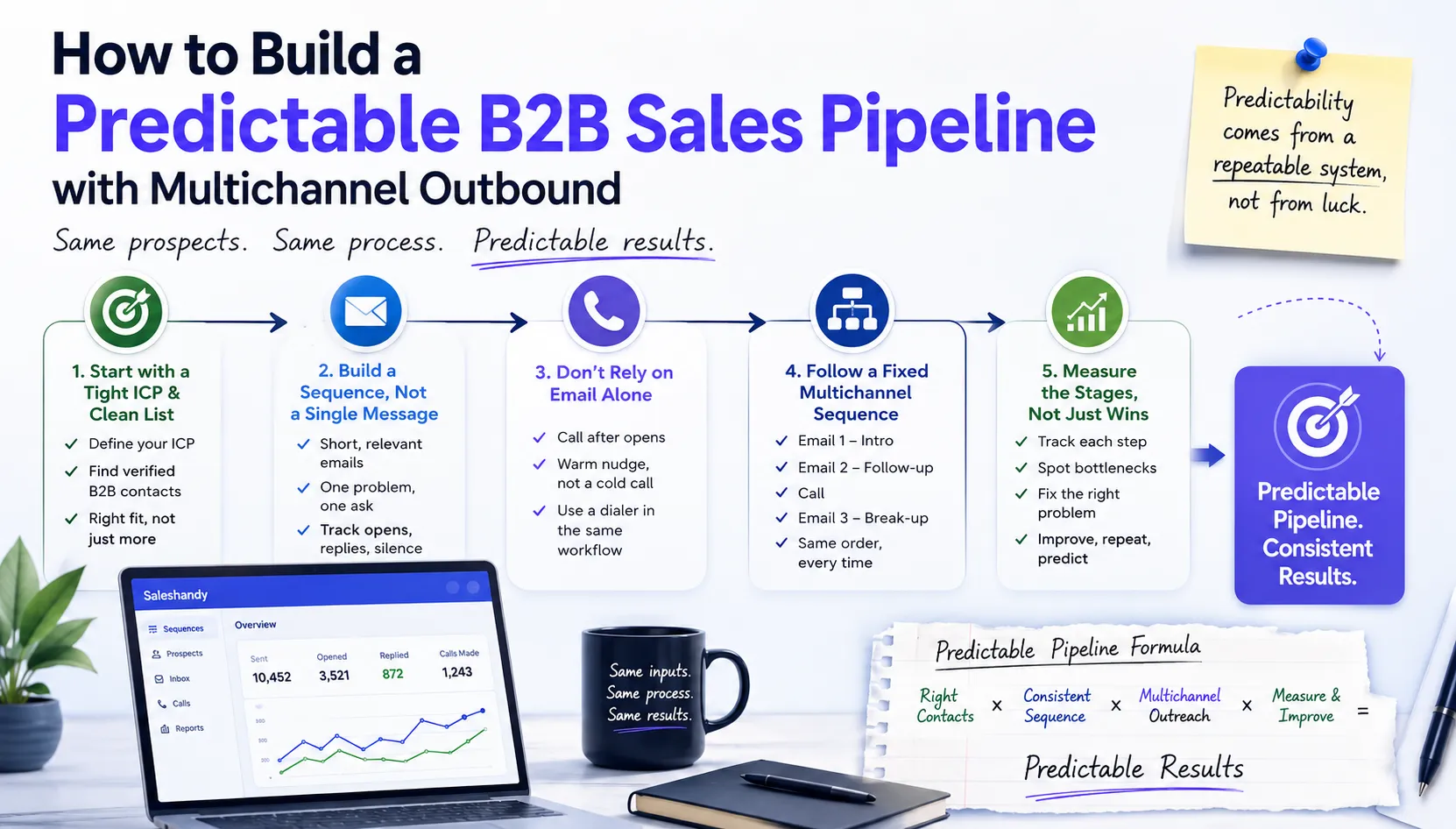
For two years, my pipeline ran on luck, and I didn't even realise it. Some months were packed with demos. The next, with the same team and the same effort, I'd book half as many. I kept treating it like a motivation problem. It was actually a predictability problem.
A pipeline you can't predict isn't a pipeline. It's a guess you happen to repeat. And the thing that finally made mine predictable wasn't a magic message or a bigger list. It was reaching the same prospect across email and phone, in a fixed order, every single time. Here is how I build that now.
What "predictable" actually means
Once I stopped chasing big months and started tracking my own numbers, the math got simple. Roughly every 1,000 right-fit contacts gave me a steady number of conversations, and those gave me a steady number of opportunities. The exact ratio doesn't matter. Yours will be different.
What matters is that the ratio only holds when every stage runs the same way twice. One bad list, one channel I drop halfway, and the forecast falls apart. So I stopped trying to work harder and started removing the randomness from each step.
Stage 1: Start with a tight ICP and a clean list
I learned this the expensive way. I once ran a sequence I was proud of into a list I bought cheaply to save time. Half bounced. Most of the rest weren't my buyer. Great emails, wrong people, nothing to forecast.
Now I get clear on exactly who I want first, then pull a list of verified B2B contacts that match those filters instead of trusting a stale export. It is boring work. It is also the highest-leverage hour in the whole process, because everything downstream is capped by who you put in at the top.
Stage 2: Build a sequence, not a single message
Email is where I start every cycle. It scales, and it respects people's time. What I changed is what I expect from it. The first email almost never books anything, and that is fine.
A prospect ignoring your first email is usually a bad moment, not a bad fit. So I keep it short, tie it to one real problem, and ask for one thing. I run the whole campaign through Saleshandy so I can see who opened, who replied, and who went quiet. That quiet group is the most valuable, because they are exactly who the next step exists for.
Stage 3: Don't rely on email alone
Calls are the part everyone agrees with, and almost nobody does consistently. I was guilty of it for years, and the reason had nothing to do with effort.
The dialer lived in a different tab from my email tool, so calling was a separate chore that quietly never happened. Once I started using a dialer built into the same workflow, the call became just another step sitting next to the emails, and it actually got made. My favourite time to call is right after someone opens an email. The message is fresh, so it lands as a warm nudge instead of a cold interruption.
If your pipeline depends on email alone, this single change will do more than any new template ever will.
Stage 4: Measure the stages, not just the outcome
For a long time, my "multichannel" was an email here, a call when I remembered, another email if I felt like it. That isn't a system. It is noise you can't repeat, which means you can't predict it either.
The fix was dull, and it worked: an intro email, a follow-up tied to their pain, a call, a final break-up note, in that order. I lay it out as one structured sequence so every prospect moves through the same steps and nobody slips because I lost track. Same inputs, same path, repeatable output. That is the whole point.
Run it from one place
"We booked eight meetings", tells me nothing I can act on. So I look at the steps instead. Low reply rate points to the list or the first email. Replies but no calls booked points at the pitch. Plenty of calls but no deals is a sales conversation problem, not an outbound one.
Each of those has a specific fix. After a few cycles, the numbers tighten, and a tight number is a number you can plan around. That is what a predictable pipeline actually is. Not a lucky month, but the same boring system producing a result you can finally count on.
Frequently Asked Questions
What does it mean to have a predictable sales pipeline?
A predictable sales pipeline means that you can forecast your outcomes based on established metrics and processes. Instead of relying on luck or sporadic successes, you have a consistent approach that generates reliable results, allowing you to plan and strategize effectively.
Why is it important to start with a clear Ideal Customer Profile (ICP)?
A clear ICP helps you identify the right prospects to target, ensuring that your outreach efforts are focused on individuals most likely to convert. Without a defined ICP, you risk wasting time and resources on contacts that don't align with your product or service, which can lead to an unpredictable pipeline.
How can I improve my email outreach strategy?
To enhance your email outreach, focus on creating a structured sequence rather than relying on a single message. Start with a concise email that addresses a real problem, and use follow-ups to engage prospects who show interest, while also measuring the effectiveness of each step in the sequence.
What role do phone calls play in a multichannel outreach strategy?
Phone calls are essential in a multichannel strategy as they add a personal touch and can significantly increase engagement rates. Calling right after an email is opened can capitalize on the prospect's interest, transforming a potential cold call into a warm follow-up.
How should I measure the effectiveness of my sales process?
Instead of only tracking overall outcomes like booked meetings, measure each stage of your outreach process. Analyzing metrics such as reply rates, call bookings, and conversion rates helps identify specific areas for improvement, making it easier to fine-tune your approach.
What is the significance of running a sales sequence from one platform?
Running your sales sequence from a single platform streamlines the process and reduces the chances of losing track of prospects. This integrated approach allows for better tracking and management of each step, leading to a more organized and predictable sales pipeline.
Why is consistency important in outreach efforts?
Consistency is crucial because it eliminates randomness from your outreach, allowing you to replicate successful strategies. A systematic approach means every prospect experiences the same process, making it easier to measure outcomes and adjust tactics as needed for better results.

























Sign in to leave a comment.