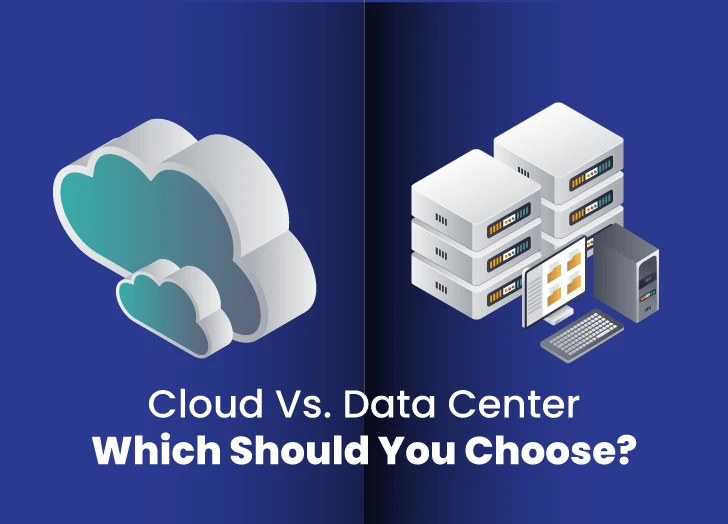

Cloud and Data Center
Despite their apparent similarities, data centers and cloud storage are very different.
Although cloud storage is a scalable solution with redundancy and accessibility from any location, it is susceptible to cyberthreats because it depends on an internet connection. The only totally configurable storage option that you have complete control over is a data center, but it is more expensive, occupies more space, and can only be accessed through an on-site corporate network. Depending on their sectors, as well as governmental laws and regulations, certain firms may be prohibited from employing cloud storage.This post is for small business owners and IT administrators who are weighing the advantages and disadvantages of various data storage alternatives.When storing and accessing vast quantities of your organization's data, cloud data services are a more affordable option than establishing and maintaining a data center.
A cloud storage service is what?
A cloud storage service is a type of data center that is not situated on the physical grounds of your business. It makes it possible for online users to access your company's data. To protect your data from outages and other issues, the cloud provider undertakes continual maintenance and updates and frequently owns numerous data centers in different geographic areas.
A data center is what?
A data center is a facility where servers are kept and from which data can be accessed and stored locally across a network. An on-site data center is often maintained by internal IT staff.
How to decide between a data center and a cloud storage service
Here are three things to think about, along with the advantages and disadvantages of each storage option, while choosing between using a cloud computing service and setting up your own data center.
Think about scalability versus customization.
For businesses that require a specialized infrastructure to provide them with complete control over their data and hardware, a data center is the best option. Because only the business uses this physical infrastructure, a data center is more suitable for a corporation that manages a variety of sophisticated workloads and applications.
A data center, however, has a finite amount of space. If your business needs to increase the storage capacity and workload of the data center, it is your responsibility to buy and install new hardware and cutting-edge technology.
Depending on your vendor's products and service levels, a cloud-hosted data system may have an infinite capacity. The drawback is that since the cloud provider owns and operates the data centre infrastructure, you have less control over the hardware that is situated remotely.
Your business will also share hardware resources with other cloud customers unless you pay to have a private cloud within the vendor's network.
Take into account your security worries.
Your organization will give its data to a third party when using a cloud vendor. The responsibility for maintaining the most recent security certifications rests on the cloud provider. Each data centre will require the appropriate cybersecurity precautions if your cloud is spread over several different regions' data centers.
Your cloud data is accessible to anyone with the right credentials from any location with an internet connection. Although convenient, this also creates a large number of access points, all of which must be secured in order to guarantee the security of any data sent through them.
The local network of your business is physically connected to a data centre. This makes it simpler to guarantee that only users with company-approved devices and login credentials may access stored apps and data. However, you oversee your own safety.
Keep your budget and charges in mind.
It will take a long time to establish a data centre from the bottom up, and your business will be in charge of maintaining and managing the system. A corporation may spend between $10 million and $25 million annually operating a large data centre.
Cloud services are more affordable, particularly for small businesses. Setting it up and running it doesn't take nearly as much time or money. After signing up, the cloud service is practically immediately usable. The cloud vendor should be able to scale your service up or down as your business's data requirements change over time. To cater for this, the majority of businesses provide a variety of subscription programmed.
Cloud storage's benefits and drawbacks
Although cloud storage has many advantages, not all businesses or industries may profit from it. Here are some advantages and disadvantages of cloud storage.
Advantages of cloud storage
The benefits of cloud storage are listed below.
According to your vendor's products and service plans, the capacity of a cloud data storage system may be limitless. It only takes a few clicks to change your capacity plan if necessary.
With a cloud vendor, your business will entrust its data to a third party that will handle security. Data security does not have to be completely within your control. The cloud service provider must hold current security certifications. Each data centre will require the necessary security measures if your cloud is spread across several different regions and data centres.
Anybody with the right credentials can access your cloud data from any location that has an internet connection. Your authorised employees can access company data from their mobile devices, but if your team will be connected on mobile, it's crucial to train them on remote cybersecurity best practises.
Low cost: Cloud storage services are economical, particularly for small businesses. As your organisation expands, a cloud vendor can swiftly scale up or down your service. To cater for this, the majority of businesses provide a variety of subscription plans.
Data recovery is simple thanks to cloud storage if something were to happen to your local machines. You may update files and download your most important material to any device using your internet connection because your info is saved in the cloud.
Drawbacks of cloud storage
Like any technological advancement, cloud storage has inherent drawbacks.
Limited control: The biggest drawback of cloud storage is the lack of control over the hardware that is housed elsewhere. If your storage system has to be customised, you must rely on the cloud vendor.
Reliance on internet connection: A dependable corporate broadband internet connection is required if you employ cloud storage. Your business operations stop completely if your internet service ever goes off.
Online risks and security: Although employing cloud storage relieves you of the responsibility of maintaining network security, inadequate security is still a major worry. Cloud storage offers several access points that need to be secured in order to ensure the security of data communicated over them because it is web-based and allows for access from anywhere. Unfortunately, once your data is online, a cyberattack is always a possibility.
Concerns about compliance and regulation: Depending on the sector or the location of a company, some organizations need an on-site data center to meet particular security standards that a cloud service can't provide.
IOTAP offers Comparison between Microsoft EMS E3 and EMS E5 and Comparison of Azure Support Plans for SMBs and large organizations.






Sign in to leave a comment.