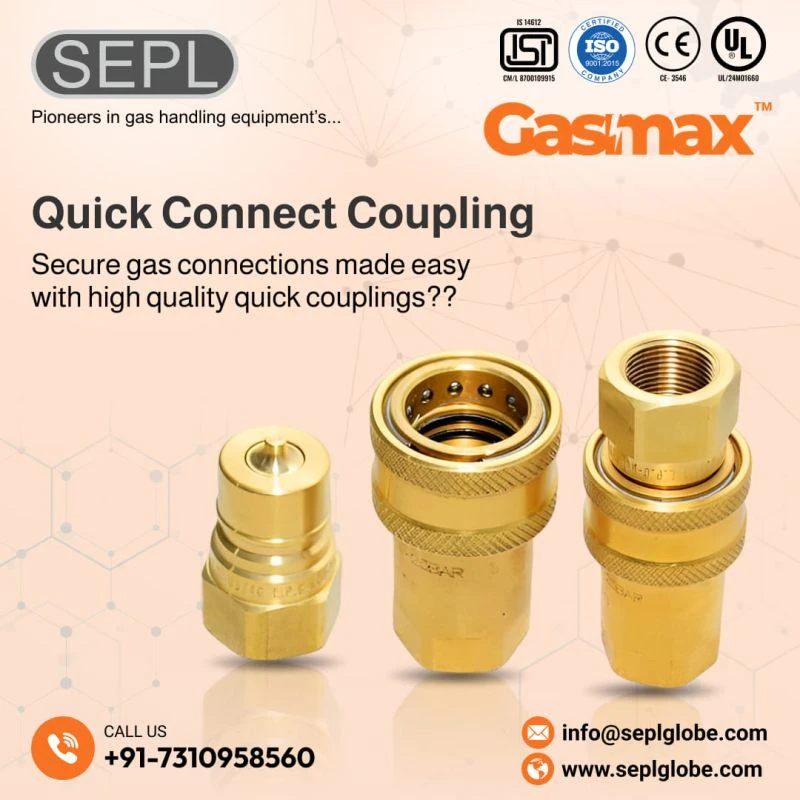

Quick-connect couplings are necessary for the majority of compressed air manufacturing facilities. These cheap, commonplace devices are not frequently not given the proper consideration in terms of size and selection. The improper coupling selection can have negative effects on safety, energy efficiency, and productivity.
Continue reading this article if you want to know more about LPG Quick Connect Coupling QCC.
Selecting criteria
Choosing an acceptable style for the application is the first choice in the proper selection of a quick-connect connection. Environment, frequency of usage, location, and safety are the top four things to think about.
Environment
Outdoor couplings need to be weather-resistant. The longest-lasting materials are those formed of malleable iron or copper alloys; plated steel rusts. Quick couplers without moving components would be the best option if the application involves physical abuse or a dirty environment.
Utilisation Pattern
The kind you choose directly affects how frequently a quick-connect connection is used. Axial connections are frequently valved and easily detachable. The valving mechanism of a rotary connect coupling is absent. When a disconnect is required, the air must be turned off at the source.
On quick-connect couplings with valves, the valve, springs, and seals typically show the highest wear. Couplings without spring-loaded, poppet-type valves and ones that use O-ring seals for heavy-duty use should be taken into consideration.
Location
The selection process depends on the coupling's position or location. The majority of coupling styles work if they are at the end of a loose hose. It is easier to utilise an automated latch or zero-pressure type coupling.
Especially when you mount it to a pipe or another fixed object because only one hand is necessary to operate it. The optimum connection to utilise when a coupling is at the end of an overhead hose drop is a zero-pressure type. It is due to the ease of engagement and lack of hose whip while disengaging.
Safety
When a connection disconnects, pressure releases along with a quick expansion of air in the unvalved portion. It is possible since the compression of air is possible. If you don't secure the hose, it leads to flail about with the risk of harm. The action will be more ferocious the more air there is in the hose.
The issue of hose whip is solvable in two different ways. The plug portion of the downstream coupling can have a ball check valve installed. At disconnect, when air releases, the ball stops the air from departing quickly. Restricted airflow while using this design is a drawback.
An alternative is to choose a quick-connect connection with zero pressure. With this system, you can cut off the upstream supply and automatically depressurize the downstream air volume. There is no longer any lingering air pressure when the coupler severes, preventing hose whip
Buyers should consider the connection types of the quick couplers. They must also have the connections to the rest of the system when choosing quick couplers. Hopefully, this article has given you everything you need to know about my college.










Sign in to leave a comment.