

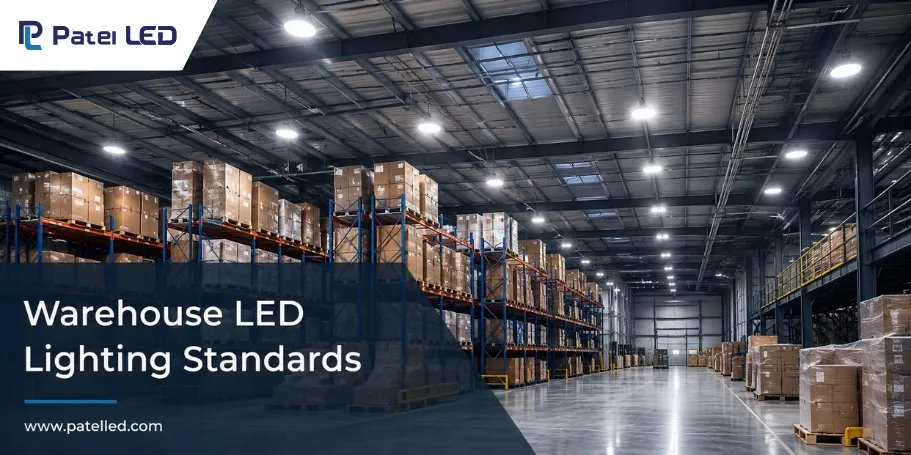
Warehouse lighting affects far more than the appearance of a building. It influences employee visibility, forklift movement, order accuracy, security, energy consumption, and long-term facility maintenance.
However, selecting warehouse lights is not as simple as replacing an old 400-watt fixture with an LED carrying a similar wattage label.
A professionally planned warehouse LED lighting system must account for the facility’s ceiling height, rack configuration, operating hours, work activities, environmental conditions, required illumination, and applicable local codes.
This guide explains the most important warehouse lighting requirements and shows how facility managers, contractors, property owners, and procurement teams can select suitable commercial LED products from Patel LED.
What Are Warehouse LED Lighting Requirements?
Warehouse LED lighting requirements are the technical, operational, and safety considerations used to create effective illumination throughout a warehouse or distribution facility.
These requirements may involve:
- Recommended illumination levels
- Federal workplace rules that apply to specific conditions
- State and local building codes
- Energy-code requirements
- Emergency and exit-lighting provisions
- Product certifications
- Project specifications
- Corporate facility standards
- Lighting-control requirements
There is no single lighting standard that applies identically to every warehouse in the United States.
An inactive storage area does not require the same lighting conditions as a packing station, quality-control table, loading dock, refrigerated room, or high-traffic forklift aisle.
That is why the best commercial warehouse lighting design begins by evaluating each operational zone separately.
Why Proper Warehouse Lighting Matters
Poor warehouse lighting can create dark aisle ends, bright hotspots, glare, difficult-to-read labels, and inconsistent visibility across work areas.
These issues may contribute to:
- Picking and packing mistakes
- Difficulty scanning barcodes
- Reduced visibility around forklifts
- Unclear security-camera footage
- Employee discomfort
- Higher electricity consumption
- Frequent fixture maintenance
- Uneven illumination on rack surfaces
- Inadequate visibility near loading areas
A warehouse may appear bright when viewed from the entrance while still having poor lighting between racks or at working height.
The objective is not to install the brightest fixtures possible. The objective is to deliver the right amount of light to the right surfaces without unnecessary glare or energy waste.
Foot-Candles vs Lumens: What Warehouse Buyers Should Know
Lumens and foot-candles are two of the most important terms in warehouse lighting.
What Are Lumens?
Lumens measure the total amount of visible light produced by a fixture.
A high-bay fixture producing 24,000 lumens generates more total light than a fixture producing 15,000 lumens. However, lumen output alone does not show how effectively that light reaches the warehouse floor, racks, labels, or worktables.
What Are Foot-Candles?
A foot-candle measures the amount of light reaching a surface. One foot-candle is equal to one lumen distributed over one square foot.
Foot-candles are important because employees need usable illumination where work actually occurs - not only at the fixture.
For example, two LED high bays may produce a similar number of lumens, but their performance may differ because of:
- Beam angle
- Fixture optics
- Mounting height
- Spacing
- Rack obstruction
- Ceiling reflectance
- Wall and floor colors
- Fixture orientation
- Dirt accumulation
- Work-plane height
Lumens describe fixture output, while foot-candles describe the light reaching a surface.
How Many Foot-Candles Does a Warehouse Need?
There is no universal foot-candle target for every warehouse. Requirements should be based on the activity performed in each area.
The following ranges can be used for early planning, but they should not be treated as universal legal requirements:
| Warehouse area | General planning range |
| Occasional-access storage | 5–10 foot-candles |
| Active bulk storage | 10–20 foot-candles |
| General warehouse floor | 10–30 foot-candles |
| Forklift aisles | 10–30 foot-candles |
| Shipping and receiving | 20–50 foot-candles |
| Picking and packing | 30–50 foot-candles |
| Small-label reading | 30–75 foot-candles |
| Inspection and quality control | 50–100+ foot-candles |
| Covered loading dock | 10–30 foot-candles |
| Warehouse office | 30–50 foot-candles |
These ranges must be adjusted according to the actual work, employee needs, rack height, fixture distribution, contrast, glare, and locally adopted requirements. The original Patel LED guide also cautions that regulatory minimums for specific situations should not automatically be treated as complete warehouse design recommendations.
Horizontal and Vertical Illumination
Many lighting plans focus primarily on horizontal illumination measured at the floor or worktable. Warehouses also require adequate vertical illumination.
Employees may need to see:
- Rack labels
- Barcodes
- Pallet tags
- Safety notices
- Storage-location numbers
- Electrical panels
- Equipment controls
- Product packaging
A warehouse may have acceptable floor-level foot-candles while rack faces remain difficult to read.
High-rack facilities should be evaluated for both horizontal and vertical illumination.
This is especially important in narrow aisles where tall shelving can block broad overhead light.
Choosing Lighting for Different Warehouse Areas
A warehouse is a collection of different working environments. Using one fixture type throughout the entire building may produce inefficient or inconsistent results.
Open Warehouse Floors
Open areas usually need broad, uniform overhead coverage. Suitable options may include:
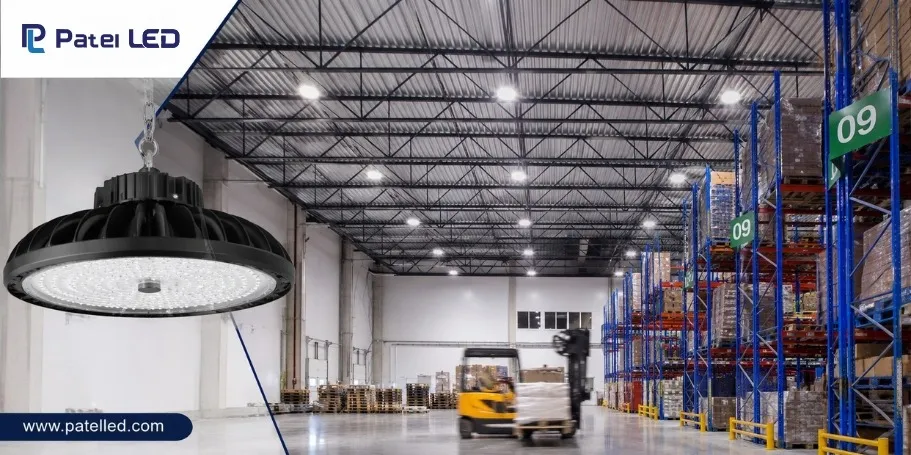
- UFO LED high bay lights
- Linear LED high bay lights
UFO high bays are compact and work naturally in grid-based layouts. They are often considered for open storage, manufacturing areas, workshops, gymnasiums, and large unobstructed commercial spaces.
Patel LED offers selectable-output UFO high bays that allow buyers to match the fixture output more closely to the application.
High-Rack Aisles
Tall racks can block light and create shadows on vertical surfaces. Long aisles frequently benefit from lighting aligned with the aisle direction.
Important priorities include:
- Directional light distribution
- Consistent row placement
- Strong rack-face illumination
- Controlled spill above racks
- Proper end-of-aisle coverage
- Reduced glare for equipment operators
Linear LED high bay lights are often a strong option for long rack aisles because their rectangular form aligns naturally with structured warehouse rows.
However, fixture shape alone does not guarantee suitable aisle performance. Buyers should confirm beam distribution and photometric data for the exact product.
Picking and Packing Stations
Picking and packing areas involve detailed visual tasks such as:
- Reading small labels
- Scanning barcodes
- Checking quantities
- Matching products
- Identifying packaging damage
- Completing paperwork
These areas may need higher task-level illumination than general storage zones.
A facility can combine overhead high bays with lower-mounted linear fixtures or task lighting to improve visibility without overlighting the entire warehouse.
Shipping and Receiving Areas
Shipping and receiving areas often include forklift traffic, pedestrians, paperwork, trailers, open dock doors, and changing daylight conditions.
Lighting should help employees move safely between bright exterior areas and darker interior spaces.
Appropriate lighting may include:
- High bays inside the building
- Canopy lights beneath covered docks
- Wall packs around doors and exterior walls
- Flood lights for selected zones
- Area lights for truck yards
Damp, Dusty, or Demanding Areas
A fixture suitable for a dry storage room may not be suitable for a damp, dusty, washdown, refrigerated, or processing environment.
Before purchasing, check the exact fixture’s:
- IP rating
- Damp- or wet-location rating
- Temperature range
- Lens construction
- Sealing
- Corrosion resistance
- Cleaning compatibility
Patel LED offers vapor-tight LED fixtures for selected moisture- and dust-prone commercial environments. Product suitability should always be confirmed using the specifications for the exact model.
Warehouse Offices
Warehouse offices usually have lower ceilings and different comfort requirements than the main industrial floor.
Suitable fixture categories may include:
- LED panel lights
- LED troffer lights
- LED tube fixtures
- Commercial strip lights
These products can provide comfortable, uniform illumination for desks, meeting rooms, administrative areas, and support spaces.
Exterior Walls and Building Entrances
Exterior warehouse lighting improves visibility around:
- Entry doors
- Service areas
- Walkways
- Loading doors
- Building perimeters
- Security zones
LED wall packs are commonly installed on exterior walls to illuminate these areas.
Parking Lots and Truck Yards
Large outdoor areas may require LED area lights, parking-lot fixtures, or selected flood lights.
The design should consider:
- Pole height
- Fixture distribution
- Vehicle movement
- Property boundaries
- Glare
- Light trespass
- Security-camera needs
- Local exterior-lighting limitations
Emergency Routes and Exits
Exit signs and emergency lights are essential life-safety components.
Emergency illumination must be planned as part of the complete facility rather than added as an afterthought. The final design should address applicable egress requirements, backup operation, fixture placement, testing, and local inspection.
UFO High Bay vs Linear High Bay
Choosing between a UFO high bay and a linear high bay depends primarily on the warehouse layout.
| Decision factor | UFO high bay | Linear high bay |
| Fixture shape | Circular | Rectangular |
| Common layout | Open grid | Structured rows |
| Open warehouse floors | Strong candidate | Application-dependent |
| Long rack aisles | Optics-dependent | Often a strong candidate |
| Installation alignment | Grid-style | Aisle-oriented |
| Fixture body | Compact | Longer profile |
| Final selection | Verify photometrics | Verify photometrics |
When to Consider UFO High Bays
UFO high bays may work well in:
- Open warehouses
- Manufacturing floors
- Workshops
- Large commercial rooms
- Gymnasiums
- Unobstructed storage facilities
Their compact form can simplify handling and grid-style installation.
When to Consider Linear High Bays
Linear high bays may be more suitable for:
- Rack aisles
- Distribution centers
- Assembly lines
- Retail warehouses
- Long production areas
- Rectangular operating zones
Their elongated distribution can help direct more useful light along aisles and work zones.
Neither high-bay style is automatically better. The correct choice depends on mounting height, optics, spacing, rack layout, and required illumination.
- Height above the work plane
- Rack height
- Aisle width
- Beam angle
- Required vertical light
- Reflective surfaces
- Skylights
- Equipment obstructions
- Ambient temperature
- Lighting controls
A 25-foot open warehouse and a 25-foot warehouse with 22-foot racks are completely different lighting environments.
Why Wattage Is Not the Same as Brightness
Wattage measures electricity consumption. It does not directly measure brightness or usable illumination.
Two 150-watt LED fixtures can have different:
- Lumen outputs
- Efficacy ratings
- Optical distributions
- Driver performance
- Thermal designs
- Dimming capabilities
- Environmental ratings
A more efficient fixture may produce more light while using the same amount of power.
Do not select an LED replacement by matching the wattage of the old metal-halide or fluorescent fixture.
Instead, compare:
- Existing fixture output
- New fixture lumens
- Mounting height
- Beam distribution
- Light loss
- Required foot-candles
- Operating hours
- Fixture spacing
- Control compatibility
How to Estimate the Number of Warehouse Lights
An early lumen estimate may start with this calculation:
Target foot-candles × warehouse area = initial lumens required at the work plane
For example, a 20,000-square-foot general storage area targeting 20 foot-candles would initially require:
20 × 20,000 = 400,000 work-plane lumens
However, this does not mean that installing fixtures totaling exactly 400,000 raw lumens will deliver the required result.
Adjustments may be needed for:
- Coefficient of utilization
- Light-loss factor
- Fixture optics
- Mounting height
- Rack blockage
- Surface reflectance
- Fixture orientation
- Spacing
- Uniformity
- Vertical-light requirements
A generic claim such as “one light covers 2,000 square feet” should not replace a project-specific lighting calculation.
A photometric layout is more dependable than dividing warehouse square footage by a generic fixture-coverage number.
High-Bay Spacing and Uniformity
Fixture spacing determines how light beams overlap.
Fixtures placed too far apart can produce:
- Dark spaces between fixtures
- Poor aisle-end visibility
- Low rack-face illumination
- Uneven floor readings
- Strong brightness contrast
Fixtures placed too closely can create:
- Glare
- Overlighting
- Higher energy consumption
- Unnecessary material cost
- Bright hotspots
Uniformity matters because an average foot-candle reading can hide major variations.
For instance, an aisle may measure 40 foot-candles directly under fixtures but only 8 foot-candles between them. The mathematical average may seem acceptable, but employees still experience significant contrast.
Selecting Color Temperature and CRI
4000K Warehouse Lighting
A 4000K fixture generally produces a neutral-white appearance.
It may be considered for:
- General storage
- Mixed-use facilities
- Warehouse offices
- Employee comfort
- Long operating shifts
5000K Warehouse Lighting
A 5000K fixture generally appears cooler and more daylight-like.
It may be considered for:
- Picking
- Packing
- Loading
- Manufacturing
- Product-handling areas
- High-visibility tasks
A higher color temperature does not automatically make a warehouse safer. Safety and visibility depend on the entire design, including glare, contrast, uniformity, CRI, distribution, and actual illumination.
Why CRI Matters
The Color Rendering Index describes how naturally colors appear under a light source.
Color recognition may matter when employees work with:
- Electrical wiring
- Hazard labels
- Product categories
- Packaging colors
- Safety markings
- Quality-control samples
- Equipment indicators
Consistent CCT and CRI across the installation can also create a more professional environment and reduce visible color differences between fixtures.
Warehouse Lighting Controls and Energy Savings
Warehouses often contain areas that are not continuously occupied, such as reserve aisles, maintenance rooms, mezzanines, seasonal storage, and overnight staging areas.
Lighting controls can reduce unnecessary operating hours.
Useful control options may include:
- Occupancy sensors
- Motion sensors
- Dimming
- Scheduling
- Daylight response
- High-end trim
- Separate lighting zones
Instead of controlling the entire warehouse as one zone, facilities can separate:
- Open storage
- Rack aisles
- Packing areas
- Loading docks
- Offices
- Utility rooms
- Exterior lighting
LED efficiency reduces connected wattage, while intelligent controls can reduce the number of hours fixtures operate at full output.
Retrofit or Complete Fixture Replacement?
Some warehouse projects can use LED retrofit products, while others benefit from complete fixture replacement.
A Retrofit May Be Considered When:
- Existing housings remain in good condition
- The electrical system is compatible
- The existing distribution is acceptable
- Labor savings are significant
- The retrofit product has suitable ratings
Complete Replacement May Be Better When:
- Existing fixtures are damaged
- Optics do not suit the warehouse layout
- Maintenance problems are frequent
- Controls need to be added
- Existing housings trap heat
- Fixture spacing must be redesigned
- Light distribution is poor
The decision should be based on total project performance rather than only the initial product price.
Common Warehouse LED Lighting Mistakes
Avoid these frequent purchasing and planning errors:
- Choosing fixtures based only on wattage
- Assuming more lumens always produce better lighting
- Using one fixture type in every warehouse zone
- Ignoring vertical rack illumination
- Applying generic spacing rules
- Overlooking glare
- Failing to verify fixture voltage
- Ignoring damp, dusty, or cold conditions
- Mixing different color temperatures
- Forgetting emergency and exit lighting
- Treating an OSHA minimum as a complete lighting design
- Ordering before completing a fixture layout
- Ignoring lighting controls
- Failing to evaluate exterior areas
- Comparing purchase price without considering operating cost
Warehouse LED Lighting Buyer Checklist
Before ordering commercial LED fixtures, confirm:
- Warehouse square footage
- Ceiling and mounting height
- Rack height
- Aisle width
- Existing fixture type and wattage
- Existing and target light levels
- Required horizontal illumination
- Required vertical illumination
- Operating hours
- Facility voltage
- Environmental conditions
- Preferred CCT and CRI
- Control and dimming requirements
- Emergency-lighting needs
- Exterior-lighting requirements
- Fixture certifications
- Applicable local codes
- Installation method
- Photometric performance
- Project budget and expected energy savings
Why Businesses Choose Patel LED for Warehouse Lighting
Patel LED supplies commercial and industrial LED lighting products for different areas of warehouses, distribution facilities, factories, workshops, and commercial properties.
Product categories available for warehouse projects may include:
- UFO LED high bay lights
- Linear LED high bay lights
- Vapor-tight fixtures
- Commercial strip lights
- LED tube fixtures
- LED panels and troffers
- Wall pack lights
- Canopy lights
- LED flood lights
- LED area lights
- Exit signs
- Emergency lights
- Lighting controls
This product range allows buyers to plan more than the main warehouse floor. A complete project can include interior high bays, aisle lighting, office fixtures, loading-dock illumination, exterior security lighting, and emergency products.
Patel LED helps commercial buyers build a coordinated lighting system instead of purchasing unrelated fixtures for each area.
FAQs
What is the best LED lighting for a warehouse?
UFO high bays are commonly considered for open, high-ceiling warehouse floors, while linear high bays may be suitable for long rack aisles and rectangular layouts. The best choice depends on mounting height, optics, spacing, rack placement, and required foot-candles.
How many lumens are needed for warehouse lighting?
The required lumens depend on the building size, target foot-candles, mounting height, fixture efficiency, optics, reflectance, and light-loss assumptions. Raw lumen output should not be used as the only selection factor.
How many foot-candles should a warehouse have?
General storage areas may use lower illumination than picking, packing, inspection, or quality-control stations. Final targets should be based on the task, facility standards, professional guidance, and applicable local requirements.
Is 5000K suitable for warehouse lighting?
Yes, 5000K is commonly considered for warehouses, manufacturing areas, loading zones, and product-handling spaces. Some facilities may prefer 4000K for a more neutral appearance and employee comfort.
Are UFO high bays better than linear high bays?
Neither option is universally better. UFO fixtures work naturally in many open layouts, while linear high bays often align effectively with aisles and rectangular spaces. Photometric performance should guide the final decision.
Can motion sensors be used with warehouse high bays?
Many compatible LED high bays can work with occupancy or motion controls. Buyers should verify sensor, driver, dimming, voltage, and control compatibility for the exact fixture.
How far apart should warehouse LED lights be installed?
Spacing depends on mounting height, beam distribution, lumen output, warehouse layout, and required uniformity. A generic spacing rule should not be used without reviewing the fixture’s photometric performance.
Can LED warehouse lighting reduce electricity costs?
LED fixtures can reduce connected wattage compared with many older lighting technologies. Additional savings may be achieved through occupancy sensors, dimming, scheduling, and zoning. Actual savings depend on existing wattage, operating hours, electricity rates, and the new system design.
Final Thoughts
A successful warehouse lighting project is not based on wattage alone. It requires a clear understanding of foot-candles, lumens, mounting height, rack configuration, beam distribution, glare, uniformity, color quality, environmental exposure, controls, and emergency requirements.
By dividing the property into operational zones, buyers can select lighting that supports the actual work taking place in each area.
Whether the project requires high bays for an open floor, linear fixtures for rack aisles, vapor-tight lights for demanding areas, wall packs for exterior doors, or emergency products for exit routes, Patel LED offers commercial lighting options for building a complete warehouse LED lighting system.
Explore Patel LED products and choose warehouse lighting based on application, performance, and long-term operating value - not simply the highest wattage or lumen number.





















Sign in to leave a comment.