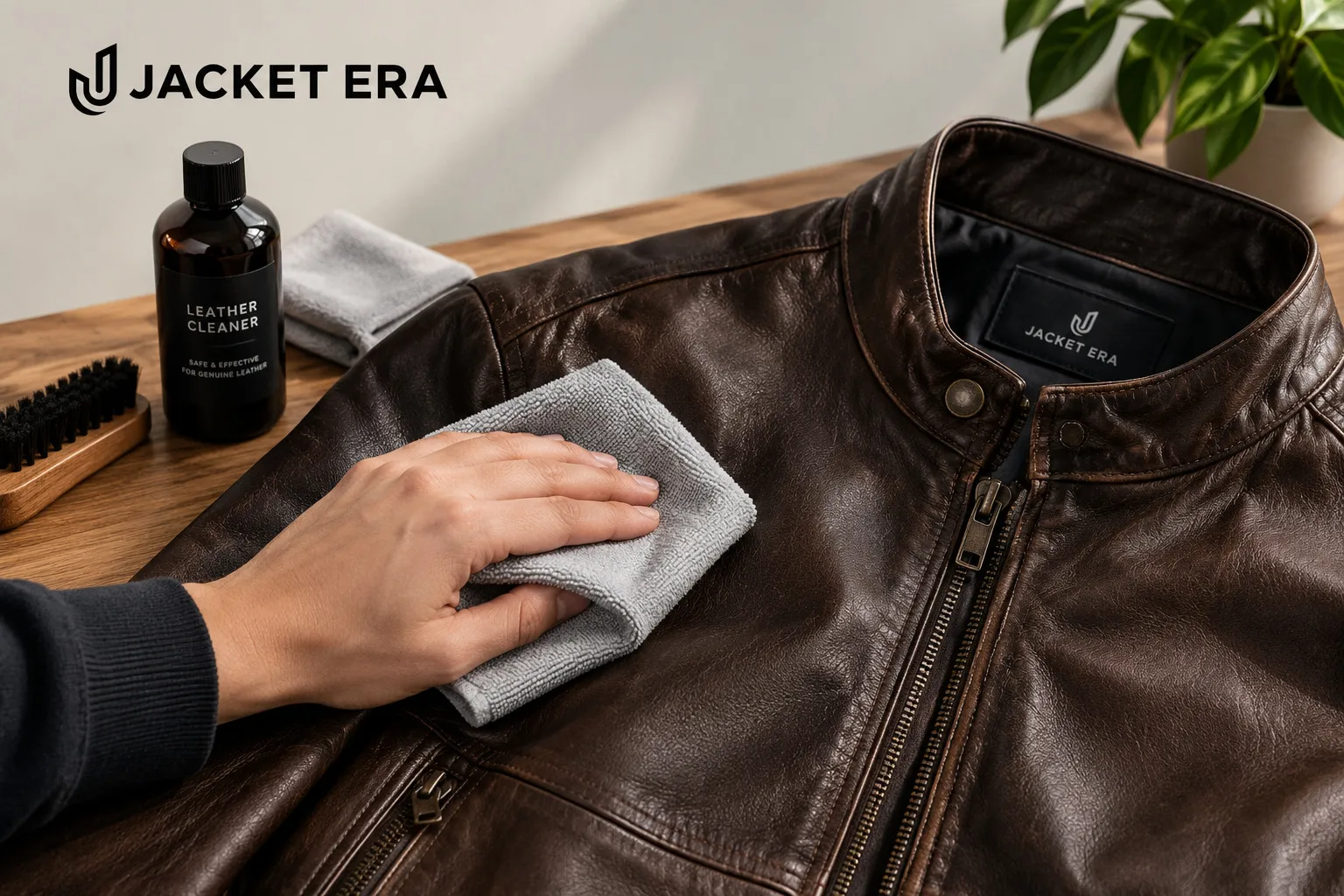

A leather jacket can pick up dust, body oils, collar grime and everyday marks, but cleaning it like an ordinary shirt or coat can damage its finish. The safest approach is to identify the leather, follow the care label and start with the gentlest suitable method.
Whether you're caring for a black leather biker jacket, a brown leather bomber or a softer lambskin style, you don't always need a full cleaning. Light surface maintenance may be enough, while stubborn stains and delicate finishes often require specialized care.
This leather jacket cleaning guide explains how to clean smooth leather at home, deal with common stains, dry a wet jacket, care for suede and store your outerwear properly.
Quick Answer: How Do You Clean a Leather Jacket?
To clean a leather jacket safely, check its care label and identify the finish first. Remove loose dust with a soft cloth, then test a compatible leather cleaner on a hidden area before treating minor marks. Use minimal moisture only when appropriate, and let the jacket dry naturally away from heat. Leave persistent stains and delicate finishes to a leather-care professional.
What Do You Need Before Cleaning a Leather Jacket?
Gather the right supplies before you start. The goal is to remove surface dirt without stripping the finish, changing the color or exposing the leather to unnecessary moisture.

Soft, lint-free cloths
Use clean, nonabrasive cloths to lift loose dust and gently wipe compatible smooth-leather surfaces. A second cloth can be useful if the cleaner's directions call for residue removal.

A compatible leather cleaner
Choose a product intended for the jacket's specific finish. A cleaner designed for finished smooth leather may not be suitable for suede, nubuck, aniline leather or shearling.

A suitable hanger
A broad, supportive hanger helps maintain the jacket's shoulder shape while it dries or rests in storage.

A ventilated drying space
Choose a clean area away from radiators, direct sunlight and other intense heat sources.
Keep the manufacturer's care instructions nearby. If the label specifies professional cleaning or prohibits a particular treatment, follow those instructions rather than experimenting.
Avoid using random household cleaners, bleach, alcohol-based products, abrasive sponges or untested oils. Products that work on washable fabric can affect leather dye, protective coatings, surface texture or flexibility. Leather-care guidance from the Leather Working Group also recommends contacting the brand or retailer for material-specific advice when instructions are unavailable.
How to Clean a Leather Jacket at Home: Step by Step
For a jacket made from compatible finished smooth leather, careful surface cleaning may be manageable at home. However, not every leather finish tolerates the same treatment. Stop if the jacket's material is uncertain or the care label calls for specialist cleaning.
1. Check the Care Label and Leather Finish
Start by determining what you're cleaning.
- Smooth, finished leather: Often suitable for gentle dust removal and cautious spot cleaning with a compatible product.
- Aniline or other absorbent leather: May be more vulnerable to water marks, uneven darkening and color changes.
- Suede and nubuck: Have a textured, raised surface that needs material-specific care.
- Shearling: Combines leather or suede with wool, so the two surfaces may require different treatment.
- Faux leather: Has a synthetic surface coating and needs care appropriate to its particular material.
The words "genuine leather" alone don't tell you how resistant a jacket is to moisture or cleaning products. The finish and construction matter just as much.
If you can't identify the material confidently, ask the manufacturer or a leather-care specialist before applying a cleaner. Different finishes can react differently to the same treatment.
2. Remove Loose Dust and Surface Dirt
Lay the jacket on a clean, flat surface or hang it securely. Use a soft, dry cloth to remove dust and loose dirt with light strokes.
Pay attention to areas that collect everyday grime, including the shoulders, sleeves, collar and cuffs. Avoid aggressive rubbing, which can scratch a finish or push dirt across the surface.
If a mark doesn't lift with dry cleaning, don't immediately add water or stronger products. Identify the material and choose an appropriate next step instead.
For routine leather jacket maintenance, removing loose dust before spot cleaning helps prevent unnecessary friction.
3. Test the Cleaning Method on a Hidden Area
Before treating a visible mark, test the proposed cleaner or method in an inconspicuous area that the manufacturer considers suitable for testing.
Apply the product exactly as directed, using the recommended amount and application method. Allow the area to dry fully before evaluating the result.
Check for:
- Darkening or lightening of the leather.
- Color transfer onto the cloth.
- A change in sheen or surface texture.
- Stiffness, tackiness or other unexpected changes.
If any of these appear, stop. A product that seems harmless when wet may leave a visible difference after drying.
A hidden-area test reduces risk, but it cannot guarantee that every part of the jacket will react identically.
4. Gently Spot-Clean the Affected Area
If the test is successful and the care instructions permit home cleaning, treat only the affected area.
- Apply the recommended amount of a compatible cleaner to the cloth if the product instructions call for cloth application.
- Work gently, using light strokes rather than scrubbing.
- Keep the treatment localized instead of saturating a large panel.
- Check the surface as you work and stop if the color or texture changes.
Avoid pouring cleaner directly onto the jacket unless the product instructions specifically require it. Excess product can be difficult to distribute evenly and may leave a visible patch.
For a lightly soiled black leather jacket, the aim is to remove the mark without creating a dull or shiny spot. The same principle applies to brown leather jackets, where uneven darkening may be especially noticeable against lighter shades.
5. Remove Residue as Directed by the Cleaner
Some leather cleaners require a follow-up wipe; others have different instructions. Follow the specific product directions rather than assuming that every cleaner must be rinsed off.
If the instructions call for a damp cloth, use only the recommended amount of moisture. Don't soak the leather or repeatedly wipe it with water to chase away residue.
If you see streaks, color changes or a sticky surface, don't keep adding cleaner. Stop and seek guidance before the affected area becomes more noticeable.
6. Allow the Jacket to Dry Naturally
Hang the jacket on a supportive hanger in a ventilated area away from direct heat and strong sunlight. Let it dry at its own pace.
Don't wear, fold or store it while it's still damp. Avoid applying conditioner until the jacket is fully dry and the care instructions indicate that conditioning is suitable.
If the leather feels unusually stiff or develops uneven coloring as it dries, don't attempt to correct the problem with more products immediately. Further treatment may make the finish less consistent.
How to Remove Common Leather Jacket Stains
The safest way to remove stains from a leather jacket depends on the substance, the finish and how long the stain has been present. A method that works on one smooth leather may be unsuitable for another.
Everyday Dirt and Light Marks
For loose dust, start with a soft, dry cloth. If a small mark remains on finished smooth leather, use a compatible leather cleaner only after checking the label and testing the method.
Don't scrub a mark simply because it doesn't disappear straight away. Repeated friction can change the sheen or wear the finish.
If the dirt covers a large area, or the leather is absorbent or unfamiliar, professional advice may be safer than attempting a full surface clean at home.
Oil or Grease Stains
Oil stains can be difficult because grease may penetrate the leather rather than remain on the surface.
For a fresh spill:
- Gently blot excess oil with a clean, absorbent cloth.
- Avoid rubbing, which can spread the stain.
- Don't apply heat to speed up the process.
- Don't experiment with solvents, strong detergents or homemade stain mixtures.
Some materials tolerate specialist absorbent treatments, but the appropriate method depends on the leather and stain. If the oil has soaked in, left a dark patch or failed to improve, contact a leather-care professional.
Important: There is no universal home remedy that reliably removes every oil stain without affecting the leather's color or finish.
Collar and Cuff Grime
Collars and cuffs often collect body oils, sweat, dust and residue from skin or hair products. Repeated contact can make these areas appear darker than the rest of the jacket.
Start by removing loose dirt with a dry cloth. If the finish permits it, a compatible cleaner may help with light surface buildup.
Treat a small area first and avoid repeatedly wetting the same spot. Collar and cuff grime can be more stubborn than ordinary dust, so professional cleaning may be necessary when the buildup has penetrated the surface.
Unknown Stains, Dye Transfer and Persistent Discoloration
Unknown stains deserve extra caution. Denim dye, ink, cosmetics and other pigments may bond with or penetrate the leather finish.
Don't try several different cleaning products one after another. Mixing treatments or repeatedly rubbing the same area can spread color, alter the sheen or damage the surface.
Seek professional help if you notice:
- Dye transfer from another garment.
- A stain that becomes larger during cleaning.
- Persistent discoloration or uneven patches.
- A finish that looks cloudy, sticky or worn.
- An unknown substance that won't lift with gentle surface care.
The safest goal is to prevent additional damage, even if that means leaving a stain for a specialist rather than trying to remove it yourself.
Can You Wash a Leather Jacket in a Washing Machine?
No. Don't machine-wash an ordinary leather jacket unless its manufacturer explicitly provides instructions allowing that method. Leather garments aren't interchangeable with washable textile clothing, and machine washing can affect their shape, color, finish and construction.
Potential risks include:
- Excessive moisture: Water may cause uneven darkening, water marks or changes in texture.
- Detergent exposure: Products formulated for laundry may be incompatible with the leather's finish.
- Mechanical agitation: Tumbling and repeated movement can stress seams, linings, coatings and decorative details.
- Drying problems: Heat or uneven drying can contribute to stiffness, distortion and other damage.
For these reasons, don't put a leather jacket in a washing machine, soak it in a sink or bathtub, or treat it like an ordinary coat.
If your jacket needs deep cleaning, consult the care label and use a specialist who handles leather garments. Some delicate finishes, including suede and absorbent leather, need particularly careful treatment.
How to Clean Smooth Leather vs. Suede
Smooth leather and suede may both be genuine leather, but their surface characteristics differ. That difference affects how you should approach cleaning, stain removal and conditioning.
| Feature | Smooth, finished leather | Suede and nubuck |
|---|---|---|
| Surface | Generally smooth, sometimes coated or polished | Soft, brushed or velvety texture |
| Routine care | Gentle dust removal with a soft cloth | Light brushing with a suitable suede brush |
| Minor marks | Compatible leather cleaner, if permitted | Suede-specific brush or eraser, if appropriate |
| Moisture | Limited moisture may be suitable for some finishes | Can develop marks or texture changes from moisture |
| Conditioner | Only if compatible with the finish | Never use ordinary smooth-leather conditioner unless specifically approved |
| Professional help | Useful for persistent stains and finish damage | Advisable for stubborn stains or uncertain treatment |
These are general distinctions, not universal instructions for every garment. Always follow the jacket's specific care label.
Cleaning a Smooth Leather Jacket
For compatible finished smooth leather, begin with dry dust removal. Use a suitable cleaner for light marks only when the manufacturer's instructions permit it.
Finished leather may have a protective surface layer, but that doesn't make every product safe. Open-pore leather, delicate dyes and specialty finishes can react differently to moisture and cleaning agents.
Avoid assuming that a glossy black biker jacket, a matte brown bomber and a soft lambskin jacket can all be cleaned identically.
Cleaning a Suede Leather Jacket
Suede has a raised nap that gives it its characteristic soft texture. Nubuck also has a textured surface, although it is made differently. Both can be sensitive to friction, oils and moisture.
For routine suede care:
- Allow loose dirt or a damp area to dry before brushing, unless the garment's instructions say otherwise.
- Use a clean suede brush with gentle strokes.
- Consider a suede eraser for a small dry mark only if it is suitable for the material.
- Test tools on a discreet area and stop if the color or nap changes.
Don't use smooth-leather polish, conditioner or cleaner on suede by default. If the jacket has oil stains, extensive water marks or dye transfer, a specialist in suede garments is usually the safer option.
Should You Condition a Leather Jacket After Cleaning?
Conditioning can help maintain the suppleness of certain types of leather by replenishing compatible conditioning agents. However, not every leather jacket needs the same conditioner, and conditioning isn't automatically necessary after every cleaning.
Whether to condition depends on the leather, its finish, the product manufacturer's recommendations and the jacket's condition.
Before using a conditioner:
- Confirm that it is suitable for the specific leather finish.
- Check the jacket's care instructions.
- Test the product in an inconspicuous area if permitted.
- Apply it only as directed.
- Let the jacket dry fully after cleaning before considering additional care products.
Avoid using household oils, petroleum-based products or untested creams as substitutes for a compatible leather conditioner. They may darken the surface, leave residue or affect the finish.
Conditioning also isn't a universal repair for cracking, peeling, severe dryness or structural damage. If the jacket already has these problems, consult a leather-care professional rather than applying repeated treatments.
How to Dry a Leather Jacket Without Damaging It
Knowing how to dry a leather jacket is just as important as knowing how to clean it. Excessive heat and hurried drying can change the leather's texture or shape.
If the Jacket Is Slightly Damp
If the jacket has only a little moisture from careful spot cleaning:
- Gently blot excess moisture with a clean, soft cloth if needed.
- Place it on a suitable hanger that supports the shoulders.
- Let it dry naturally in a ventilated area.
- Keep it away from radiators, hairdryers and direct sunlight.
- Wait until it is completely dry before storing it.
Don't vigorously rub the surface to remove moisture. Blotting is gentler and reduces unnecessary friction.
What If the Jacket Gets Soaked in the Rain?
If your jacket becomes thoroughly wet, first check the care label. Gently blot excess surface water without twisting, wringing or rubbing the leather.
Hang it in a ventilated space away from direct heat and let it dry naturally. Avoid stuffing it tightly into a closet while damp, and don't use a hairdryer to speed up the process.
A soaked jacket may develop stiffness, water marks, changes in texture or uneven coloration. If it is heavily saturated, unusually stiff, visibly discolored or made from delicate leather, contact a leather-care specialist for guidance.
Natural drying can reduce additional risk, but it cannot guarantee that moisture damage will be reversed.
How to Protect a Leather Jacket From Water
No leather jacket should be assumed waterproof simply because it is made from genuine leather. Water resistance varies with the leather type, finish, construction and any factory-applied treatment.
To reduce avoidable moisture problems:
- Check the care label for approved protective products.
- Use a leather or suede protector only if it is suitable for the specific finish.
- Test a permitted product in an inconspicuous area.
- Avoid applying an unfamiliar spray to the entire jacket without checking its compatibility.
- Allow the garment to dry naturally after incidental moisture exposure.
Protective treatments may help with certain types of exposure, but they don't make every jacket waterproof or eliminate the need for careful drying.
How to Store a Leather Jacket Properly
Proper storage helps maintain a jacket's shape and reduces avoidable exposure to moisture, heat and prolonged compression.
Follow these practical steps:
- Use a supportive hanger. Choose one broad enough to support the shoulders without creating pressure points.
- Store it in a clean, dry space. Avoid damp closets and areas with persistent moisture.
- Allow airflow. Don't compress the jacket between tightly packed garments.
- Avoid prolonged direct sunlight. Extended exposure may fade or change the color of some finishes.
- Keep it away from strong heat. Don't store it next to radiators or other heat sources.
- Use breathable storage. A suitable fabric garment cover can help protect it from dust while allowing airflow.
Make sure the jacket is fully dry before putting it away. If you won't wear it for an extended period, check it occasionally for unusual odors, dampness or visible changes.
Leather jacket storage should protect the garment without sealing moisture inside or placing unnecessary pressure on its shoulders and sleeves.
Leather Jacket Cleaning Mistakes to Avoid
Small mistakes can turn a minor mark into a more noticeable problem. Avoid these common leather jacket care errors.
| Mistake | Why it can be a problem | Safer approach |
|---|---|---|
| Machine-washing an ordinary leather jacket | Can affect shape, finish and construction | Follow the care label; seek specialist cleaning |
| Soaking the garment | May cause uneven darkening, stiffness or water damage | Use only approved, limited cleaning methods |
| Applying harsh or incompatible products | Can alter dye, coatings or texture | Choose a compatible leather-care product |
| Aggressively scrubbing stains | Can scratch or wear the surface | Use gentle, localized treatment |
| Drying with a hairdryer or radiator | Intense heat can change texture and contribute to stiffness | Allow natural drying away from heat |
| Conditioning without checking compatibility | May darken or leave residue on the finish | Confirm that the conditioner is suitable |
| Treating suede like smooth leather | Can flatten the nap or leave marks | Use suede-specific care methods |
| Repeatedly treating a stubborn stain | Can spread discoloration or worsen damage | Stop and consult a specialist |
The central principle is simple: don't keep escalating the treatment when the first gentle method fails. More moisture, stronger products and additional rubbing aren't necessarily more effective.
When Should You Take a Leather Jacket to a Professional?
Home care is most appropriate for light maintenance when the leather type and care instructions are clear. Professional cleaning is worth considering when a stain or condition requires more than routine surface care.
Contact a leather-care specialist if your jacket has:
- Deep or persistent oil, ink or other stains.
- Extensive discoloration or color bleeding.
- Significant water damage or stiffness after drying.
- Mold or unusual surface changes.
- Delicate, vintage or unfamiliar leather.
- Mixed materials, such as suede panels, shearling or specialized trims.
- A finish that becomes sticky, cloudy, cracked or uneven during cleaning.
- A cleaning requirement that the care label reserves for professionals.
Look for a cleaner experienced with leather garments rather than assuming that every conventional dry cleaner handles leather in the same way.
Before handing over the jacket, explain what caused the stain, what products have already been applied and whether the garment has become wet. This information can help the specialist assess the safest next step.
Professional treatment can reduce some stains and improve certain appearance issues, but no cleaner can guarantee that every stain or form of damage is reversible.
Final Leather Jacket Care Checklist
Use this checklist whenever you need to clean or store your leather outerwear.
Leather jacket care checklist
- Read the care label before cleaning.
- Identify smooth leather, suede, nubuck or another finish.
- Remove loose dirt with a suitable soft cloth or brush.
- Choose a compatible cleaner and test it discreetly.
- Avoid excessive moisture, soaking and harsh products.
- Let the jacket dry naturally away from heat.
- Condition only when appropriate for the leather.
- Store on a supportive hanger in a clean, dry, ventilated space.
- Seek professional help for stubborn stains or visible damage.
Conclusion
The safest way to clean a leather jacket is to start with the care label, identify the finish and use the gentlest compatible cleaning method. For finished smooth leather, that may mean removing dust and carefully spot-cleaning minor marks. Suede, nubuck, shearling and other delicate materials need different treatment.
Avoid machine washing, soaking, aggressive scrubbing and intense heat. Let the jacket dry naturally, condition it only when appropriate, and store it in a clean, dry space.
For stubborn stains, significant water damage or an unfamiliar finish, professional advice is generally safer than experimenting with stronger cleaning products. Consistent, careful maintenance can help keep your leather outerwear looking its best without exposing it to unnecessary treatment.
If you're exploring leather outerwear for your wardrobe, Jacket Era offers an online destination for men's and women's leather and shearling styles. Choose a jacket based on its material, construction, fit and intended use, and keep its care instructions for future maintenance.
7. Frequently Asked Questions
1. How do you clean a leather jacket at home?
Check the care label and identify the leather finish first. Remove loose dust with a soft cloth, then test a compatible cleaner on a hidden area if home cleaning is permitted. Gently spot-clean minor marks and let the jacket dry naturally. Use professional cleaning for persistent stains or delicate finishes.
2. Can you wash a leather jacket in a washing machine?
Ordinary leather jackets should not be machine-washed unless the manufacturer explicitly permits it. Water, detergent and mechanical agitation can affect the leather's shape, color, finish and construction. Follow the care label and consult a leather-care specialist when deep cleaning is needed.
3. What is the safest way to remove stains from a leather jacket?
The safest method depends on the stain and leather finish. Remove loose dirt gently and use a compatible leather cleaner only when the care instructions permit it. Test the method first, avoid aggressive rubbing and seek professional help for persistent oil stains, dye transfer or discoloration.
4. Can you use soap and water on a leather jacket?
Not as a universal cleaning method. Some finished smooth leather may tolerate limited moisture and a specifically approved cleaning product, while absorbent leather and suede can react differently. Check the care label and product directions before using soap or water, and never soak the garment.
5. How do you dry a leather jacket if it gets wet?
Gently blot excess moisture with a clean cloth and hang the jacket in a ventilated area away from direct sunlight and intense heat. Don't wring it out or use a hairdryer or radiator. If it becomes soaked, stiff or visibly discolored, consult a leather-care specialist.
6. Should you condition a leather jacket after cleaning it?
Not necessarily. Conditioning depends on the leather type, finish, condition and manufacturer's recommendations. If conditioning is appropriate, use a compatible product and test it discreetly first. Conditioner isn't a universal repair for cracking, peeling or serious leather damage.
7. How do you clean a suede leather jacket?
Start with the care label and remove dry surface dust using a suitable suede brush and gentle strokes. A suede eraser may help with some small, dry marks if the material permits it. Avoid ordinary smooth-leather cleaners and conditioners, and seek specialist help for oil stains, dye transfer or extensive water marks.
8. How should you store a leather jacket when you're not wearing it?
Hang the jacket on a supportive hanger in a clean, dry, ventilated closet. Make sure it is fully dry before storing it, avoid prolonged compression and keep it away from direct sunlight and strong heat. A breathable garment cover can help protect it from dust.
Frequently Asked Questions
How do I know if my leather jacket is suitable for home cleaning?
Start by checking the care label on your jacket, which provides crucial information about the specific leather finish. Smooth, finished leather is often suitable for gentle cleaning, while aniline, suede, or nubuck leathers may require specialized care. If you're unsure, consult a leather-care specialist for guidance.
Can I use regular household cleaners to clean my leather jacket?
No, it's best to avoid household cleaners, bleach, and alcohol-based products on leather jackets. These substances can damage the leather's finish, alter its color, and affect its flexibility. Always use a cleaner specifically designed for the type of leather you have.
What should I do if my leather jacket gets wet?
If your leather jacket gets wet, gently blot excess moisture with a soft cloth and hang it to dry in a ventilated area away from direct heat. Avoid folding or wearing it until it's completely dry, as this can distort its shape and texture.
Is it safe to machine wash my leather jacket?
No, you should never machine wash a leather jacket unless the manufacturer explicitly states it is safe to do so. Machine washing can lead to excessive moisture, damage the leather's structure, and affect its color and finish.
How do I remove oil stains from my leather jacket?
For fresh oil stains, gently blot the area with a clean, absorbent cloth to lift excess oil without rubbing it in further. If the stain persists or has soaked into the leather, it's best to contact a leather-care professional, as home remedies may not be effective and could cause further damage.
Should I condition my leather jacket after cleaning it?
Conditioning is not always necessary after every cleaning and depends on the type of leather and its condition. If you choose to condition, ensure the product is suitable for your jacket's specific finish and test it on an inconspicuous area first.
What is the best way to store a leather jacket?
Store your leather jacket on a broad, supportive hanger to maintain its shape and in a cool, dry area away from direct sunlight and heat sources. Avoid folding or compressing it, as this can lead to creases and distortions.














Sign in to leave a comment.